
Saturday, November 13, 2021

Bible Geocoding and Rethinking the Bible Atlas

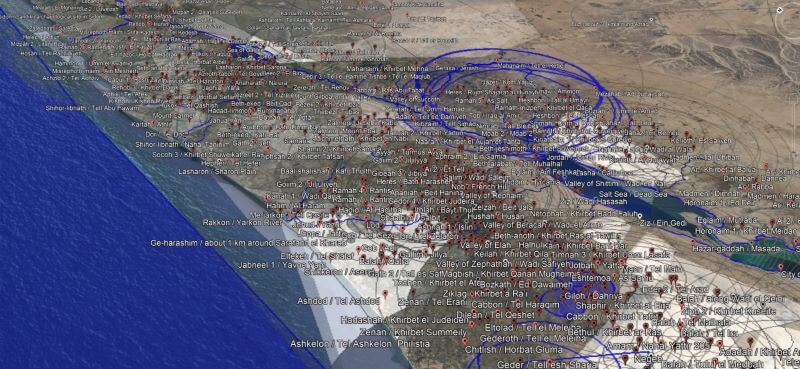
An example of the KML file results which has about 7,100 placemarks in Google Earth.

I have mention OpenBible.info before as an excellent resource for things like data visualizations and especially its Geocoding. Stephen Smith has recently updated his work and explained what he's been doing in this post: "Past as Probability: Rethinking the Bible Atlas for 2021." He writes:

What does rethinking the Bible Atlas mean?

This project is a Bible atlas (technically, a gazetteer) that (1) comprehensively identifies the possible modern locations of every place mentioned in the Bible as precisely as possible, (2) expresses a data-backed confidence level in each identification, and (3) links to open data to fit into a broader data ecosystem. The goal is to provide a baseline for future Bible geography projects to use.

In my original design document for this project, I have the following guiding principles; I’ll discuss their implementation below:

  1. Comprehensively reflect current scholarship.
  2. Use linked data.
  3. Be accurate and precise.
  4. Quantify uncertainty.
  5. Handle non-point data.
  6. Include media.
  7. Open the data.

It's a pretty stunning achievement considering the amount of work pulling the material together. His description of his work is worth reading, but if you just want to take advantage of his work, go to the Geocoding section. From there you can download the KML file for Google Earth with its 7100 Bible placemarks linked to the passages where a site is mentioned. You can also browse online by book and chapter of the Bible.

Thanks are due for sharing this resource so openly!

Monday, November 8, 2021

Mark 13.1-8 Translations and Notes (RCL25th Sunday after Pentecost Year B )

Jerusalem Temple Mount from the Mount of Olives where Mark 13 discourse is set.
Mark 13.1-8 is the RCL designated text for the 25th Sunday after Pentecost Year B which occurs on 14 November 2021. The following Sunday is Christ the King Sunday that concludes the lectionary year, so Mark 13 is the eschatological chapter that leads up to that commemoration. 

Verses 1-8 of the chapter, however, are limited in their scope, focusing primarily on what would prove to be the destruction of the Jerusalem Temple by the Romans in 70CE. Still, there is the warning about those who would deceive people in the face of "wars and rumors of wars," nations rising up against each other, earthquakes, and famines. If all these are but the "beginning of the birthing pains," Christians still need to watch out!

Here are a collection of translations, including my own, and my notes on translating this passage.


Monday, November 1, 2021

John 11.32-44 Translations and notes (All Saints Sunday)

The Lazarus story of John 11 takes place in Bethany. There is a "Tomb of Lazarus" there today commemorating the event.
John 11.32-44 is the appointed RCL text for All Saints Sunday. The whole of John chapter 11 is a unity, so this selection is only notable for including the scene where Lazarus (somehow, considering that he is all bound up!) comes out of the tomb. The story is well told and actually includes some humorous elements. (The dead man’s sister, Martha, says to him, “Lord, already there’s going to be a stench. It’s been four days, you know.”) One can also easily imagine it in oral performance.E.g., the parenthetical explanation that the tomb was a cave strikes me as something that would be spoken to an audience quite naturally.

The text is also notable for including the third shortest verse in the NT, 11.35: "Jesus wept." (KJV) Yes, it's the shortest verse in English in the KJV, but the shortest verse in the NT in the Greek is actually Luke 2.30!

Careful translation does not solve some of the puzzling aspects in the story. In particular, Jesus' emotions of anger, agitation, and distress in verses 33 and 38 are the subject of considerable speculation in the commentaries.

Here are a collection of translations, including my own, and my notes on translating this passage.


Monday, October 25, 2021

Mark 12.28-34 Translations and Notes (RCL23rd Sunday after Pentecost Year B )

The blue box shows where Solomon's Portico was located on the east side of the Temple Mount. It is reasonable to suggest that this is where Jesus' teaching occurred that is described starting in Mark 11.27.

Mark 12.28-34 is the RCL designated text for the 23rd Sunday after Pentecost Year B which occurs on 31 October 2021. (Many Lutheran / Protestant congregations will probably celebrate Reformation Sunday on this day. I'll have a separate post for John 8.31-36.)

On Monday of Holy Week, Jesus had driven the merchants out of the Temple Mount, but he returned on Tuesday to continue his teaching. Jesus is confronted with questions by various Jewish authorities to trick or entrap him, but he replies and refutes each challenge successfully. And that brings us to the last question posed to him here in Mark 12.28-34.

Here are a collection of translations, including my own, and my notes on translating this passage.

Sunday, October 17, 2021

Mark 10.46-52 Translations and Notes (RCL22nd Sunday after Pentecost Year B )

Mark 10.46-52: Jesus and Bartimaeus on The Way from Jericho to Jerusalem
https://biblemapper.com/blog/index.php/2020/01/04/jericho-wilderness-of-judea-and-qumran/

Mark 10.46-52 is the designated RCL text for the the 22nd Sunday after Pentecost, 24 October in 2021. This account of Jesus healing blind Bartimaeus forms a frame with the earlier healing of a blind man in 8.22-26. This time, Bartimaeus 'sees' Jesus for who he really is and ends up being a model of discipleship following Jesus on The Way to Jerusalem and Jesus' crucifixion.

Here are a collection of translations, including my own, and my notes on translating this passage.

 I also recommend that people check out the resources at the GoTell site including this chapter 7 on the Bartimaeus story in Thomas Boomershine's  Story Journey: An Invitation to the Gospel as Storytelling

Sunday, October 10, 2021

Mark 10.35-45 Translations and Notes (RCL21st Sunday after Pentecost Year B )

Mark 10.35-45 is the appointed text for the RCL 21st Sunday after Pentecost Year B and occurs on October 17, 2021.

The disciples continue to display their lack of comprehension. Following Jesus is not a matter of glory and sitting in honor but of following Jesus and enduring in some way what he also was going to endure. Once again, pointing back to Mark 9.35, we hear that true greatness is about service, even being a slave to all. Mark 10.45 gives the most explicit explanation of an atonement theory in Mark. 

For even the Child of Humanity didn’t come to be served but to serve and to give his life as a ransom for many.”

Here is a collection of translations of Mark 10.35-45 along with my notes on translating this passage. My own translation tries to capture the oral character of how this story might have been 'heard' when originally performed.

Monday, October 4, 2021

Mark 10.17-31 Translations and Notes (RCL20th Sunday after Pentecost Year B )

"As Jesus was setting out on the way..."(Mark 10.17) - Wadi Hamman path with Arbel in distance

Mark 10.17-31 is the account of Jesus meeting the person who wants to know what he should he do to inherit eternal life. It the appointed RCL text for the 20th Sunday after Pentecost, Year B, which occurs on 10 October 2021. The account ends up centering around wealth and following Jesus. 

There are a number of notable narrative details.

  • Note that the effect of the account is ruined if it is billed as the story of the "rich young man." Only Matthew describes him as young. (Luke introduces him as a "ruler" which also changes the dynamic of the story.) In Mark, we only learn that he is rich at the very end, a detail that heightens the suspense of the story.
  • The hearer / reader struggles to know how to respond to the man. It seems he is sincere and not testing Jesus because he kneels before him. But then Jesus chides him for calling him "good." I think the reader is supposed to admire the man for his faithfulness in observing all the commands Jesus mentions, but the astute reader is also mindful of what is not mentioned. (And when Jesus tells him to sell all and follow him, is that what the first part of the commandments dealing with humans' relationship to God is about?) It is not clear whether the man responds simply with dismay and sorrow or shock and anger. Importantly and surprisingly, however, we are told that Jesus "loved him." This is the only person in the whole gospel of Mark whom Jesus explicitly "loves."
  • Do not forget the man's original question: "What must I do to inherit eternal life?" What must anyone do to inherit anything? Usually nothing... but someone has to die.

Here is my collection of translations and notes.

Monday, September 27, 2021

Mark 10.1-16 Translations and Notes (RCL19th Sunday after Pentecost Year B )

View of Bethany beyond the Jordan looking east from Jordan. Jordan river and traditional site of Jesus' baptism in green area in center of picture. Judea in the distance beyond it. This is setting of as described in Mark 10.1.

The designated text in the RCL for 19th Sunday after Pentecost (3 October in 2021) is 10.2-16, but verse 1 includes meaningful context that should be included. The passage includes two events: the issue of divorce and the welcoming of children. The divorce matter appears to me to relate to Herod Antipas' divorcing Phasaelis in order to marry Herodias. Remember that John the Baptizer had been arrested and ultimately killed for criticizing what Herod did. (Mark 6.17-19) But if Jesus figuratively took up the mantle of John, why doesn't Jesus also criticize Herod? It appears to me that Mark 10.l-12 actually does address it, and Jesus basically affirms John's criticism of Herod, but Jesus is more discrete about. (Jesus is only explicit when he is "in the house.")

As for the matter of children, Mark is counting on people remembering the incident in 9.33-37 where Jesus welcomed children. Here in 10.13-16, the disciples once again demonstrate their failure to comprehend. In terms of translation and performance, how can one remind hearers of that earlier incident?

Also in terms of performance, in 10.6-8, how does one convey to the modern listener that Jesus is actually quoting from Jesus and distinguish the quotations from Jesus' own conclusions? I have suggested that holding up a Bible when quoting the OT is one possible way to do so.

See what you think... Here is a collection of translations including my own along with my notes on the translation.

Tuesday, September 21, 2021

Mark 9.38-50 Translations and Notes (RCL18th Sunday after Pentecost Year B )

Salt crystals on the shore of the Dead Sea
Mark 9.38-50 is the appointed RCL text for the 17th Sunday after Pentecost in Year B. If the goal is simply to translate words, there is no problem. But translating for good sense and making evident the intricate weaving of repeated words turns out to be complicated. And even if one can produce a satisfactory translation, there still remains the problem of figuring out what it actually means!

The brief anecdote culminating with the memorable saying of Jesus serves as the starting point for a string of loosely connected sayings linked by catchwords. There is plenty of repetition, but there is also slight variations. The textual tradition reflects both the desire to make the wording more consistent and also to clarify.

Close attention to the Greek shows evidence of how the text was pieced together, but also that the pieces do indeed come from different settings. There are changes in the word order, pronouns, perspectives, and descriptions. My color-coded translation at the end of the linked document shows both the repetitions and where the repetitions are broken.

Sunday, September 12, 2021

Mark 9.30-37 Translations and Notes (RCL17th Sunday after Pentecost Year B )

"Peter's House" in Capernaum where the action of Mark 9.35-37 is located
Linked below are my notes to Mark 9.30-37 which happens to be the appointed RCL text for the 17th Sunday after Pentecost Year B. Last week (Mark 8.27-9.1) recorded Jesus' first passion pronouncement and Peter's negative response. 9.30-37 is the second pronouncement, but this time the disciples "weren't understanding what he was talking about, and they were afraid to ask him about it." It is followed by a dispute among themselves about who was the greatest which leads to Jesus speaking and demonstrating that to be first is to be last and servant of all.

It should be noted that "welcoming" a child was not normal in a society focused on honor and shame. "Welcoming" was reserved for people who had honor and who could dispense or gain honor by welcoming someone. Children had no honor to share

The Greek of this passage is marked by quite a few imperfects, but the one historical present is in verse 35 highlighting Jesus' statement: “If anyone is wanting to be first, they will have to be last of all and servant to all.”

Here is my collation of translations including my own along with notes and introduction: 


Sunday, September 5, 2021

Mark 8.27-9.1 Translations and Notes (RCL16th Sunday after Pentecost Year B )

Caesarea Philippi (mgvh 2012)

Mark 8.27-9.1 is the well-known passage of Peter's confession of Jesus as the Messiah. (Note that the RCL appointed reading only goes to 8.38, but the unit really does extend one more verse and includes 9.1. I suspect it may have been omitted because it is such a challenging verse.) It also includes Jesus' first of three passion pronouncements in Mark, and Peter's failure to understand that Jesus' suffering and death are precisely what it means for him to be the Messiah. 

There are some fun nuances in the Greek that I try to capture in my translation.

  • The use of the historical present highlights Peter's confession in v29 and Jesus' rebuke to him in v33.
  • The use of nominative pronouns focuses both questions and responses.
  • The word ἐπιτιμάω = epitimaō occurs 3 times in quick succession marking reversal of expectations. 

The big question remains today: Who do people / you say that Jesus is? And once you make that identification, what do you think it means? Jesus defines true discipleship, but he also requires us to imagine what the dominion of God coming in power looks like.

Here is my collation of translations including my own along with notes and introduction: 


Thursday, September 2, 2021

Mark 7.24-30 Translations and Notes (RCL15th Sunday after Pentecost Year B )

The text for this coming Sunday (5 September 2021) is Mark 7.24-37, and I am providing translations and notes for the first part, Mark 7.24-30, the story of the Syrophoenician woman. There are some critical interpretive issues, and this is a text where the 'performance' of it can significantly change the reception of it. I think it can be agreed that the point of a story is not simply to indicate that Jesus can cast out unclean spirits.

The biggest issue is how one perceives Jesus' role in the story and thus how one 'performs' his words.

  • Is he aware of how it will all turn out and intends to help her all along, so that one perceives him gently provoking or merely testing the woman to get her to express her confidence in him? (But note that "faith" is never mentioned in the story at all! Matthew's version in 15.21-28 is quite different, and he does make faith the final point.) 
  • Or is Jesus genuinely annoyed at being disturbed, affronted by the woman's boldness (in that culture, no woman, especially this non-Jewish one, should interrupt or initiate a conversation with a man) and intentionally insulting her? In that case, the woman genuinely changes his mind.

IMO, the latter is more likely.

  • In the story, there is one use of the historic present to introduce the woman's response. I.e., more attention is given to her statement than to Jesus'. 
  • I parallel this story to the sort of verbal sparrings that occur throughout Mark. E.g., in 12.13-17 the Pharisees and Herodians test Jesus asking about taxes. Jesus replies with a question, and that results in a conclusion that was not anticipated but opens new perception. Similarly, you'll see in my translation that I take a small liberty in the Greek and set her statement as a question to Jesus.
  • I also think this story ties in directly with the preceding 7.1-23 where Jesus has been talking about impure/unclean foods, hand, and pots and such. In a way, the woman forces Jesus to acknowledge that what he said about what comes out of a person is the defiling factor (not the externals or what goes in) also applies to people. And remember it's an "unclean spirit" that comes out of her daughter. The woman and her daughter are not impure because of their race, gender, or ethnicity.

As an example of the way performance affects interpretation, check out this collection of performances collated by Phil Ruge-Jones.  

Here is my collation of translations including my own along with notes and introduction: