Showing posts with label greek instruction. Show all posts

Monday, January 27, 2020

Understanding New Testament Greek grammar for Accordance

I am happy to report that my Understanding New Testament Greek grammar has just been released as a module for Accordance. (2020.01.27) You can read my full description on the announcement page.
TLDR: Due to changing seminary requirements, I have needed to teach Greek in a single semester for a few years now. It's impossible to teach anyone to read Greek in that time, so I teach students how to understand Greek grammar, syntax, and lexical possibilities. The only way to do this is to use Bible software. I've developed a visual way of color coding the text that links to the grammar. E.g., you see something in gold (which means an indicative verb), and you look for the gold section in the grammar to see the range of translating indicatives.
I hope you will check it out! For now, it's a quick download into Accordance, and it's on sale!
If you just want to see how the highlighting works without buying the grammar, HERE is the highlight file. After unzipping, put the HLT file in your Accordance Files\Highlights subdirectory, and it will appear as an option in Accordance when you open the Highlighting tool.

Saturday, August 18, 2018

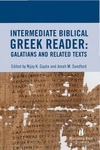
Free Intermediate Biblical Greek Reader: Galatians and Related Texts from Nijay K. Gupta and Jonah M. Sandford

Nijay K. Gupta announced that he is sharing for free an Intermediate Biblical Greek Reader: Galatians and Related Texts co-written with Jonah M. Sandford. Actually, the book is the result of an advanced Greek reading class who used Google Docs to collaborate on the writing of the notes. Read about it HERE. From that page you can find the link to the download which is available as PDF, ePub, or Mobi. The text includes helpful syntactical notes, grammatical/morphological notes, lexical notes, and textual notes. Thanks to Gupta and Sandford for sharing this!

Wednesday, December 13, 2017

GlossaHouse Illustrated Greek-English New Testament Review

I'm teaching an intensive course on Mark this January (2018), and I will be focussing on narrative and performative aspects of the text. I came across the GlossaHouse Illustrated Greek-English New Testament online and asked for more information, and they sent me the book in exchange for a review. 


Mark: GlossaHouse Illustrated Greek-English New Testament (2014)
T. Michael W. Halcomb and Fredrick J. Long

This attractive, soft-cover, 8.5 x 11” book intends to provide “an innovative resource that will allow readers of Greek to have more embodied and engaging experience with the Greek New Testament.” While “embodied” is an odd word choice to describe a book, this illustrated color text certainly is “engaging.” At first glance, it looks like a comic book, but, in contrast to the overly dramatic renderings of most comic books or the stylized depictions of a Manga, it depicts historical settings of Jesus’ first century, Palestine world. While I appreciate its consistency and visual appeal, it certainly paints a more colorful world (especially in terms of dress) than was likely. (For an example, cf. the FreeIllustratedBible website.)
The Greek text provided is that of the Society of Biblical Literature Greek New Testament (SBGNT). Narrative sections are placed in rectangular yellowish boxes, direct quotations are in white speech bubbles, and Scripture quotations are in orangish ‘parchment’ boxes. It provides a useful visual way of seeing how the text works.

In addition to the illustrated presentation of the text, the other most important feature is the English translation placed at the bottom of each page (in extremely small point size that sometimes spills over into the illustrations). There are 8 pages explaining the translation philosophy of the GlossaHouse English Version (GEV). Here’s what they say:

This translation is fresh and fairly literal; we have attempted to preserve word order significance and accurately represent important features of the Greek text that are more emphasized and, therefore, more prominent. All of this was intended for the beginning student in mind, who may need help with Greek word meanings and understanding the significance of special constructions, like purpose, conditionals, and participles. In the translation work, we have applied current research on linguistics and Greek grammar, emphasis constructions, orality, performance, and social-cultural backgrounds. We have sought to strike a balance between trying to translate the import (as far as we can gather) of every sentence element but ye not “over-translating” and moving into commentary.

The rest of the introduction provides an excellent overview of the kind of considerations involved in translating: word order, gender inclusiveness, punctuation, treatment of particles and conjunctions, and rendering of verb tenses in both indicative and non-indicative moods. Examples from the text demonstrate why it is important to attend to such matters.

I find the translation to indeed be fresh and lively with a distinct oral character that is consistent with the Greek of Mark. While there are quibbles I have with some choices, overall I believe it accomplishes Halcomb and Long’s intent of providing an English text with some transparency to the original language for a student learning Greek. It also works well as a text that could be used in the performance of the Gospel of Mark.

Other observations: There are chapter numbers set off in the text and verse numbers within the text, but there are no chapter:verse indicators at the top or bottom of the page, making it difficult to locate a specific passage quickly. I was further confused by their use of Greek numbers for the chapters, because it does not follow the standard Greek numbering system. (The digamma is used for six as expected, but eta for eight is omitted and thus every number thereafter is off. Iota, therefore is nine, and iota-alpha is ten, etc…)

The majority scholarly opinion is that Mark ends at 16.8, and the SBLGNT text continues with verse 9 in double brackets indicating that it is probably not original. The illustration, however, makes no indication of the distinction, nor does the GEV text at the bottom of the page.

SUMMARY: The GlossaHouse Illustrated Greek-English New Testament is an interesting project that uses attractive visuals as a means for reinforcing reading of the Greek text. As significantly, the GlossaHouse English Version text printed at the bottom of the pages is a vibrant rendering of Mark’s Greek, and I especially commend the reflections on the principles of their translating work described in the preface.

Wednesday, November 22, 2017

Greenlee's Concise Exegetical Grammar of NT Greek - Free Download


Apparently this may have been around for some time, but I just found it. J. Harold Greenlee's A Concise Exegetical Grammar of NT Greek is available as a free download from Asbury Seminary. It's available as a PDF, ebook, or for Kindle. Recommended!
HT: John Linebarger on the Anglican Biblical and Theological Languages Forum Facebook group.

Thursday, November 16, 2017

Mark 3.22-26: An Exercise in Greek Conditionals


I am teaching an online Greek class and trying to develop exercises that put the grammatical concepts into actual practice. Below is a link to a PowerPoint exercise that walks you through the fascinating collection of Greek conditional statements in Mark 3.22-26.
BTW, the colorful nature of the text is due to the morphological coding system I use. I have a resource packet with different colored pages, and I share morphological coding schemes for the Bible software that matches those colors. (Accordance, BibleWorks, Logos) Indicative is gold, Subjunctives are pink, Infinitives are green, Imperatives are red, etc. So, when you see a gold indicative verb, you know to look on the gold indicative sheet for guides on translation.
HERE is the link to the PowerPoint. Let me know what you think!

Tuesday, September 2, 2014

Greek New Testament Vocabulary Lists

In preparation for teaching biblical Greek again this fall, I am once again thinking about the vocabulary I am asking my students to memorize. Since my students will eventually be getting Bible software, the first argument I need to make is why bother memorize any Greek vocab at all. My response is that we need a foundational vocabulary simply to talk about the more significant matters of Greek grammar. Additionally, vocabulary memorization gives me an opportunity to talk about Greek words and their range of meaning and usage. (E.g., what is the distinction between ουρανός in the singular and plural? OR What does ἀμήν mean? What is its Hebrew background? How is treated in the LXX? What is distinctive about John's use of it?) Additionally again, even when we start using Bible software, having a basic vocabulary will make one so much more efficient in the use of the software and even in just knowing which word to put the mouse over!

So, how much vocabulary do we need to know? According to a number of studies, a person needs to know 95% of the words in order to deduce the meaning of the others from the context. (Cf. here and here.) In the Greek New Testament, there are 5400 lexical forms which are used 138,020 times. (BTW, I'm using BibleWorks9's edition of NA27 and the Wordlist Manager for my word statistics. I suspect there are differences depending on the program and text you use.) It doesn't really mean that a person needs to know 5130 (5400 x .95) lexical forms. That's a good thing since there are about 1934 hapax legomenon (i.e., words used only once) in the Greek NT. Rather, a person would want to know about 131,119 (138,020 x .95) words according to their instances in the GNT. This would require a person to know every word that occurs 6 or more times and a bunch of the ones used 5 times in the GNT. That is, one would need to know about 1700 of the 5400 lexical forms. That's way to many for my students to memorize in a semester.

Let's start from the top instead. I like to tell my students that if they know the Greek article along with καί and δέ, they know about 23% of the words in the GNT! Some other stats which provide specifics to the chart at the top of this post.
  • The 10 most common words cover nearly 38% of the GNT
  • The 18 words used 1000 or more times cover over 44% of the GNT.
  • To know 50% of the words in the GNT, you need to know the 27 most common ones.
  • The 37 words used 500 or more times cover over 54% of the GNT.
  • The 100 most common words cover over 66% of the GNT.
  • The 200 most common words cover just about 75% of the GNT.
  • The 311 words use 50 or more times cover almost 80% of the GNT.
There are certainly other factors which could complicate these stats. Most notably, if you know a word root, you can often determine related lexemes. Again, knowing the prepositions and knowing some verbs, the addition of prepositional prefixes is an easy matter.

So what have I decided to do? Given our limited time, given that we are not aiming to speak or write compositions in Greek, and given that we will be using Bible software, I'm going for the 311 words used 50 or more times in the GNT. Students will be asked to learn 30+ words each weeks for 10 weeks. The vocab quizzes will consist of 10 words each and are multiple choice. Students need to get at least 7 of the 10 correct, and they have 3 chances to take the quiz. I'm also going to make life easier for the students by taking the frequency list and sorting it alphabetically. That way, they will have a mix of common and less common words each week.

I've created my own lists of Greek lexical forms ordered either according to frequency or alphabetically. I've added my own glosses which in many cases provide a bit more information than the typical, minimal glosses. If you would like to use these files which are DOCX files you can get them here:
I'd be interested to hear what vocabulary memorization requirements others of you have.

Thursday, July 24, 2014

Playing with Powerpoint, Greek, and Video

http://www.scrollandscreen.com/images/erxomai.pinw.2.mp4
I'm figuring out the best ways to create short (but perhaps up to 20 minute) videos using PowerPoint. I've started using Microsoft's Office Mix, but I'm still practicing with it. It does allow me to record videos with inset webcam video of myself plus narration plus annotations.

Another option in Office 365 (and Office 2013, I believe) is to create a PowerPoint, rehearse the timings and add narrations, then use File > Export and save it as a video. Here is a 54 second one with a little music and some animations. If you know some Greek, you may actually think it's a bit humorous!

Click here or on the graphic above: Ἔρχομαι and πίνω

I've also used programs like Camtasia for screen recordings. It's more work to use this, but the results are a bit more polished. In any case, see what you think, and let me know if you have other ways for producing videos like this. Thanks.

Wednesday, September 21, 2011

On teaching Koine Greek

On his και τα λοιπα blog, Daniel R. Streett has been running a great series on teaching Greek. 
He's not done yet, but he's been building up an argument for an immersive, oral/aural, 'communicative' approach to learning Greek. His next post will be on how such an approach might be integrated into a typical seminary curriculum. I'm anxious to see what he proposes, because this is where I've been challenged. (I've replied to a couple of his posts, and I'm quoting large parts of my comments here.)

Back in the day when I was learning Greek at seminary (~1980), the Greek requirement was basically 2 years worth with follow-up in required exegetical courses. The result? I would estimate that at least 90% of pastors were no longer using Greek within 5 years of graduation from seminary. Why? They never achieved a level of competence to allow for truly “reading” Greek. In the seminary where I teach now, the Greek requirement has been reduced to about 1 year with follow-up in in required exegetical courses. There is absolutely no way I can teach students to “read” Greek. I have, therefore, had to change my goals. I try to create a foundation of Greek vocabulary and grammar, but I reduce the amount of vocab memory and analysis to a minimum. Instead, I focus on grammatical significance, syntax, using lexical tools, and learning ways of working with the Greek text. This also means, as you might guess, that Bible software becomes very important. I encourage students to use software about 2/3 of the way through the course. This also means that my quizzes and tests (apart from some foundational memory aspects) are usually open resource (i.e., they can use book, notes, software), based on biblical texts, and ask the students to compare English translations and then consult the Greek to analyze what is going on.

That was my early response to Streett's postings, but in his latest post he points out the challenge of using a 'tools' approach and just learning enough Greek to become 'dangerous' with it. He also sets up the admirable goal that we are helping students become biblical scholars, and argues that just learning 'tools' will not accomplish that. I'd like to think I'm doing something different. Here's why:
  1. Given the year of required dedicated Greek course work plus follow up in exegetical classes, we can get deeper into Greek than simply going with a one semester tools course.
  2. Almost all my students are planning to become pastors, not biblical scholars. Yes, I realize that sounds very bad, but the reality is that they want to be able to engage the Bible to support their ministries. They are not doing ministry to support their biblical scholarship. It's simply a matter of priority. They most certainly want to be fully aware of the Bible and to interpret and communicate it faithfully and with integrity, but the ultimate goal is to become a pastor or teacher in the church, not a biblical scholar. Those two things are certainly (and hopefully!) not exclusive, but priorities will dictate where time is spent.
  3. As I think about it, there is probably more than just 'tools' or 'reading' levels of competence. I would be more comfortable defining my approach as something more like 'faithful engagement' with the text, a level somewhere between tools and reading. (I'll say more in a moment.) We should probably also note that there is a 'translator' level beyond the 'reader' one. Students sometimes think they will learn to 'translate' the Greek, but that is a far more complicated task. None of my students (and I will also include myself here) is likely to come up with a better translation than the leading English versions which are products of committees of scholars who know Greek and linguistics better than my students or I.
  4. Given #3, one of the first things my students come to realize, however, is that no translation is perfect. Every translation is making some kind of compromise or is stuck trying not only to render Greek words into English but also to capture a whole culture, context, and tradition of their use.
  5. Because of #4, I have found that one of the best ways for my students to get at the Greek is by looking at a range of English versions. This approach highlights the places where the translation committees were having the most difficulty getting it right, and these are the places where they need to look more closely at the Greek. Here, then, is where the tools start to come in to play. Are the differences the result of text critical issues? Is it a lexical matter? A grammatical matter? The tools will provide the lexical and parsing and analysis and such, but you will still actually need to know some Greek to figure out what a circumstantial participle is, and how it works in Greek, and what difference it makes that it is present and not aorist. At this point, they should also be able to understand what is being said about the Greek text in the more technical commentaries like ones in the NIGTC series. (I don't know that a simple 'tools' approach would achieve this level of competence.)
As I hope you can see, students actually have to learn some Greek in my classes. No, they will not be able to 'translate' nor even 'read' the Greek. They will, however:
  • understand something about how Koine Greek works grammatically, 
  • have a grasp of syntactical features of Greek, 
  • be able to use tools, especially Bible software,
  • know how to make sense of a lexical entry in BDAG (a simple tools approach can't do this either),
  • understand discussions about Greek texts in commentaries or the footnotes of the very helpful NET Bible, and 
  • evaluate the relative merits of English versions. 
All of this can be accomplished in a year. I’d love to think I could use a more ‘communicative’ approach (though we do sing Greek songs, recite the Lord’s Prayer…), but given the time constraints imposed by our curriculum, I am taking an approach that I think (and early feedback is tending to confirm) will allow students to “use” Greek with integrity for the rest of their careers.