Showing posts with label greek new testament. Show all posts

Thursday, January 18, 2024

The First Computer-Generated Greek New Testament

Alan Bunning from the Center for New Testament Restoration has an article in TC: A Journal of Biblical Textual Criticism 28 (2023): 111–126 on "The First Computer-Generated Greek New Testament." (available to read online HERE)

Abstract: A plausible Greek New Testament text can be automatically generated by a computer program using statistical analysis and algorithms that weigh the earliest manuscript data in a manner simulating a reasoned-eclecticism approach. This method offers several substantial advantages by providing a consistently weighed text that is openly transparent, without any theological bias, and scientifically reproducible, and the results are very similar to our best modern critical tests. This initial accomplishment could have a number of future implications for the field of textual criticism regarding advances in the use of statistics and algorithms for further refinements in the production of critical texts.

The project was started by hand in 2012, but by 2020, the first computer-generated Greek New Testament was created, the Bunning Heuristic Prototype Greek New Testament. (BHP) That text was deprecated, and with further developments, in 2022 it became the Statistical Restoration Greek New Testament (SR). All the earliest manuscript evidence is fed directly to a computer program as raw data, and the most probable text is generated based on statistical analysis and algorithms." SR is now available as an open-licensed (CC) text available for download HERE.

Monday, January 27, 2020

Understanding New Testament Greek grammar for Accordance

I am happy to report that my Understanding New Testament Greek grammar has just been released as a module for Accordance. (2020.01.27) You can read my full description on the announcement page.
TLDR: Due to changing seminary requirements, I have needed to teach Greek in a single semester for a few years now. It's impossible to teach anyone to read Greek in that time, so I teach students how to understand Greek grammar, syntax, and lexical possibilities. The only way to do this is to use Bible software. I've developed a visual way of color coding the text that links to the grammar. E.g., you see something in gold (which means an indicative verb), and you look for the gold section in the grammar to see the range of translating indicatives.
I hope you will check it out! For now, it's a quick download into Accordance, and it's on sale!
If you just want to see how the highlighting works without buying the grammar, HERE is the highlight file. After unzipping, put the HLT file in your Accordance Files\Highlights subdirectory, and it will appear as an option in Accordance when you open the Highlighting tool.

Thursday, July 26, 2018

Jonathan Robie: "Needed - An Open, Trustworthy, Trusted Greek Text"

Jonathan Robie at biblicalhumanities.org presents an important argument about the need for an open, trustworthy, trusted Greek text. He writes:
The Bible is at the heart of digital biblical humanities, and open scholarship depends on an open text that can be used in scholarly publications and translations. For the Greek New Testament, the critical editions that can be used in scholarly publications and most translations are not open. The texts that are open are generally not considered acceptable for scholarly publications or translation. Something's got to give.
While arguing for such a Greek NT text, he notes that for the Hebrew OT there is


HT: James Tauber @jtauber on Twitter

Friday, May 11, 2018

Biblia Hebraica, Septuagint, Greek NT, Apostolic Fathers Free Android Apps

https://play.google.com/store/apps/developer?id=Matt+Robertson
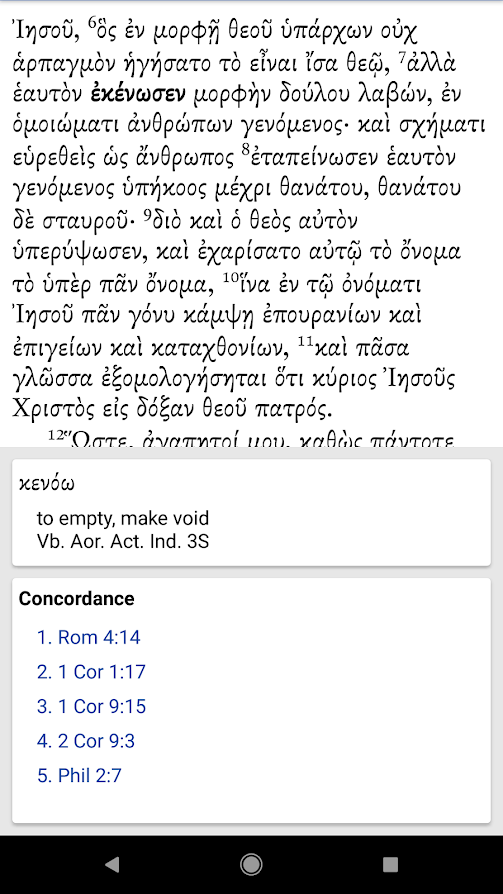
These are simple but very nice Android apps for reading the Biblia Hebraica, Septuagint, Greek New Testament, and Apostolic Fathers. If you don't already have an app, these look great and provide gloss and parsing info. Each app has specific features, and the most full-featured is the SBLGNT:
- Text: full text of the SBLGNT
- Glosses: quickly displays glosses and parsing for a word by touching it
- Concordance: full concordance displayed by touching any word
- Vocab: keep track of the vocab you need to learn for each chapter. Use the Vocab Wizard to automatically add words based on your reading level.
- Audio: audio playback available for every chapter
- SpeedRead: displays text one word at a time at an adjustable pace to improve your speed reading ability
- Reading Plans: choose a reading plan to track your progress and encourage your reading!
I'm not sure who Matt Robertson is, but he deserves thanks for providing these handy, original language Bible reading apps.
HT: John Linebarger on FB

Wednesday, December 13, 2017

GlossaHouse Illustrated Greek-English New Testament Review

I'm teaching an intensive course on Mark this January (2018), and I will be focussing on narrative and performative aspects of the text. I came across the GlossaHouse Illustrated Greek-English New Testament online and asked for more information, and they sent me the book in exchange for a review. 


Mark: GlossaHouse Illustrated Greek-English New Testament (2014)
T. Michael W. Halcomb and Fredrick J. Long

This attractive, soft-cover, 8.5 x 11” book intends to provide “an innovative resource that will allow readers of Greek to have more embodied and engaging experience with the Greek New Testament.” While “embodied” is an odd word choice to describe a book, this illustrated color text certainly is “engaging.” At first glance, it looks like a comic book, but, in contrast to the overly dramatic renderings of most comic books or the stylized depictions of a Manga, it depicts historical settings of Jesus’ first century, Palestine world. While I appreciate its consistency and visual appeal, it certainly paints a more colorful world (especially in terms of dress) than was likely. (For an example, cf. the FreeIllustratedBible website.)
The Greek text provided is that of the Society of Biblical Literature Greek New Testament (SBGNT). Narrative sections are placed in rectangular yellowish boxes, direct quotations are in white speech bubbles, and Scripture quotations are in orangish ‘parchment’ boxes. It provides a useful visual way of seeing how the text works.

In addition to the illustrated presentation of the text, the other most important feature is the English translation placed at the bottom of each page (in extremely small point size that sometimes spills over into the illustrations). There are 8 pages explaining the translation philosophy of the GlossaHouse English Version (GEV). Here’s what they say:

This translation is fresh and fairly literal; we have attempted to preserve word order significance and accurately represent important features of the Greek text that are more emphasized and, therefore, more prominent. All of this was intended for the beginning student in mind, who may need help with Greek word meanings and understanding the significance of special constructions, like purpose, conditionals, and participles. In the translation work, we have applied current research on linguistics and Greek grammar, emphasis constructions, orality, performance, and social-cultural backgrounds. We have sought to strike a balance between trying to translate the import (as far as we can gather) of every sentence element but ye not “over-translating” and moving into commentary.

The rest of the introduction provides an excellent overview of the kind of considerations involved in translating: word order, gender inclusiveness, punctuation, treatment of particles and conjunctions, and rendering of verb tenses in both indicative and non-indicative moods. Examples from the text demonstrate why it is important to attend to such matters.

I find the translation to indeed be fresh and lively with a distinct oral character that is consistent with the Greek of Mark. While there are quibbles I have with some choices, overall I believe it accomplishes Halcomb and Long’s intent of providing an English text with some transparency to the original language for a student learning Greek. It also works well as a text that could be used in the performance of the Gospel of Mark.

Other observations: There are chapter numbers set off in the text and verse numbers within the text, but there are no chapter:verse indicators at the top or bottom of the page, making it difficult to locate a specific passage quickly. I was further confused by their use of Greek numbers for the chapters, because it does not follow the standard Greek numbering system. (The digamma is used for six as expected, but eta for eight is omitted and thus every number thereafter is off. Iota, therefore is nine, and iota-alpha is ten, etc…)

The majority scholarly opinion is that Mark ends at 16.8, and the SBLGNT text continues with verse 9 in double brackets indicating that it is probably not original. The illustration, however, makes no indication of the distinction, nor does the GEV text at the bottom of the page.

SUMMARY: The GlossaHouse Illustrated Greek-English New Testament is an interesting project that uses attractive visuals as a means for reinforcing reading of the Greek text. As significantly, the GlossaHouse English Version text printed at the bottom of the pages is a vibrant rendering of Mark’s Greek, and I especially commend the reflections on the principles of their translating work described in the preface.

Tuesday, September 2, 2014

Greek New Testament Vocabulary Lists

In preparation for teaching biblical Greek again this fall, I am once again thinking about the vocabulary I am asking my students to memorize. Since my students will eventually be getting Bible software, the first argument I need to make is why bother memorize any Greek vocab at all. My response is that we need a foundational vocabulary simply to talk about the more significant matters of Greek grammar. Additionally, vocabulary memorization gives me an opportunity to talk about Greek words and their range of meaning and usage. (E.g., what is the distinction between ουρανός in the singular and plural? OR What does ἀμήν mean? What is its Hebrew background? How is treated in the LXX? What is distinctive about John's use of it?) Additionally again, even when we start using Bible software, having a basic vocabulary will make one so much more efficient in the use of the software and even in just knowing which word to put the mouse over!

So, how much vocabulary do we need to know? According to a number of studies, a person needs to know 95% of the words in order to deduce the meaning of the others from the context. (Cf. here and here.) In the Greek New Testament, there are 5400 lexical forms which are used 138,020 times. (BTW, I'm using BibleWorks9's edition of NA27 and the Wordlist Manager for my word statistics. I suspect there are differences depending on the program and text you use.) It doesn't really mean that a person needs to know 5130 (5400 x .95) lexical forms. That's a good thing since there are about 1934 hapax legomenon (i.e., words used only once) in the Greek NT. Rather, a person would want to know about 131,119 (138,020 x .95) words according to their instances in the GNT. This would require a person to know every word that occurs 6 or more times and a bunch of the ones used 5 times in the GNT. That is, one would need to know about 1700 of the 5400 lexical forms. That's way to many for my students to memorize in a semester.

Let's start from the top instead. I like to tell my students that if they know the Greek article along with καί and δέ, they know about 23% of the words in the GNT! Some other stats which provide specifics to the chart at the top of this post.
  • The 10 most common words cover nearly 38% of the GNT
  • The 18 words used 1000 or more times cover over 44% of the GNT.
  • To know 50% of the words in the GNT, you need to know the 27 most common ones.
  • The 37 words used 500 or more times cover over 54% of the GNT.
  • The 100 most common words cover over 66% of the GNT.
  • The 200 most common words cover just about 75% of the GNT.
  • The 311 words use 50 or more times cover almost 80% of the GNT.
There are certainly other factors which could complicate these stats. Most notably, if you know a word root, you can often determine related lexemes. Again, knowing the prepositions and knowing some verbs, the addition of prepositional prefixes is an easy matter.

So what have I decided to do? Given our limited time, given that we are not aiming to speak or write compositions in Greek, and given that we will be using Bible software, I'm going for the 311 words used 50 or more times in the GNT. Students will be asked to learn 30+ words each weeks for 10 weeks. The vocab quizzes will consist of 10 words each and are multiple choice. Students need to get at least 7 of the 10 correct, and they have 3 chances to take the quiz. I'm also going to make life easier for the students by taking the frequency list and sorting it alphabetically. That way, they will have a mix of common and less common words each week.

I've created my own lists of Greek lexical forms ordered either according to frequency or alphabetically. I've added my own glosses which in many cases provide a bit more information than the typical, minimal glosses. If you would like to use these files which are DOCX files you can get them here:
I'd be interested to hear what vocabulary memorization requirements others of you have.

Saturday, November 17, 2012

AAR SBL 2012 Meeting - Great deal on NA28

I'm enjoying the 2013 AAR-SBL meeting in Chicago. It's always a great time to hear some speakers, catch up with friends, and peruse the exhibition hall. Quick tip for anyone who is here and may happen to read this blog: Stop by at the Crossway Books booth #331. Until they run out they are selling a very nice, hardbound, ESV-NestleAland 28th for only $15. I don't think you are going to find the new NA28 for that cheap anywhere else. Mention my name, and it won't mean a thing...
Off to the Fortress Press reception!

Tuesday, March 20, 2012

"Recent Trends in the Textual Criticism of the New Testament"

 I'll confess that I have fallen behind the curve in the area of NT textual criticism. I was reminded of this when I read the article by J. K. Elliott in the new, free, peer-reviewed online journal, BABELAO*, devoted to oriental studies. If you want to get up to speed, I recommend his article, "Recent Trends in the Textual Criticism of the New Testament: A New Millennium, a New Beginning?" (Free PDF download HERE.)

I was aware of Ehrman’s work and his pessimism about the text, but in my one class session for textual criticism, I have been teaching a rather traditional approach to text criticism. What this has meant for me is that:
  • I provide an introduction to the dissemination of texts, 
  • talk about families of text-types, 
  • acknowledge the priority of the Alexandrian family (especially Vaticanus and Sinaiticus), 
  • show how critics weigh internal/external evidence, 
  • conclude that we can basically rely on NA27, 
  • show how to use the text critical apparatus, and 
  • encourage use of the NET Bible notes (and/or Metzger’s commentary) to help make sense of the significant variants.
In the article, JK Elliott completely dismisses text-types, blasts Kurt Aland, says Metzger is only for "the nostalgic or curious,” and indicates that textual criticism may be more helpful in tracing the social and theological history of Christianity. Elliott is aware of the problems, but he is advocating a thoroughgoing eclecticism.

The new approach with its avoidance of concentrating on one text-type as having the monopoly of authorial readings and its hesitation to establish a critical text which discourages the study of the ‘secondary’ readings jettisoned or abandoned in the apparatus criticus means that, just as Parker or Ehrman do, we may now look at our textual heritage in the round and as a totality. In its entirety one may now discern in a full apparatus much information relevant to church history, or fluctuations and fashions in Christian doctrine let alone the more recherché pursuits of the development of the Greek language and, indeed, the plotting of our New Testament text’s own histories. (pg 14 of PDF, pg 130 in BABELAO)
He seems fairly confident that most of the textual decisions can be made on internal grounds: which text can explain subsequent ones and which one is most consistent with the rest of the author’s composition.

I’m actually a bit relieved about these developments. Elliott broadly refers to the tremendous possibilities technology offers to the field, especially software for collation of manuscripts and online sharing and updating of work. Most of my students have found the NA27 apparatus hopelessly confusing, and I have hated to require them to spend time on mastering its complexities. And now that we have something like BibleWorks9 which can display something like this, I'm not sure whether I want to bother with it at all.

BibleWorks9: Note that the left window provides a view of both mss and edited texts. Sinaiticus is even morphologically tagged. The center window shows the work of the CNTTS Apparatus. It is even more complexly annotated than NA27, but at least every abbreviation is a click away from an explanation. The right window shows the work of the BibleWorks Manuscript Project that allows for collation of texts and images of a number of the actual mss.
(BTW, Accordance offers help with the critical apparatus, but they have done a particularly fine job of implementing the CNTTS data. Check out their two videos here and here giving a fine overview of what Accordance can do. Logos offers the NA27 critical apparatus but lags behind in displaying mss texts.)

So, I’m trying to rethink how to go about teaching NT textual criticism in the very brief and introductory way that I have time for. With BW9, it's quite easy for students to see the differences in the mss. Focusing on internal evidence would allow me to draw attention to the text and to the author rather than on a knowledge of manuscripts and text-types.

To this end, I'll concur with Elliott who closes his article by quoting Ehrman (Orthodox Corruption of Scripture  [New York - Oxford, 2011] p. 361; pg. 20 of PDF; pg. 136 of BABELAO)

 This (shift in orientation in New Testament textual criticism) is a movement away from construing the task of a textual critic in narrow terms as establishing some kind of ostensible “original” text of the New Testament. The material and textual data at our disposal – that is the surviving manuscripts and the texts they contain – can do far more for us than help us know what the authors of the New Testament originally wrote. They can also help us understand the social history of Christianity in many of its forms, some of which are seriously underexamined as yet. They can help us know and appreciate the work, concerns and ideas of otherwise unknown and anonymous scribes. And they can help us appreciate the theological, polemical and other ideological contexts out of which these early Christians (sic) copyists worked and lived as they produced the texts that have come down to us as treasures from the past.”
 ________________
*Regarding BABELAO (statement by David Phillips on the Hugoye List-Syriac Studies Group, Digest #1983)
The name BABELAO means « Bulletin of the Abelao », more precisely « Bulletin de l’Académie Belge pour l’Etude des Langues Anciennes et Orientales » (Bulletin of the Belgian Academy for the Study of Ancient and Oriental Languages). ABELAO (www.abelao. be ) is a non-profit organization which seeks to promote teaching and research in the various fields of ancient and oriental culture and languages, especially by means of summer-courses on the campus of the University of Louvain (Louvain-la- Neuve, Belgium).

Its Bulletin, BABELAO, is conceived as a scholarly journal. It covers the various fields of oriental studies : philology, palaeography, history of the ancient and oriental world, language history, comparative literature, edition of texts, etc. Its Editorial Board, the members of which are recruited internationally, brings together scholars who are able to provide expertise in all the required fields.

Web hosting for BABELAO is provided by the Université catholique de Louvain (Louvain-la- Neuve, Belgium). Issues of BABELAO here.