Thursday, July 24, 2014

Survey of the Lands of the Bible - Free MOOC

Interested in the lands of the Bible? Do you enjoy history or maps or archaeology? Planning a trip to any of the lands that are part of biblical history?

I would like to invite anyone who is interested to participate in a free, online course I am offering, “Survey of the Lands of the Bible.” It is being offered as a MOOC (= Massive Open Online Course) starting in September, 2014 through Gettysburg Seminary where I teach. Students are able to participate as much or little as they wish. There is no cost, and buying the course textbook is optional. I believe that the course provides not only a geographical overview, but it also serves as a good Bible history survey that informs the modern situation. Students cannot receive credit for the course from the seminary, but it is a great learning opportunity.

The course will be conducted in English, but I’m hoping for an international audience.

There really are no costs and no risks to register for the course. There is more information HERE.
You can also check this PDF course brochure available HERE.

If you have any questions, please let me know. I hope to see some of you online!

Playing with Powerpoint, Greek, and Video

http://www.scrollandscreen.com/images/erxomai.pinw.2.mp4
I'm figuring out the best ways to create short (but perhaps up to 20 minute) videos using PowerPoint. I've started using Microsoft's Office Mix, but I'm still practicing with it. It does allow me to record videos with inset webcam video of myself plus narration plus annotations.

Another option in Office 365 (and Office 2013, I believe) is to create a PowerPoint, rehearse the timings and add narrations, then use File > Export and save it as a video. Here is a 54 second one with a little music and some animations. If you know some Greek, you may actually think it's a bit humorous!

Click here or on the graphic above: Ἔρχομαι and πίνω

I've also used programs like Camtasia for screen recordings. It's more work to use this, but the results are a bit more polished. In any case, see what you think, and let me know if you have other ways for producing videos like this. Thanks.

Monday, July 7, 2014

Logos 5 Lutheran Gold Review Part 2


Logos 5 Lutheran Gold Review Part 2

In Part 1 of my review, I surveyed the resources available in Logos 5 Lutheran Gold. In this Part 2, I will look at how the resources are implemented within the program.

A great strength of Logos is its capabilities as a library management system. With the integration of and hyperlinking between biblical texts and references, a person has a fast and powerful way of studying the Bible and conducting research.

Starting with a biblical text

One of the most often cited passages for summarizing a Lutheran perspective is Ephesians 2.8-9. (And verse 10 should also really be included!)  So if I go to Ephesians 2.8, right click, and choose Reference and then Passage Guide, I get the following.


All those headings can be expanded, but of interest here is the Commentaries which include these from the Lutheran Gold collection:
  • Augsburg Commentary on the New Testament, Ephesians and Galatians (1985)
  • The Lutheran Commentary, Annotations on the Epistles of Paul to the Ephesians, Philippians, Colossians, and Thessalonians (1896)
  • Lange’s Commentary on the Holy Scriptures, Ephesians (~1870? - more info on Lange's here)
Once you've opened the commentary you want, it's easy to link the commentary window with the biblical text window so that they scroll together.

Biblical cross-referencing within a resource

As with all Logos secondary resources, wherever there is a reference to a biblical passage, one simply needs to hover the cursor over that reference in order for it to appear in a popup.

Searching for biblical references within a resource

As just noted, since the resources have had all the biblical references tagged, it also means that one can search any resource for any particular passage. Here you can see where I've used a Basic search for Ephesians 2.8 in the Book of Concord and obtained 8 hits.

One can search one's entire library of resources (with all the resources I have, I get 2402 results in 1918 articles in 448 resources) or a sub-library = a collection. Collections can be very helpful. In the graphic below you can see where I used Tools > Collections and then typed in Augsburg Commentary on the New Testament and named the resource ACNT. Searching this collection, I get 19 results in 14 articles for Ephesiasn 2.8.

Further, having created this ACNT collection, I can now click on the Library icon, click on Prioritize, search for ACNT, right click on the list of books and choose to prioritize this series. I moved this one rather high on my list, so now when I use the Passage Guide (cf. above), the ACNT commentaries will be among the first to appear.

Starting with a topic

Regardless of whether a word is found in a biblical text or some other resource, if one wants to do further research on that word/topic, simply right-click on it, and then choose Power Lookup, Bible Word Study, or Topic Guide. Any of these tools will provide access to the host of resources in Logos.
It is also possible to use a Basic search and choose a resource (or collection or entire library) and search for the word / topic that way. (580 instances of "grace" in the Book of Concord.)

As another example, Lutherans are often known for affirming sola scriptura, sola gratia, and sola fides (Scripture alone, grace alone, faith alone). A Basic search in my entire library for "sola gratia luther" returns 4096 results in 126 articles in 53 resources, almost all of which are found in the resources in the Logos 5 Lutheran Gold.

Other features of Logos 5

All the other usual features of Logos 5 work with the Lutheran Gold version. Not only is it available for either Win or Mac, I also want to highlight that one's purchase of a Logos 5 library entitles one to use it on two computers (not at the same time) and also makes it available on a variety of other platforms. In particular, free apps can be downloaded for iPhone/iPad, Android, or Kindle Fire devices. One can also access resources on the web at Biblia.com (cf. graphic below) though there is not nearly as much functionality.

SUMMARY

Logos has done a fine job of  packaging Lutheran resources and implementing them in Logos 5 Lutheran Gold. For a Lutheran interested in building a library of Lutheran primary and secondary resources that will integrate with biblical study, it is an excellent choice. As mentioned in Part 1 of my review, the collection lacks Luther's Works, but there are numerous other Lutheran-oriented resources that make this an attractive option. If one is more interested in just working with the biblical texts, it might be worthwhile to look at Accordance or BibleWorks or Logos' own Biblical Languages library. With Logos one could always then add any other Lutheran resources, but the Logos 5 Lutheran Gold provides considerable value in the resources it does include.

Friday, July 4, 2014

Logos 5 Lutheran Gold Review - Part 1

Logos 5 Lutheran Gold Review
Part 1


I have long used Logos Bible software and have reviewed versions and aspects of it in the past. I have primarily used it for original language study of the Bible and to gain access to the numerous resources available for Bible study. The latest version, Logos 5--with its collection of new datasets, additional resources, and deeper integration of reverse interlinears--is an outstanding program. (Cf. my 3-part review of Logos 5 Gold.Part 1, Part 2, Part 3) I also appreciate being able to use my Logos resources not only my Win7 desktop computer but also on the web and on my Android smartphone. (Comments here.)

As a Lutheran (ELCA) myself and a teacher at a Lutheran seminary, I was pleased to be asked to review the Logos 5 Lutheran Gold collection. I will briefly note some of the aspects of Logos 5 for biblical study, but the focus of this review will be on the specifically Lutheran resources and their use within the program.

The Logos site describes the Logos 5 Lutheran Gold collection thus:
A Bible study powerhouse: Lutheran Gold comes with all of Logos 5’s advanced tools, including the Timeline, Bible Sense Lexicon, Sermon Starter Guide, and everything from the lower base packages. Plus, you’ll get a huge library of 752 resources worth over $18,000 in print. These include key titles, like Bible-history commentaries on the Old and New Testament, the 19-volume Continental Commentary Series, the Liddell and Scott Greek–English Lexicon, and over 30 additional volumes on the life and influence of Martin Luther.
This package is specifically designed for the Lutheran tradition—it combines smart Bible study tools with a world-class library of Lutheran resources, making it perfect for anyone wanting to go deeper into Lutheran studies.
In this first part of my review, I am mainly focusing on the resources available in Logos 5 Lutheran Gold. In a subsequent part, I will review the implementation of the resources in the Logos program.

Standard and Lutheran Gold Collections: Resources Comparison

Logos offers a variety of Bible software collections: Starter, Bronze, Silver, Gold, Platinum, Diamond, Portfolio, and Biblical Languages. Within the last year or so, Logos has also offered specialized 'families' oriented to various denominations or backgrounds: Español, Anglican, Reformed, Seventh Day Adventist, and Roman Catholic (labeled as Verbum). The Lutheran collection is one of these family offerings, and for now is offered only in a Starter, Bronze, Silver, or Gold level.

This history of Lutheranism in the United States is rather complicated, but today there are three primary branches which have supporting publishing houses whose works are included in the Lutheran Gold library.
  • Evangelical Lutheran Church in America (ELCA) and (Augsburg) Fortress Press
  • Lutheran Church Missouri Synod (LCMS) and Concordia Publishing House
  • Wisconsin Evangelical Lutheran Synod (WELS) and Northwestern Publishing House
Works from Fortress Press are especially featured in the Lutheran Gold collection, but I suspect this is the result of publishing agreements and available digital versions rather than any denominational bias. What Logos has done is modify their standard Gold library by omitting some resources and adding ones with a Lutheran background.
Logos 5 Lutheran Gold lists for $1550 before any discounts (faculty, student, occasional sales...) According to Logos and as noted already, it has 752 resources with a print value of $18,000. The standard (non-Lutheran specific) Gold collection also lists for $1550 and has 1076 resources with a print value of $21,000. How many of the resources are actually valuable to you, however, is a different matter.

So what do you get or not in Lutheran Gold as compared to the standard Gold collection? (Note: I am comparing the standard and Lutheran Gold collections as of 2014.07, but resources do sometimes change.)
  • All the Logos Datasets, Maps, Photos, Media, Parallel Passages and Harmonies are the same or nearly so.
  • Among "Ancient Texts and Morphologies," you get Biblia Hebraica Stuttgartensia in the standard but not the Lutheran. Neither offers Nestle-Aland, but in both, you will still have plenty of reliable Hebrew and Greek texts to do original language work. There are similar and sufficient "Original Language Grammars and Tools" and "Original Language Lexicons and Word Studies" in both standard and Lutheran Gold to conduct further study.
  • The only real texts of note lacking among "Ancient Texts in Translation" in the Lutheran Gold are Josephus and Philo and the Nag Hammadi Library in English.
  • There are plenty of the most used English Bible versions (and Interlinears) in standard or Lutheran Gold, and the only ones that I consult missing in the Lutheran package (though available for purchase separately) are the Good News Translation and Peterson's The Message.
  • Among "Bible Introductions and Surveys," both standard and Lutheran Gold include resources like the Faithlife Study Bible, Ryrie's Guide, and the Holman Bible Handbook, none of which are Lutheran in background, however. A better option would have been to include The Lutheran Study Bible (Concordia).
  • Though there are fewer resources in the Lutheran Gold "Bible Reference" category, it includes more than enough useful ones (I especially like the HarperCollins Bible Dictionary) and adds The Lutheran Cyclopedia. Among the resources that Logos labels as "Biblical Studies," the Lutheran collection is, I believe, far superior and is a notable highlight. It includes three books by N.T. Wright (published by SPCK), and others by Helmut Koester (the valuable Cites of Paul and Paul and His World), Malherbe, Theissen, and Zetterholm (all by Fortress). Among Bible Commentaries offered, both include a number of old series, and both have the very useful United Bible Society OT and NT Handbook Series. The standard Gold offers relatively recent series like the Holman NT  Commentary, New American Commentary, and Black's NT Commentary. The Lutheran Gold offers fewer commentary series, but the ones included from Lutheran publishers are quite good, most notably the Continental Commentary Series and the Augsburg Commentary on the NT.
  • Among "Bible History and Culture," both include The Archaeological Encyclopedia of the Holy Land and New Manners and Customs of the Bible, but where the standard offers The Context of Scripture, the Lutheran Gold includes Schürer's History of the Jewish People in the Time of Jesus Christ and The Dead Sea Scrolls Study Edition.
  • In the "Church History / Church Fathers" categories, the Lutheran collection actually offers more, including a number of specifically Lutheran resources, noting in particular Gritsch's A History of Lutheranism.
  • In the "Theology" category, there are far more resources in the Lutheran Gold, and most of them have a Lutheran connection.
  • The Lutheran Gold does not offer resources in the categories of "Counseling," "Ministry," or "Devotionals and Spiritual Formation," but I think it was reasonable to omit these since they do not have specifically Lutheran focus. There are also far fewer resources in the "Preaching and Teaching" category, but the Lutheran Gold does significantly include the 13 volumes of the Fortress Press Homiletics Collection
  •  Lectionaries: The lectionary tools are very helpful for identifying and accumulating the Scripture readings for any particular week. Christian Worship (WELS) and Lutheran Service Book (LCMS) one- and three- year lectionaries are included as well as the three-year and daily readings of the Revised Common Lectionary (used by most ELCA and many other mainline denominations). I know of quite a number of (Lutheran) congregations that are using the four-year Narrative Lectionary, and I encourage Logos to add this schedule to their resources.
  •  Liturgy, Hymns and Prayer Books are unique to Lutheran Gold. There are ten volumes with publishing dates between 1715 and 1921 and hence primarily valuable simply as historical documents.

Logos 5 Lutheran Starter, Bronze, Silver, or Gold?

For comparison sake, I also looked at the other Lutheran collections, and Logos makes it easy for you to make your own comparison. Prices listed are before any available discounts.
  • Starter: 195 resources, $295
  • Bronze: 368 resources, $630
  • Silver: 506 resources, $1000
  • Gold: 752 resources, $1550
The Starter library really is limited and doesn't even really take full advantage of the basic Logos 5 program. It does include The Book of Concord, but it does not appear to be a great value to me. Stepping up to the Bronze level does provide for much more thorough biblical studies and biblical reference works in addition to more Lutheran works. Silver mainly provides more biblical tools, early Church, and biblical studies resources, though notably Bonhoeffer's Works are added. Moving up to Gold notably adds the Continental Commentary Series, the UBS Handbooks, the Fortress Press Homiletical Collection, and the Select Studies in Martin Luther's Life and Influence (29 vols.). If I were starting with nothing, I would at least want the Bronze level, but there are good reasons and value to step up to Silver or Gold. If you already own a Logos product, they do take into account resources you already own, so it is worth checking the personalized prices.

SUMMARY: Logos 5 Lutheran Gold Resources

With Logos 5 Lutheran Gold, Logos has assembled a commendable set of resources for conducting biblical study (in both the original languages as well as English) supplemented by a collection of Lutheran resources. Books from Fortress Press are particularly well represented. The resources in the Biblical Studies, Bible Commentaries, Bible History and Culture, and Preaching and Teaching groups are particularly strong. The Theology group does include many excellent resources from a Lutheran theological perspective, but the lack of Luther's Works is notable.

For a more detailed listing of the resources with additional comments, consult this page I have posted.
In the next part of my review, I will see how these resources are implemented in the program overall.

UPDATE: Part 2 of my review is now posted.

Wednesday, April 2, 2014

Quick Notes: BibleWorks Mac Update and Logos Free Book for April 2014

Just a couple quick notes...

BibleWorks: BibleWorks has just announced an update of their Mac installer. According to their announcement, the update provides:


  • Clearer screen text
  • Touchpad scrolling supported
  • Numerous visual fixes
  • OS X Mavericks support
  • Chinese, Korean, Arabic, Japanese, & more Bible version display
  • Faster performance
Want to update your existing BibleWorks 9 Mac installation? Follow these instructions.

I can report that I have a number of students running BW on a Mac, and things have gone smoothly for the most part.


Logos:  The free book for the month of April 2014 is Steve Moyise's Jesus and Scripture. Moyise is a very good scholar, and his books are worth reading. This is a fairly new (2011) book and sells for $12-20 on Amazon, so if you have Logos, get this book now.

Wednesday, March 26, 2014

What's New in Bible Software

In case you don't subscribe to their free online publication, Kevin Purcell at Christian Computing Magazine has a quick update on what the major Bible software companies are doing. (That link will open a PDF.) As he notes, there isn't a whole lot going on. Mainly companies are doing minor improvements and working on getting their software to work on various platforms.

Monday, March 10, 2014

Google Maps Gallery and National Geographic Lands of the Bible Maps


Thanks to a post on the Bible Gateway blog, I see that Google Maps recently announced the Google Maps Gallery.
Maps Gallery works like an interactive, digital atlas where anyone can search for and find rich, compelling maps. Maps included in the Gallery can be viewed in Google Earth and are discoverable through major search engines, making it seamless for citizens and stakeholders to access diverse mapping data, such as locations of municipal construction projects, historic city plans, population statistics, deforestation changes and up-to-date emergency evacuation routes. Organizations using Maps Gallery can communicate critical information, build awareness and inform the public at-large.
Basically what is happening is that organizations can share maps as overlays on Google Maps. There is a transparency slider that allows you to control the visibility of the overlay and the underlying Google Map. With the Google Map, you have the choice of displaying it as a map--with or without terrain shading--or satellite view.

Among the maps are a number of Lands of the Bible maps from National Geographic from 1938, 1946, 1956, and 1967. The citations of biblical sites does not change much in those maps, but, as you can imagine, there is a tremendous amount of geopolitical changes that occur over those years.

Friday, March 7, 2014

Making a Custom Bible Map - Accordance and ...

David Lang at Accordance recently posted a fine 11 minute video on the Accordance blog showing how to make a custom map of Genesis 19 using the map module in Accordance. It is a great feature that I don't think any of the other Bible software packages can handle. BibleWorks does include a map module, but it would be very difficult to create the kind of map you see above with the labeling and highlighting. What's more, you don't have the 3-D option that Accordance offers.

Of course, you don't always want to create your own maps. Accordance offers a number of overlays illustrating biblical events, some even with animations. There are also atlas modules available. The map module in BibleWorks also uses a more extensive system of overlays to highlight periods or books of the Bible or particular events. They also include The New Moody Atlas of the Bible which has a very good collection of maps. Logos 5 has a Bible Places Guide that is very helpful, and they have a large selection of very nice maps. (Don't buy one of the old map sets. What you want are the Bible Facts: Places and the Logos and Faithlife Infographics datasets that are included with most libraries.) All three of these programs have integration of the maps with biblical text and related resources.

Still, only Accordance has the map creation possibility that's as nice as one that David Lang created. There are two other possibilities, however.
  •  One is using Google Earth. Lang's article partly caught my attention because I had occasion last fall to want to create exactly the same kind of map he did. Using this Google Earth KMZ file from the Geocoding page at OpenBible.info, I have quick access to all the biblical sites. Then I navigated around until I was able to capture the view above and put it into my PowerPoint. Compare it to Lang's map above!
  • Another option is a standalone Bible mapping program called BibleMapper created by David P. Barrett. You can use version 3 for free (no limitations) or get the improved version 4 for $37. The map of the Seven Churches of Revelation is one I created in BibleMapper. One of the great virtues of this program is that any map you create is your own, and you don't need to obtain any copyright permissions or pay any costs to share your map. (Accordance allows free usage of any map you create, but they appreciate attribution. If you want to use their maps for any commercial project, however, you should contact them.)
If I'm missing something, let me know!

Related to this topic, Todd Bolen on the BiblePlaces blog recently pointed out the availability of physical 3-D topographical maps for various biblical and modern periods. (When I was a kid and we visited the USA national parks, I always used to get one of those 3-D maps of the park.) The maps are 9" x 14" and about $30 each.

Thursday, March 6, 2014

Hacking the Bible

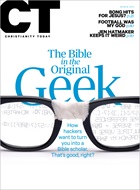
This just popped up in my Feedly... "Hacking the Bible: Inside the world of the new Bible coders—and how they will change the way you think about Scripture" You can read it online at Christianity Today. It's a really lively and fine article by Ted Olsen, a managing editor at CT.

Steve Smith, whose amazing work I've admired at OpenBible.info, is featured. They talk about the "Franken-Bible" project which I previously blogged about. There's a bunch of good stuff on Logos that's fun reading. I like Logos' Eli Evans' comment about what Bible tech is enabling: ""What we're doing here makes it very easy to run with theological scissors." I also think Logos' CEO Bob Pritchett is right when he talks about what technology enables. He says, "I like to follow rabbit trails. But I want curated rabbit trails. I want to be taken to places I'd never go to." I agree that hyperlinking is indeed an invitation to follow an endless array of rabbit trails. It's usually pretty fun, but it often leads to dead ends and is only occasionally helpful. So, yes, curated rabbit trails are needed, but even there we need to curate the curators.

There are some insightful concerns raised about atomization of the Bible (a 'vertical' reading enabled by Bible tech but one that loses sight of the context of a Scripture passage) and the role of biblical experts from the academy and the democratization of Scripture made possible by the Bible tech available at everyone's fingertips.

Ah, just read the article!

BTW, the article describes and links to Vincent Setterholm's (also at Logos) The Toracle: Oxen Law. That's a rabbit trail worth checking out for a bit!

HT: OpenBible.Info

"Presence and pixels: Some impacts of electronically mediated communication on Christian living" by Tim Bulkeley

Tim Bulkeley reports that his article, "Presence and pixels: Some impacts of electronically mediated communication on Christian living," has just been published at Review and Expositor (111,1, 2014, 56-63). I think you can read the whole article for free (at least for now) on the Sage site. HERE is the PDF. Here's the abstract:

The cultural changes we are experiencing as progressively more of our lives are digitally mediated provoke strong hopes and fears. Among many potentially striking impacts, new technologies offer new possibilities in mission. In particular, past difficulties in making good culturally appropriate Christian teaching available in developing contexts may be overcome. Yet we have hardly begun to adapt our thinking and Christian practice to this new world. The public reading of Scripture from tablets instead of print books has recently begun to provoke discussion. As well as practical concerns, the symbolism of such actions needs consideration. Christians understand these issues in the context of faith in God incarnate in Christ. Yet digital mediation raises questions about the incarnation of human contact. For all conversation is mediated, often by technologies. Some of these are familiar and so “invisible” as technology, like the acoustics of a church building, or writing on paper. Different media communicate a sense of the person communicating in different ways (sound, vision, directly, or with a time delay), and different people respond differently to these media. Our understanding of real presence needs to accommodate not only differing degrees of presence, but also different media preferences.
To give you my take on the article, I'll adapt a comment I left there.

Helpful facts, even more helpful reflection. As you might guess, I lean to the advantages (and inevitability) of the technological opportunities. Like Bulkeley , I don’t see it being a simple matter of one being better than the other. Rather, old and new media and forms of communication are simply different with inherent and potential strengths and weaknesses. To paraphrase John 4.20ff, our ancestors may have read and used the Bible the old way, but you say we must use the new technology. Which is it? The hour is coming, and is now here, when neither of those is really the point of the matter!

As for the part about the Bible, I’m imagining a day when it will be possible to have a microchip embedded in our brains. Would you choose to have a Bible embedded and instantaneously available just by thinking it? (Is this a fulfillment of Deut 6:8; 11:18 or Revelation 14:9?)

As for the communication part, Bulkeley does a good job of showing the potentials and pitfalls of technologically mediated forms. In my own experiences, I’ve had both good and bad. In part, as you noted at the end, it works to varying degrees with different kinds of people. But in defining “presence as a measure of the sense of relating to a real person,” I think one needs to consider both quality and quantity. I’m thinking of Facebook in particular. There isn’t much quality interaction there, but the frequency of it has enabled me to reconnect and ‘keep in touch’ with friends and even family that would have disappeared long ago. It also greatly improves the quality of interaction when we do have something substantive to discuss or, even better, are able to meet face to face. So, thanks again. I’m with him. (Figuratively and in a presence kind of way!) 
If you would like to comment on the article, go to Tim's page.

BTW, as another way I'm trying to communicate, I'll be offering a free MOOC in the fall of 2014 entitled "Survey of the Lands of the Bible." Within a couple months I'll say more about it on this blog, but I'm hoping to catch people interested in this new technologically opportunity.
Helpful facts, even more helpful reflection. As you might guess, I lean to the advantages (and inevitability) of the technological opportunities. Like you, I don’t see it being a simple matter of one being better than the other. Rather, old and new media and forms of communication are simply different with inherent and potential strengths and weaknesses. To paraphrase John 4.20ff, our ancestors may have read and used the Bible the old way, but you say we must use the new technology. Which is it? The hour is coming, and is now here, when neither of those is really the point of the matter!
As for the part about the Bible, I’m imagining a day when it will be possible to have a microchip embedded in our brains. Would you choose to have a Bible embedded and instantaneously available just by thinking it? (Is this a fulfillment of Deut 6:8; 11:18 or Revelation 14:9?)
As for the communication part, you do a good job again of showing the potentials and pitfalls of technologically mediated forms. In my own experiences, I’ve had both good and bad. In part, as you noted at the end, it works to varying degrees with different kinds of people. But in defining “presence as a measure of the sense of relating to a real person,” I think you need to consider both quality and quantity. I’m thinking of Facebook in particular. There isn’t much quality interaction there, but the frequency of it has enabled me to reconnect and ‘keep in touch’ with friends and even family that would have disappeared long ago. It also greatly improves the quality of interaction when we do have something substantive to discuss or, even better, are able to meet face to face.
So, thanks again. I’m with you. (Figuratively and in a presence kind of way!)