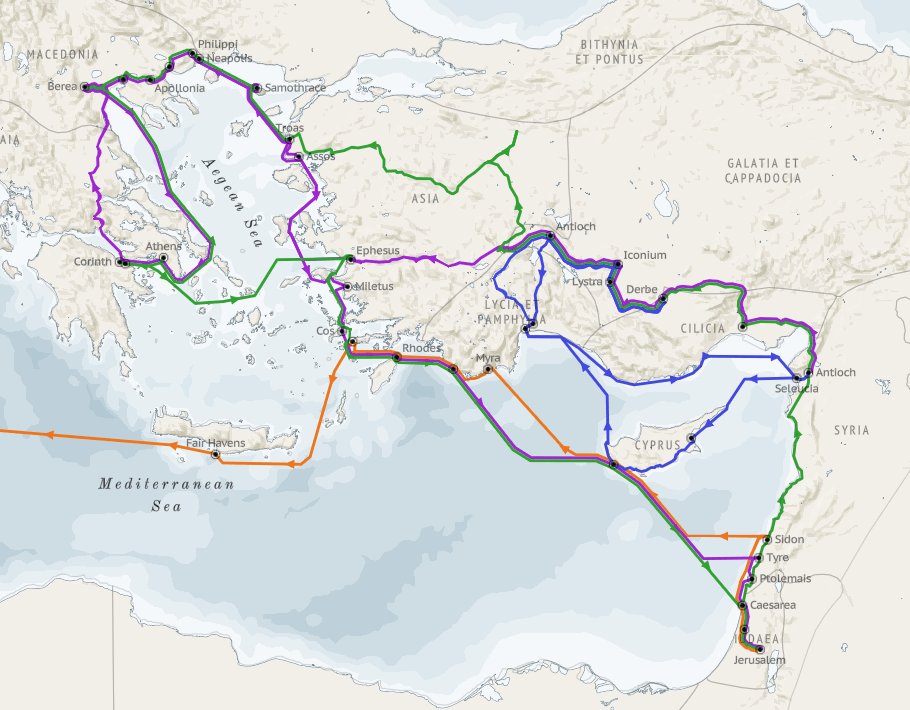

HERE is the Rouse's blog post describing the work he did in creating the map, and while you're on the VizBible site, be sure to check out the other visualizations he's created.
HT: Tim Bahula on Twitter
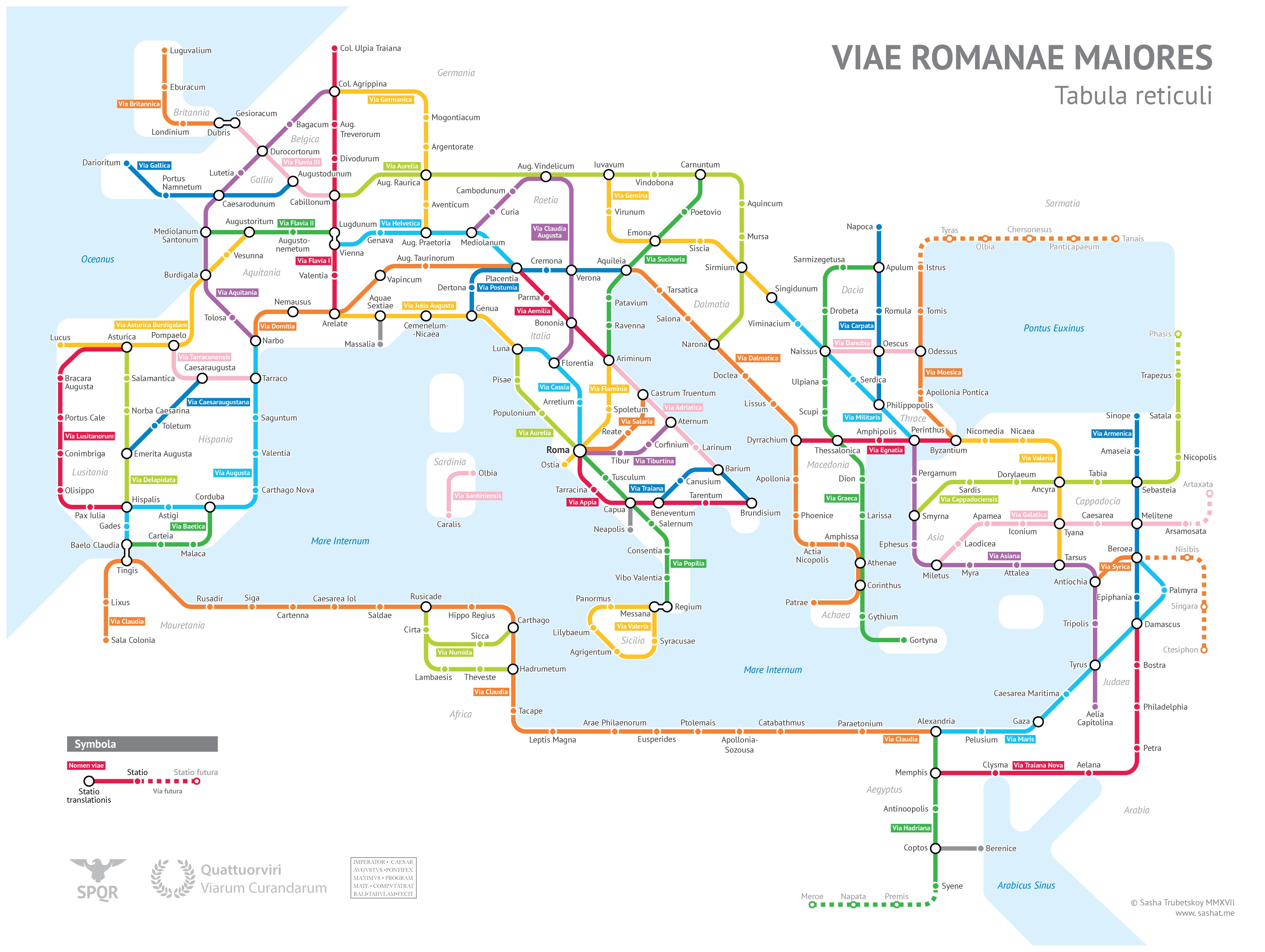 |
| https://sashamaps.net/docs/maps/roman-roads-original/ |
Creating this required far more research than I had expected—there is not a single consistent source that was particularly good for this. Huge shoutout to: Stanford’s ORBIS model, The Pelagios Project, and the Antonine Itinerary.That's a great use of those online mapping resources! (You will certainly want to check out both the ORBIS for ancient travel planning and the Pelagios site for a very detailed map.) He had to make a number of compromises, and he did not include sea routes, but it still provides a fun and helpful overview. (The map supplied on the site is quite large, but Trubetskoy can send a more detailed version via a Paypal link.)
A guest post by Tim Bahula, ardent Logos user
The Bible software showdown continues! When I read Rod Decker's article on finding complex sentences in Mark using Accordance, a spark was kindled. But not having a particular interest in complex sentences, in Mark, or in Accordance, it faded. When I read MVGH's article on doing the same search in Bibleworks, I knew that I need to try my hand at it in Logos.
Even though I've heard rave reviews about using Bibleworks for biblical research, my only experience with it was just after I completed my M.Div. in 1992. At the time I was a poor struggling graduate and couldn't justify the expense of Bible study software. When I had money a few years later, I purchased Logos Bible software and have since made a significant investment in adding library resources. So I want to make it work.
My search approach was spawned by a comment made by Mike on MVGH's entry. He suggested,
"I do think it could be done with a graphical query though, since Logos also allows crossing verse boundaries."

Do not be dismayed if it looks like you only get one hit! Click on "Concordance at the top right of the box, then sort "By reference." The verses listed indicate the end of a sentence just prior to a sentence with 50+ words. (Note Vincent's observation above about 'words' in in the graphical query editor. I.e., there will be some sentences with less than 50 words.)My method described above avoids all of these problems except for the "word" count problem inherent in Logos. MVGH also highlighted the way that Logos handles the semi-colon, which will affect the results returned.
Now click on one of the references to open up the NA27 text.You will have to scan through the results, but note that there are colored markers to indicate the major stop before a long sentence and a different colored marker at the end of the sentence. (emphasis added)
True confessions here...
I started blogging over a year ago just to figure out what this blogging business was about and whether it had any value for my teaching. As I continued blogging, I found that I have been focusing on a number of areas:
As you can see from this survey, this blog is not really intended to be a discussion-generating blog, but it has been a neat way to make contacts with a number of others in these fields. I am grateful that Tim Bahula has provided some guest entries. This blog has also provided connections for me with people like Tim Bulkeley at SansBlogue, Todd Bolen at BiblePlaces.com, David Barrett of BibleMapper fame, the remarkable James Tauber (the person behind MorphGNT), Rick Brannan and others at Logos, the BibleWorks wizards Michael Hanel and James Darlack, and many others.
NOW, for the point of this post: As I mentioned in the anniversary survey post, I have been keeping up this blog as part of my sabbatical work. I have developed an unsustainable lifestyle of posting about 4 times per week, so once I am teaching again, that will have to be cut back.
BUT, does this blog 'count' for real academic work? My seminary has been very supportive of my technological interests, but at the same time, my postings on this blog are not valued in the same way as if I had been busy instead writing articles and publishing books (though I am trying to do that too!). Take a look at this section from our faculty handbook that describes one aspect of how faculty performance will be evaluated.The following sources and criteria for evaluating a faculty member's professional development shall be used:
Does this blog constitute acceptable "publication"? Does it count as "research"? Do the interactions with other scholars who read this blog serve as "participation" in the scholarly community? Do the few comments my posts generate function as "peer review"?
I suspect that those of you who are even of the sort to be reading a blog like this (and reading this far into a blog post like this) are fairly sympathetic to my hopes that this blog 'counts' as real research and publication. I don't know what kind of numbers publishers hope to attain when they publish a book or journal, but over the last month or so, this blog is averaging about 100 visits per day and about 2 pageviews per visit. A blog entry may be a rather shallow form of engagement, but that readership seems fairly wide to me.
Bottom line: When I write up my post-sabbatical report, how much emphasis should I place on the work I've put into this blog? What are the rest of you doing when asked to give an account of your work?
I started this blog a little over a year ago as an experiment. I wasn't too sure about this whole blogging business back then, but I would say that over the course of just a year, blogging has become a commonplace on the web. It's a format that is here to stay. I suspect, however, that just about as many blogs are dying as new ones are being created. It seems to me that the ones that last will fall into one of three categories:
Thanks to Tim Bahula for contributing this post!
In the Greek Logos newsgroup, Terry Cook asked this question:
I answered by a suggesting a syntax search. Terry wondered,While digramming Galatians 5:8 I've come across a construction I haven't seen before: a preposition followed by a participle, i.e., a participle that is the object of a preposition.
Having not encountered this construction previously I attempted to search for its frequency... without success.
Would someone please explain to me how to find this?
While I can't hope to answer the question for all cases, I intend in this post to demonstrate why a syntax search is the preferred method for finding a participle as object of a preposition.Is there a short video or some written tutorial instructing the Libronix user on how to determine when to use a "syntax search", a "graphical query", and a "morphological Bible search"?
Before the advent of syntax searches, a morphological search was the best choice for trying to find this construction. In this first video clip (view it here), I use a morphological search. The "[=P] before 1-2 words [=V??P-???]" search returned 752 occurrences in 365 verses, including Gal. 5:8. But it also returned Gal. 5:6, where the participle is in the nominative case and is not the object of the preposition.
I realized after I recorded the video that the morphological search could be refined to exclude the nominative and vocative case. The "[=P] before 1-2 words [=V??P-?[GDA]?]" search returned 406 occurrences in 197 verses. However, there are still results returned where the participle is not the object of the preposition, such as Gal. 3:23. The problem lies in the proximity constraint. It is simply not possible to open the window wide enough to catch all occurrences without making it so wide that it includes occurrences that don't really fit the criteria.
In the second video clip (view it here) [UPDATE: link fixed], I explore using a graphical query (right-click, "save target/link as..." to download Preposition Participle refined.lbxqyg) to search for the construction. The results are the same. The upside is that the results are returned faster when using a graphical query, the downside is that creating the query is not as intuitive as creating a morphological search.
Finally, the third video clip (view it here) explores using a syntax search (right-click, "save target/link as..." to download OpenText- participle as object of preposition.lbxstq) to find the construction. The easiest way to create the syntax search is the mimic the structure of the example. The search results include 113 occurrences. I have not verified them... yet. It would be interesting to see if any legitimate results from the morphological search are missed by the syntax search. The downside of the syntax search is that it takes quite a bit longer to return the results... on the other hand, it beats having to weed through false positives.
The syntax search is a great tool to use when searching for words that must be in a certain relationship and there may be intervening words. It seems that the documentation is still weak. Learning to construct the queries takes some practice and the Logos website has some good examples of creating syntax searches.
I'm pleased to have Tim Bahula, a missionary in Trinidad & Tobago, as a guest blogger. He figured out a clever way to create a 'graduated' reader in Logos3. Thanks, Tim!
Following BibleTech:2008, I read (and watched) with some interest James Tauber's work on creating a "new kind of graded reader". It caught my attention because I'm teaching first-year Greek for the first time at the Baptist Seminary of the West Indies where I'm Principal. I decided to use the popular Mounce BBG method. But most of the students are struggling, mainly because they haven't applied themselves, but also because they haven't seen much of a pay off yet. I'm looking for ways to increase that pay off.
When I saw Mark's post about "Creating a 'Graded' Reader in BibleWorks7 (and Logos?)",
I have been searching, but I can't figure out to create a similar sort of highlighted text in Logos. Perhaps one of the Logos experts can show the way...I knew I needed to try my hand at it. I have heard of the wonders of BW7 from some of my friends and watched as Mark whipped that 'Graded' Reader together. But I am a Logos user, have been for nearly 10 years, and don't own BW7. So I need a made-in-Logos3 solution. I don't consider myself an expert, but have learned some things over the 10 years through experimentation and reading the Logos newsgroups.


Verse:
John 3:16; Jn 3:16; John 3
Keyword:
Salvation, Jesus, Gospel
With Operators:
AND, OR, NOT, “ ”


