Monday, November 17, 2008

REVIEW: QuickVerse 2009 Standard & Parsons Bible Atlas

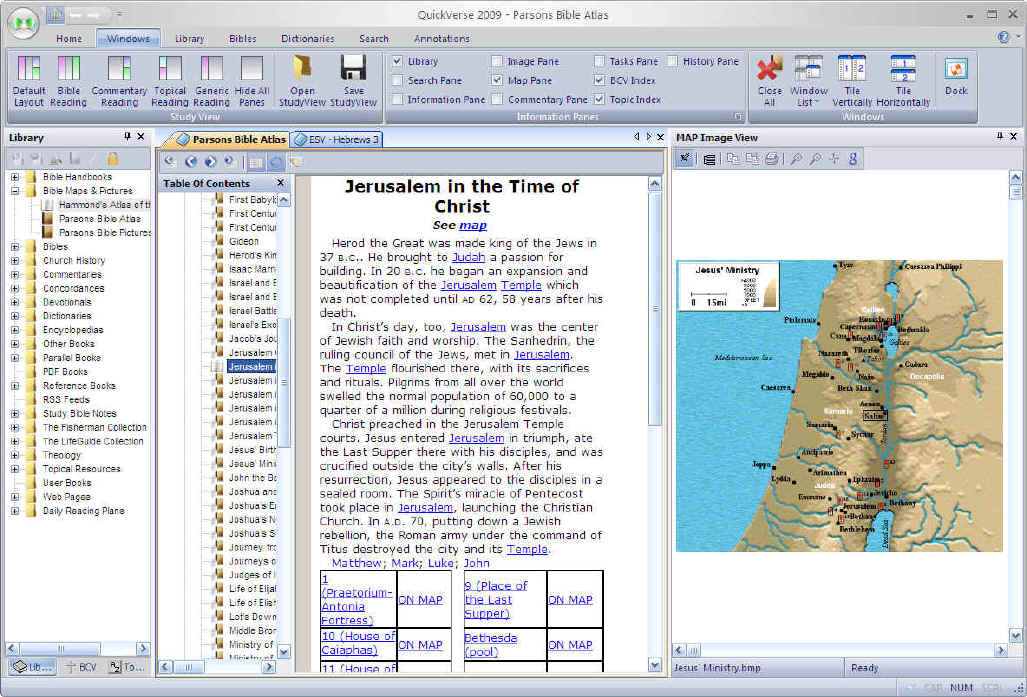
I have posted a full review of the recently released QuickVerse 2009 Standard edition. The main focus of the review is on the mapping resources within the new QuickVerse 2009 for Windows program, namely, Hammond's Atlas of the Bible and especially the Parsons Bible Atlas (2nd ed.). Especially of note in this release is the integration of the Parsons maps with Google Maps online.

Sunday, November 16, 2008

Accordance & BibleWorks (and Logos?): Searching for long, complex sentences

Rodney Decker has a fascinating blog entry entitled, "A note on complex sentences in Mark’s gospel." It's interesting, first, because he was noting complex sentences which are not the norm in Mark's gospel with its paratactic style. It's interesting, second, because he had to figure out how to find long sentences with the Accordance software he uses. David Lang from Accordance provided the steps needed to construct such a search which looks like this:
Linked to the construct tab is this GNT-T tab. As you can see the results are easy to spot, and they were returned quite quickly.
That was an interesting challenge, and I was trying to figure out how to run such a search in BibleWorks7 with which I am more familiar. I came up with two ways, and they are interesting for figuring out the capabilities of the Graphical Search Engine.
1) In the first search, the trick was to enable the cross verse boundary search (found in the GSE under Query > Properties > Flags tab > check "Cross verse boundaries"). In the ordering mode box, I required custom punctuation of a Greek period or question mark. Here is the QF file if you want to download it and run it for yourself. (Save it to the ASE subdirectory, and be sure to set a range to a single Bible book before you run it.)And here is what the results look like for the Gospel of Mark.
You can see that you have to scan through the whole gospel and look for instances where the highlighted words, which mark first and last words of sentences, are furthest apart.

2) In the second search, I took the opposite approach. I again used the cross verse boundary search, but I somewhat arbitrarily asked for between 50 and 100 words where there was not a period or question mark. Hence in the ordering mode box I excluded those markers. Here is the QF file to try it for yourself.The results look like this. You need to ignore the highlighting because of the word range search I did, but you can see that the search results are exactly the passages that Decker found and commented upon.I suspect there is another way to do this in BibleWorks using Range Filters (in the word boxes), but I couldn't get that to work. If you find a better way, please share it here or on the BW forum.
I'm still learning the intricacies of Logos3, but I'm guessing there must be a way to do such a search using syntax search. If someone figures that one out, please share it here!

Saturday, November 15, 2008

NLT Study Bible

The previous post noted the availability of the ESV Study Bible in a variety of digital formats. It's only fair then (as a commenter noted to that post), to draw attention as well to the NLT Study Bible. Purchase of a hardcopy edition entitles the owner access to the full online version. As Keith Williams from Tyndale House noted:

Anyone can get free access to the complete contents of the NLTSB online for 30 days, and buyers of a print edition get lifetime online access. The initial digital offerings also include Libronix, WordSearch, and Laridian.

If you are going to be at ETS or SBL later this month, stop by the Tyndale booth to get a free code to download the Laridian version.
(I added the links.) Check it out.

Thursday, November 13, 2008

ESV Study Bible on Digital Platforms

According to the ESV blog, their new study Bible has been selling extremely well. I don't plan to get it myself, but I like the idea that buying a hardcopy gives you the ability to access it online and save notes, highlighting, etc. What's more, according to a recent announcement:

Crossway is pleased to announce the forthcoming release of the ESV Study Bible on a wide spectrum of digital platforms, including Mac, PC, Windows Mobile, Palm, iPhone, Blackberry, Google Android, and Symbian.To achieve the widest possible digital distribution, Crossway has partnered with the leading digital software providers, including Accordance, Biblesoft, Laridian, Olive Tree, and WORDsearch, to make the ESV Study Bible available with all of its notes, articles, and features.
I'm not enamored with the translation, and the study notes do reflect an acknowledged 'conservative' perspective, but I do commend them for their business model. Crossway has been giving away the text for free on the Internet and encouraging its usage online, but they are demonstrating that even doing so, one can still run a viable and profitable company. With access to the text only (but with the ability to add notes and highlighting), check the ESV online here.
UPDATE: Some have noted that Logos is not on the list of software providers. From reports on the Logos forum, they are working on getting rights for the ESV Study Bible in Libronix format.

Wednesday, November 12, 2008

Ancient Rome in 3D in Google Earth

This is very cool. Using layers in Google Earth, ancient Rome has been recreated in 3D. Structures are also tagged with more information. Check out the announcement on the GoogleEarth blog and download it as soon as it becomes available. For now, check out the preview video.


I'd love to see similar treatments for Jerusalem, Athens, Ephesus, and Corinth.

Tuesday, November 11, 2008

Blog Typealyzer

Totally off topic, but fun enough and preternaturally accurate, I think...
Enter your blog URL at Typealyzer, and it will determine the Myers-Briggs profile of the blogger. I think it got me right as an INTJ for this blog. (For my family blog, it more appropriately determined an ESTP personality at work!)
HT: Downes

Thursday, November 6, 2008

Logos for Mac ready for pre-orders

Logos has just announced that the Mac version of their Bible software is now available for pre-ordering with anticipated shipment by Christmas. Check out the video on the linked page.
Though built from the ground up as a Mac program, it certainly looks similar to the Windows version. Pricing is the same as well. Note on the bottom of the page that users can crossgrade simply by buying the Mac engine. (There is also a way to get it for free.) Your current library of resources can be transferred over without additional cost.

Israel Road Maps Now Viewable in Google Earth

Google Earth is a great mapping tool. One longtime deficiency that indirectly affected its value for biblical studies was that there were no road maps for Israel. This has just recently been remedied. To see the roads, enable "Roads" in the Layers menu. A couple ways that it helps:

  • It makes it easier to figure out where you are/were when you are/were traveling in Israel.
  • You can apply map overlays to compare ancient and modern roadways. In the graphic above I have done just that. Of course the modern maps of the ancient roadways are somewhat imprecise, but this should allow greater clarity. Since the transparency of map overlays can be adjusted in GoogleEarth, you should at least be able to see in the graphic that the ancient north/south trunk road is a major north/south road still today.
(HT: GoogleEarth blog)

Monday, November 3, 2008

Google Book Search Lawsuit Settled

Dan Cohen provides a helpful summary of the resolution of the Google Book Search lawsuit. Here's my summary of his summary and my reading of the Google statement:

  • Google was sued by authors and publishers for copyright issues in their digitizing of books.
  • Google now has permission to work with authors and publishers on making previews available of in-copyright books with possibilities for actual book sales or subscription service viewings.
  • This is especially useful for in-copyright but out-of-print books.
  • This agreement will also be a boon for research since rights are being granted to search all the digitized books. It appears that this is what SBL has done in allowing all its books to be searched. (Cf. this post from a few days ago.)
All in all, very good news for readers and researchers.

Another Zotero Update

This is great news as reported by Dan Cohen: your Zotero data can now be synchronized across the net. That is, you can work on multiple computers and keep your Zotero data and notes in sync. They've also added rich text editing. Do note that this is a preview version with potential of loss of data. (So far so good for me.)
BUT... Thomson Reuters, makers of the commercial EndNote program, have filed suit against George Mason University claiming that Zotero has reverse engineered the coding for the bibliographic formatting. (The Zotero project is based at the University’s Center for History and New Media.) Here is the George Mason University official response. I'm cheering for Zotero and their open source approach on this one.

Digital Biblical Mapping Resources Presentation at SBL

I'm looking ahead to the SBL meeting in Boston in a few weeks. The full listing of programs is available here. Douglas Mangum at Biblia Hebraica has started pulling together a list of bibliobloggers who will be presenting. I hope he will add mine to the list:

Computer Assisted Research - 11/24/2008
9:00 AM
Room: Meeting Room 307 - CC
Theme: Digital Resources for Research and the Classroom
Mark G. Vitalis Hoffman, Lutheran Theological Seminary at Gettysburg
Digital Resources for Biblical Maps and Mapping (30 min)
I've blogged quite a bit about digital biblical mapping resources, and this presentation will be an updating and a condensing of the presentation I did in January 2008 for BibleTech08. If you know of a great resource in this area that isn't listed on this page, please let me know. I also would like to hear of specific qualities or features you are looking for in maps. Why do you like/use some maps instead of others? What makes a map good or useful? Thanks for any comments.

If you plan to be at SBL in Boston, I would love to meet in person some of you who read this blog!

Friday, October 31, 2008

Search Full Text of All SBL Books

I had not noticed this before, and it looks to be a new feature on the SBL (Society of Biblical Literature) web site. It is now possible to search the full text of all SBL books. (If I have discerned correctly, there are over 1100 SBL books.) You do not need to be a SBL member to have access to this tool. Go to the SBL publications page and scroll down to the bottom where you will see this box.

Search the Full Text of all SBL Books

If you have used Google book search, the results will look familiar. I couldn't find any results that were more than limited preview, but this is still a great tool for doing research and finding references in a corpus that is specific to the field of biblical studies.

Monday, October 27, 2008

Google Earth on iPhone / iTouch

I've long admired the achievements of Google Earth, and now it is available to run on an iPhone/iTouch as a free app.

Check out the video, and follow the links from the Google Earth blog post to find out more and get it installed. Now you can check out those biblical sites anytime/anywhere...

Saturday, October 25, 2008

The Four Most Influential Literary Works...

... that I have read other than the Bible. This is not a technology oriented post, but the question seems to arise regularly about the best things I've ever read. There is plenty of wonderful literature (Lucian, William Blake, Mark Twain, Frederick Buechner, JRR Tolkien, CS Lewis, John Irving...that list should be some indicator of my tastes), but there are only a few books/articles that have really changed my way of understanding. You will see that the Abraham/Isaac story in Genesis 22 and issues in the life of Jesus have been important dialogue partners for me that have truly shaped my faith and overall perspective. Other than the Bible (and within the Bible, Genesis, Mark, Romans, and Philippians are my 'canon within the canon'), I return to the following works:

  • Erich Auerbach's essay "Odysseus' Scar" in Mimesis (online here and a summary here): This essay is somewhat of a challenging read, but Auerbach compares the fully foregrounded, fully explicit narrative of Homer with the "fraught with background," enigmatic nature of Genesis 22. The result: "The Scripture stories do not, like Homer’s, court our favor, they do not flatter us that they may please us and enchant us—they seek to subject us, and if we refuse to be subjected we are rebels." A profound reflection on the way that biblical narrative creates (demands!) a faithful reader.
  • Soren Kierkegaard's Fear and Trembling: Kierkegaard explores that enigmatic background in the Genesis 22 story described by Auerbach by providing four brief scenarios to fill in the gaps. These serve as a springboard for his subsequent reflections on faith and his descriptions of the "knight of faith," the "move of infinite resignation," and the paradoxical "leap of faith."
  • Albert Schweitzer's The Quest of the Historical Jesus (also available as a free downloadable PDF ebook here): Schweitzer was not only a remarkable physician and humanitarian, he was also a world-class musician, philosopher, theologian, and biblical scholar. After reading his Quest, one may not agree with Schweitzer's conclusions, but his critique of what often passes as biblical scholarship should humble and caution anyone who wants to makes assertions about the historical Jesus.
  • Fyodor Dostoevsky's The Brothers Karamazov and the chapter on the "Grand Inquisitor" in specific: The heart of this epic novel is the "Grand Inquisitor" chapter which can be pretty much read on its own with a bit of introduction. Since my students never need to read it anytime else in our MDiv curriculum, I make it required reading in my Gospels course as we talk about the temptation of Jesus by the devil and the implications this has for ministry today. There is so much truth here... I think it is a critical reflection piece for those serving in ministry who are so often tempted--usually out of a sense of care and concern--to make the Gospel "manageable."
So, what other classics do you recommend?

Thursday, October 23, 2008

Gaggle of Search Engines Update

In a previous post, I described a variety of search engines beyond Google. After some more time spent using them and after improvements on some of the sites, here's a quick update using one I kind of like, Searchme.com. (Move the little blue slider to see the other sites.


SearchmeView in searchme: full | lite
Comments after comparing results on a search for "accordance bibleworks logos."
  • One addition to the earlier list: Middlespot provides both a text and thumbnail view of site results, but what is interesting is that it lets you create a "workspace" to store a bunch of sites you want to investigate further. Page rendering is a bit jerky, but it's a decent idea. (Note that a similar effect is available in Searchme using 'stacks' and in Viewzi using the Power Grid view.)
  • Searchme Lite is, as you may guess, a lite version of Searchme that suggests categories as you begin typing your search.
  • As much as I like Searchme, it turns out that your stacks are stored in a Flash cache on your computer, and if you clear your cache... I discovered the issue the wrong way. They report they are working on fixing this problem.
  • Viewzi has added additional views. You now can choose between these views: Web Screenshot (using Yahoo results), Simple Text (using Alexa, Yahoo, Google), Power Grid (using Yahoo, Google), Google Timeline (uses Google and charts by recency), Site Information, 4 Sources (using Ask, Yahoo, Google, MSN), a bunch of photo views, and a number of others oriented to searches for books, music, etc.
  • I am also finding uses for the Firefox plugin, Ubiquity, I described in the previous post. There are some neat things you can do by highlighting text and then activating Ubiquity. Another option I'm using is the Hyperwords addon for Firefox which works via mouse rightclicking.
BOTTOM LINE: I'm still mostly using Google for quick searching. I'm occasionally using Searchme and Viewzi for the additional capabilities they offer such as storing stacks and having multiple views. If I can't find what I want, then I move on to Yahoo or LiveSearch. (If you are searching for online books, however, do check this Online Book Search posting.)
BONUS: With two teenage daughters, we pretty much had to go with an unlimited text messaging plan. If you are not paying for each text message, you really ought to check out the Google SMS service. It is a fantastic way to have weather, movie times, directions, definitions, translations, price checks, etc. available to you on your phone.

Tuesday, October 21, 2008

Fun Tools for Learning Greek

On Nijay K Gupta's blog, he describes a Kuklos Eudaimonias (Wheel of Fortune) game he is using to teach Greek. He also asked for some other such fun tools for teaching Greek. Some suggestions:

If you have other good stuff, share it here or over on Nijay's blog.

*Harry Potter and the Philosopher's Stone

Saturday, October 18, 2008

Logos Sermon File Addin - Free

As part of Pastor Appreciation Month (i.e., for a limited time), Logos is giving away a free copy of their Sermon File Addin. It is a great way to organize sermons and illustrations by providing integration within Logos and links to any Bible passages cited. Logos states:

The new Sermon File Addin plugs right into Logos Bible Software and provides a way to store, organize and search your sermons and illustrations. As you enter or import your sermons and illustrations, they become a full-fledged Libronix book in your digital library. Your sermons and illustrations show up in Passage Guide. And you can open, browse, search, KeyLink, and mark up the text just like you would any other Logos book!
If you don't have Logos but want to give it a try and see what the Logos program is like, get the free eBible starter from Nelson, set up an account at Logos, and download/unlock the Sermon File Addin. One thing to note that has been a subject of criticism on the Logos newsgroup: when you compile your sermon, the default setting is that it is also published to Logos' database. (See the circled item on the compile screen.)
Regarding this, Logos states:
Select this option in order to submit this sermon to the Logos Sermon Database. Our plan is to make submitted sermons available through a future web service, or an existing online sermon database. By submitting your sermons and illustrations to the online database you grant Logos Research Systems, Inc., and its assigns, a perpetual royalty-free, world-wide license to republish your sermon or illustration. You also create an opportunity for others to benefit from your study and teaching. We will never publish your sermon without attribution.
Hmmm... not so sure I want to grant Logos a "perpetual royalty-free, world-wide license" for my sermons and illustrations...
In any case, it's still a great deal. Thanks, Logos!
(You may need to use the code - PAM2008 - to get it for free.)

Thursday, October 9, 2008

Books to download: ICC Commentaries

Charles Halton > Charles Savelle at BibleX > Rod Decker at NT Resources
If you follow that chain, you will end up at Decker's NT Resources site where he comments on the older, now-out-of-copyright commentaries in the ICC series available for free download on the Internet Archive. As he notes there, they are dated, but they often have worthwhile comments on grammar and syntax. I concur with his recommendation to download the black/white PDF versions. Decker provides a list of the NT commentaries, so check his site. I provide here a list of the OT ones that I found. There are 2 or 3 links for some of the books, and I am not sure why. They look to be scans of the same book, but files sizes are often different. If someone can confirm they are the same or recommend the scanning sequence that appears to be best, let me know, and I will thin out this list.

Thursday, October 2, 2008

NRSV iPhone App now available

Christian Classics Ethereal Library (CCEL) announces that the NRSV is now available as an iPhone app. Cost is $11.99. It comes with 3 devotional books and either with/out the Apocrypha. Read the full announcement, but here are the highlights:

With the NRSV Bible, all of the standard NRSV features are supported including the notes. The app remembers your previous location so you can immediately pick up where you left off. Navigation is easy through the hierarchical table of contents. Scripture references are linked, so you can view the passage in a slide-up window. All books are included in the original install, so you don’t need an Internet connection to use the application.

Coming soon: the ability to download and install books from the Christian Classics Ethereal Library, search capabilities, and more. Get it now at a special introductory price, with no charge for upgrades to later editions.

Wednesday, October 1, 2008

Zotero - Major Feature Updates

More reasons to like Zotero even more as your bibliography management tool as reported on Dan Cohen's blog... As he notes, you can now check out your Zotero library on any web browser including those on iPhone or iPod Touch.
In addition, the Zotero 1.5 SyncPreview 2 now offers a way to sync your library across the web, retrieve metadata from PDFs and more.