

Sunday, April 5, 2020
Unicode Fonts for Ancient Scripts


Friday, April 3, 2020
Virtual touring and museum visting while quarantined...

- Peirene Fountain in Corinth
- Lots of stuff from Ephesus
- Damascus Gate in Jerusalem
- Bethsaida (et Tell)
- Capernaum Synagogue
Enjoy!
Digital Maps of the Ancient World

The Digital Maps section is useful for those studying Ancient History and Archaeology, who would like to gain a better understanding of certain sites or where certain events took place. The Pompeii Map is also useful for those studying the Cambridge Latin Course.From a biblical perspective, the most interesting sections are the Ancient Maps and the Digital Maps. For example, this one on provinces of the Roman Empire with clickable info popouts.
The Mythology section is useful for those studying Greek and Latin who would like to understand the mythology behind the translations and those who have an interest in Ancient History.
For those studying Greek and Latin at school, there are dedicated languages sections with resources for grammar and vocabulary for the various UK examination boards, particularly for Common Entrance. The Greek Mythology and the Recommended Reading (Historical Fiction) and Media sections will help with understanding the cultures behind the languages.


The Qumran Texts Composite Edition from Elisha Qimron - Open Access and Downloadable


Thanks to Qimron for making this work available, and note that it should be cited as:
Elisha Qimron. (2020). The Qumran Texts: Composite Edition. Zenodo. http://doi.org/10.5281/zenodo.3737950
And not to neglect Greek and Latin readers, remember that I had previously noted that all the Loeb's in the public domain are available for free download too!
HT to Reed Carlson and IOQS - International Organization for Qumran Studies on Facebook
Friday, March 27, 2020
Ancient Theaters, Amphitheaters, Stadiums, and Odeons in Turkey

If I were to quibble at all about the map, I think a distinction can be made between a stadium / stadion and a hippodrome, the former for footraces, the latter for horse and chariot. Technically, I think it's a hippodrome in Istanbul (Byzantium) that is near the Blue Mosque. The stadium at Aphrodisias is so huge that I can imagine horses there, but it doesn't seem to have the starting posts or center spine as hippodromes would. For those who have traveled to Israel or Jordan, there are fine examples of hippodromes at Caesarea Maritima and Gerasa (where races are still held for tourists). Of course the most famous hippodromes is probably the Circus Maximus in Rome. (On a personal note, I have fulfilled one of my bucket list items of running at all four stadiums of the Panhellenic Games cycle: Olympia, Delphi, Isthmia, and Nemea.)
As for theaters, the one in Ephesus is one of the largest in the ancient world, capable of holding up to 25,000 spectators. The one in Aspendos is one of the best preserved. The one in Pergamum is the steepest. There is a full list of Roman theaters in Wikipedia. I suppose that can be someone's project to map all those along with the list of ancient Greek theaters!
Wednesday, February 26, 2020
Smithsonian releases 2.8 million+ images that can be used for free


If you find something really interesting, please let me know!
Tuesday, February 25, 2020
St. Catherine Monastery Icons Now Available Online
 |
| http://vrc.princeton.edu/sinai/files/original/6451/0154.jpg |
This website displays all the color transparencies and color slides in the possession of the Department of Art and Archaeology at Princeton. The online images are limited to a size of 1024 pixels. These images are available to download and use for teaching and scholarly purposes.There are 1294 images, and they can be browsed by tag or searched.
BTW, the center image crop at the top is the oldest and one of the more famous images of Christ Pantokrator from the 6th century. Quite a few years ago, I was puzzled by the sort of side-eye Jesus had in the drawing, so I did a little image manipulation to mirror the two sides of his face. It highlights that Jesus is being depicted both as Savior and Judge. I've since discovered that I'm certainly not the only nor first to recognize this, but if someone has a link to the 'rules' of iconography that detail this aspect, please share. Also, at least in the crude way I composed the two images, it sure looks like a dove on the neck of Jesus on the left and a lion on the one on the right. Is that my imagination, or is that also a part of the iconographer's intent?
Monday, January 27, 2020
Mapping Time
 |
| "The Temple of Time" (1846) by Emma Willard — Source (Cartography Associates: CC BY-NC-SA 3.0). |
The article is worth reading, and Willard's mappings of time are remarkable. Consider "The Temple of Time" pictured above. (Click HERE to see it with full magnification possible, and you really do need to zoom in to see all the detail.) It's interesting enough that history is organized by Statesmen, Philosophers, Discoverers, Theologians (in the center position of prominence!), Poets, Painters, and Warriors. Also note, however, the way history is viewed. As Schulten writes, "Emma Willard sought to invest chronology with a sense of perspective, presenting the biblical Creation as the apex of a triangle that then flowed forward in time and space toward the viewer." While creation is the apex, there still is the sense that the further back in time things are, the less prominent they are in present memory.
 |
| Detail from "Picture of Nations; or Perspective Sketch of the Course of Empire" (1836) by Emma Willard — Source (Cartography Associates: CC BY-NC-SA 3.0). |

Understanding New Testament Greek grammar for Accordance

TLDR: Due to changing seminary requirements, I have needed to teach Greek in a single semester for a few years now. It's impossible to teach anyone to read Greek in that time, so I teach students how to understand Greek grammar, syntax, and lexical possibilities. The only way to do this is to use Bible software. I've developed a visual way of color coding the text that links to the grammar. E.g., you see something in gold (which means an indicative verb), and you look for the gold section in the grammar to see the range of translating indicatives.
I hope you will check it out! For now, it's a quick download into Accordance, and it's on sale!
If you just want to see how the highlighting works without buying the grammar, HERE is the highlight file. After unzipping, put the HLT file in your Accordance Files\Highlights subdirectory, and it will appear as an option in Accordance when you open the Highlighting tool.
BiblePlaces.com celebrates 20 years!

While at BiblePlaces, also check out his blog with weekly updates of info related to the Bible, archaeology, mapping, museums, and more. Better yet, just sign up for his newsletter!
Congratulations to Todd Bolen and the others at BiblePlaces for 20 years!
Friday, January 24, 2020
Hoplite Polytonic Greek Keyboard for iOS and Android
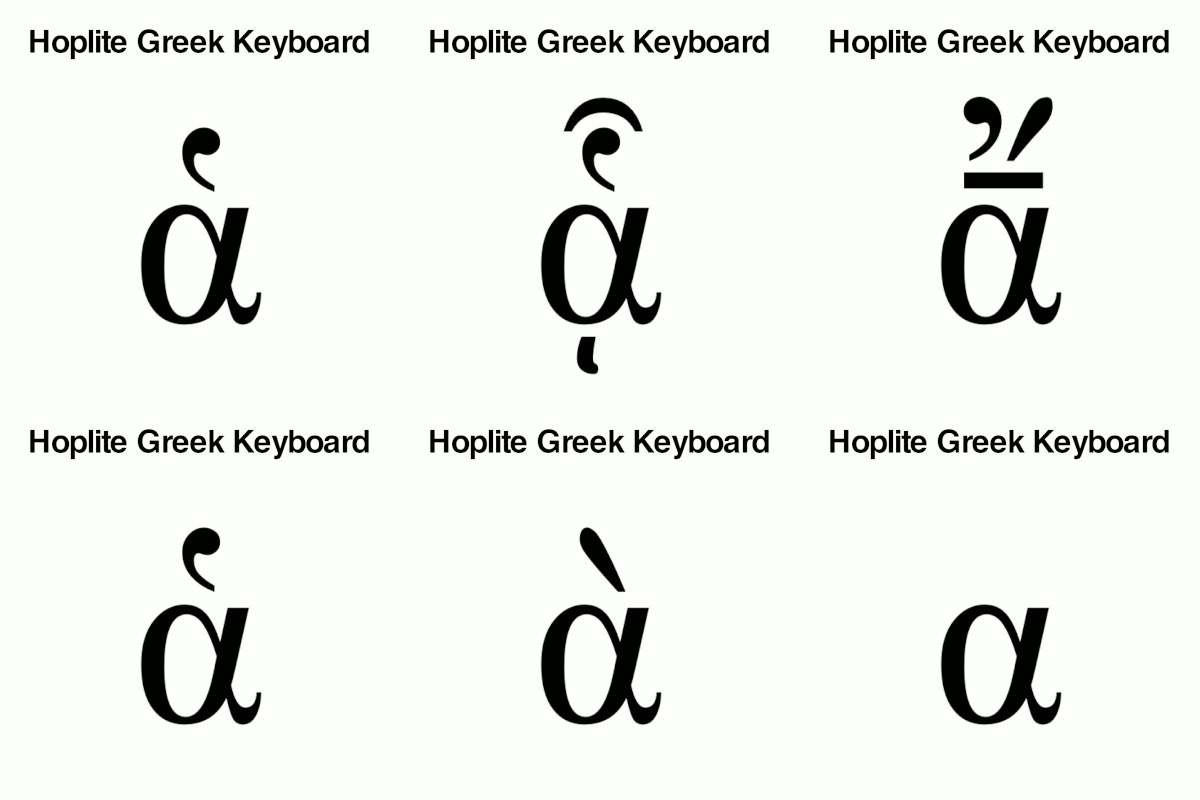
The Hoplite Polytonic Greek Keyboard facilitates typing polytonic Greek diacritics. On iOS and Android, the Hoplite Keyboard can be installed as an alternate keyboard system-wide and used in any application. On Mac, Windows, and Linux the Hoplite Keyboard can be used as a LibreOffice extension: type base letters with the Greek keyboard provided by your operating system and toggle on/off diacritics with the Hoplite Keyboard's hot keys.I have used the Keyman Galaxie Greek/Hebrew (Mnemonic) Keyboard for my Greek and Hebrew typing, but it looks like this Hoplite program is a good option if Keyman is not doing what you need. Like Keyman, Hoplite is also free.
Features:HT: Anglican Biblical and Theological Languages Forum on FB
- One key per diacritic
- Add diacritics after typing the vowel
- Add diacritics in any order
- Toggle diacritics on/off
- Breathings, accents, subscripts, macrons, breves, diaereses: no problem! (If font supports it)
- Choose precomposed, precomposed with private use area, or combining-only Unicode modes.
Tuesday, January 7, 2020
More biblical text visualizations
I love these kind of visualizations. How helpful are they? I'm not sure, but they do provide a big picture perspective of relationships between the biblical texts. I'm pulling this from this thread on Twitter.
The first is by Cody Kingham who writes:
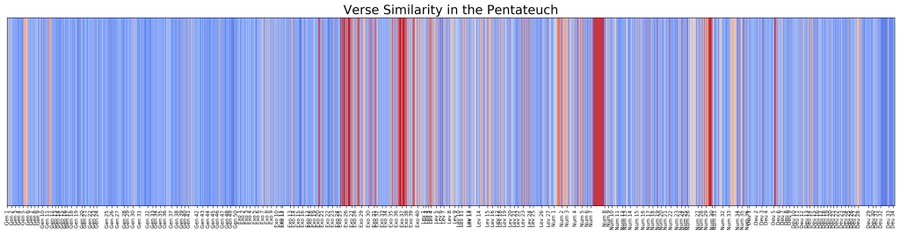 Also in that Twitter thread, Camil Staps writes:

The first is by Cody Kingham who writes:
Formulaic Language in the Pentateuch
In reading through the Pentateuch, I've noticed that several sections contain a lot of repetition. This formulaic language seems to serve as a way of organizing and carefully structuring segments of text. In this notebook, we will visualize this phenomenon in the Pentateuch with a heatmap. A heatmap is a graph which visualizes integers as "temperatures". The lower a value, the "cooler" it is, and vice versa. The colors blue and red are used to represent cold and hot values.
Here is a similar project of mine: on the internet, which verses are frequently mentioned together? There's quite some noise, but nevertheless you can see the popularity of Gen 1-11, Ps & Isa, vs. e.g. Est & Lam. Also note the synoptic parallels in Kgs/Chr and Mt/Mk/Lk!
The darker red square in the lower right is the NT. In the upper left of that square is a slightly darker red that indicates relationship between the Gospels.
Thanks to Kingham and Staps for sharing these!Saturday, January 4, 2020
Religious apps with sinful permissions

I will acknowledge that I've naively assumed that the Bible apps I use are not problematic, but it's worth checking out the permissions your Bible app requests. If you're like me, you usually just click through those things.
The article highlights problems with some King James Bible apps and especially notes issues with apps connected to the Christian Broadcasting Network, Christian Mingle and Christian Matrimony, Cold Case Christianity, and the Bible Verses App from SpringTech. (This last is identified basically as a browser hijacker.) I haven't used any of those apps, but there is a long section on the YouVersion Bible app which I do use and have on my phone now. Apparently they have been reducing the number of permissions it requires, but I just went and looked on the Google Play store for what's going on with the Android version. Here's what it says:
YouVersion
This app has access to:
Contacts
- find accounts on the device
- read your contacts
- view Wi-Fi connections
- find accounts on the device
- read your own contact card
- approximate location (network-based)
- precise location (GPS and network-based)
- read the contents of your USB storage
- modify or delete the contents of your USB storage
- read the contents of your USB storage
- modify or delete the contents of your USB storage
- take pictures and videos
- receive data from Internet
- run at startup
- prevent device from sleeping
- connect and disconnect from Wi-Fi
- allow Wi-Fi Multicast reception
- view network connections
- use accounts on the device
- control vibration
- read Google service configuration
- full network access
Logos
This app has access to:
Contacts
- find accounts on the device
- add or remove accounts
- find accounts on the device
- precise location (GPS and network-based)
- read the contents of your USB storage
- modify or delete the contents of your USB storage
- read the contents of your USB storage
- modify or delete the contents of your USB storage
- receive data from Internet
- create accounts and set passwords
- read Google service configuration
- use accounts on the device
- view network connections
- full network access
- prevent device from sleeping
Accordance:
This app has access to:
Photos/Media/Files
- read the contents of your USB storage
- modify or delete the contents of your USB storage
- read the contents of your USB storage
- modify or delete the contents of your USB storage
- view network connections
- full network access.
Thursday, December 5, 2019
Y'all Version online!

To the rescue is the Y'all Version! It's a version of the "Bible Web App (3.0): Online Bible study application with bonus study features for studying Greek and Hebrew" ... Developed by Digital Bible Society with major contributions from John Dyer and Michael Johnson."
As you can see in the graphic above, you (singular) get to choose various forms of the second person plural to highlight or use including "you all," "y'all," "youse guys," "yinz," and more! It may seem a little silly, but it is significant. E.g., in the graphic above is Matthew 20.20-23. James and John's mother asks a favor of Jesus for her boys, but in 20.22, Jesus replies to her using the second person plural, i.e., to James and John, not to their mother.
Check it out!
(Thanks to one of my students, NP, for pointing this out to me.)
Monday, November 25, 2019
OpenText 2.0: A Stratified Annotation for Multi-Layer Searching

The OpenText.org project is a web-based initiative to develop annotated Greek texts and tools for their analysis. The project aims both to serve, and to collaborate with, the scholarly community. Texts are annotated with various levels of linguistic information, such as text-critical, grammatical, semantic and discourse features.In their presentation, they described an upcoming update. Here is their summary:
The upcoming OpenText 2.0 analysis of the GNT is an open annotation derived from data released by the Global Bible Initiative 2016. In addition to various minor modifications to the GBI syntax model, OpenText 2.0 introduces a stratified model that includes explicit distinctions between graphological, morphological, lexico-grammatical, semantic, and discourse-level markup. It also introduces feature annotations beyond just morphological parsing, allowing other units to be queried for meaningful features that have been identified in advance (to give a simple example, the clausal analysis explicitly identifies intransitive and transitive clauses). All of this data, however, is encoded in a single XML document using in-line markup, so that it is intuitive to query using standard XQuery—and even easier with the custom query resources that we are developing. In this presentation, we will present a series of queries that demonstrate the richness of the stratified data, focusing specifically on investigating phenomena that cut across the different annotation layers. We will also show how this markup is useful for teaching Greek by demonstrating a simple web page that allows students to investigate the syntax and semantics of a specific Greek lexeme. For both examples, we will show how the feature annotations facilitate the display of meaningful quantitative information about the relevant search results.There have been some delays so they were not fully able to show the new tool in action, but the graphic above gives an example of what it will look like. The color bands provide a way to visualize the various semantic elements in the sentence. Using well-defined XML coding, it allows for advanced semantic searches. An example they gave was how OpenText 2.0 makes it possible to discern different types of narrative, e.g., the parables of Jesus are distinguishable from the context.
I'm looking forward to their work becoming available. (Perhaps January 2020, they said?)
Friday, November 22, 2019
Accordance 13 released - A Quick Review
I first started using Accordance 8 in 2008 running it under emulation on a Windows machine. As a Windows person, I ended up using BibleWorks and Logos, but a couple years ago I made Accordance the required program for my Greek students at ULS where I teach. With Accordance 12, we had a full-featured, reasonably priced software tool that worked well on both Windows and Macs. We use Accordance's Greek and Hebrew Discoverer Collection which provides most everything a beginning Bible scholar needs.
With the just released Accordance 13, we have a more full-featured, reasonably priced software tool that works well on both Windows and Macs! Τhe upgrade pricing from version 12 to 13 is very reasonably priced as well. I would describe this as more of an incremental upgrade than a major overhaul, but there are some significant new features, and everything in 13 is easy to use for those familiar with 12. You will want to check Accordance's own description of what's new in version 13, but I want to highlight some new things that I think are especially noteworthy.
- User Interface: The program does look 'cleaner,' and there are some options for choosing a theme. There is even a dark mode available for macOS (with the options for Windows promised). The icons look fresher, and there is greater consistency in the location of buttons. (I am referring to open/close/maximize buttons, and it is a challenge trying to have consistency give the fundamental differences between the basic Mac and Windows interfaces.) While that is all good, I do find that the themes are all rather light pastels. I would like a theme with greater contrasts.
- Tutorials: This is an outstanding new feature. It's a great selling point for a new user to Accordance as well as for experienced users. In general, the way one learns how to use a software program is through trial and error, necessity, or, as a last resort, read the manual or watch a video. The tutorials, however, provide a task-based approach to learning which I believe is more helpful. There are 75 interactive tutorials organized by skill and topics. They range from basic guides to opening books and doing basic searches to advanced work in using specialized commands like MERGE and TEXT with Hebrew and Greek texts. The "Getting Started with Accordance" module is still available, and it has an excellent and well-organized collection of training videos, but I suspect most people will enjoy and profit more from using the step-by-step, interactive tutorials.
- Live Highlighting: This is a feature I anticipate using when I am teaching and using Accordance. Using the Pen tool, if you draw on the text something approximating an oval, circle, rectangle, line, curve, or line with an arrowhead, the program will automatically convert your drawing into the proper shape. You can use the Eraser tool to remove your markup. Even more useful for me is the Whiteboard feature. It basically 'freezes' the screen and allows you to draw anywhere on the whole screen. It's easy to 'erase' the screen. This will be a helpful teaching tool.
- Cross-Highlighting for Hebrew - LXX - (Tagged) English texts: This is
an incredibly helpful feature when working with OT texts. Hovering over
a word in the Hebrew or LXX or any tagged English text (e.g., NRSV, ESV,
JPS, KJV, NET 2nd edition just released, NIV) highlights the word in the
other two versions. It makes it easy to track where you are and make
comparisons. (I don't know whether it would ever be possible, but the
next step is to get a tagged version of the New English Translation of
the Septuagint.)
 |
| An example of running the TEXT command searching for all the ways the NIV and NRSV translate any Greek words related to the δικη root. |
- For example (and one I hope to post about here soon) is to conduct a search in the NRSV of all the times that it translates a Greek word based on the Greek root δικη. (To do so, I would be working with the NRSV as my display text and do a Words search with [GNT28-T +δικη] in the command line.) The reason why something like this is helpful is because it is one way of establishing the lexical range of a word. E.g., δικαιόω is translated variously in the NRSV with "acquitted, free/d, justice, justify/fies/fied, vindicated.
- As another example, I can search for all the ways the Hebrew word חֶסֶד is translated in the LXX. Something similar can be done using the MT-LXX Parallel resource, but using the TEXT command highlights all the instances in the LXX text.
- Or, I can search all the instances in the NRSV where the word "faith" occurs within 3 words of either Jesus or Christ in the genitive. (Using: faith <WITHIN 3 Words> [GNT28-T =Ἰησοῦς@ [NOUN genitive] <OR> =Χριστός@ [NOUN genitive] ] )
- Or, with this command, I can conduct syntactical searches in an English version, since I can access the Greek behind the English. As an example, I can have highlighted in the NRSV all the times "God" is the object of a preposition using: [GNT28-T [PREPOSITION] <FOLLOWED BY> <WITHIN 3 Words> =θεός@ [COMPLEMENT] ]
- As I first stated, there look to be many ways to use the TEXT command.
 |
| I had highlighted και εγενετο in NA28 and then used the AMPLIFY to CONSTRUCT to generate this search. As you can see, it would be a lot of work to construct that from scratch. |
- The program works well on OS X and Windows. Purchasing the program allows you to get the iOS (iPhone/iPad) or Android apps with access to your resources. (I can confirm that the Android app runs very well.)
- The support is very good. Within the first two weeks, there have already been two minor updates to the initial 13 release.
- Accordance has become my primary software tool since I ask my students to use it, but I still use BibleWorks and Logos on a weekly basis depending on the task. I can make some comparisons:
- BibleWorks is no longer in business, sadly, but the program still runs fine. Neither Accordance nor Logos have the Word List or Verse List manager that I regularly used. BibleWorks had the best way to un/select search results and is the only one capable of generating multiple versions in customized formatting into a Word doc. On the other hand, BibleWorks was always a bit flaky on a Mac, and the interface was really one an old time DOS person could really like. Plus, they were never going to get iOS or Android apps out.
- In some ways, Accordance 13 is catching up to Logos 8. Logos has had the cross-highlighting for some time now. The interface is nothing special, but I'm quite happy with its functionality. Accordance has an advantage with its new live highlighting, but Logos has the useful Canvas tool for presenting information. Logos' Bible Word Study feature is one I use regularly and it is quite thorough. I find Accordance's Construct searches to be easier to use than Logos' advanced searches, but for most search functions, the ability to view, sort, and organize search results in Logos is extremely powerful. I like the new Tutorials in Accordance, but Logos offers Workflows to customize walking through a text study. So why don't I require Logos for my students? To be honest, it would cost my students hundreds more to get what is enough for their needs in Logos as compared to Accordance. Both have a wide and different selection of more advanced books and resources to add to their basic collections, and so for myself, I use both programs.
Wednesday, November 20, 2019
NET Bible 2nd edition: Online and now available in Accordance

- tc = Text-critical Note: These notes cover most every significant text variant with a good explanation of the issues involved. Important variants receive lengthy comments. (E.g., "God's Son" in Mark 1.1 or the endings of Mark) I give my students a basic introduction to text criticism, but I don't have time, and they don't have the interest to get into the weeds of the NA28. So, I basically tell them just to look at the NET Bible for a tc note, and that's really all they need. The NET does indicate instances where they differ from NA28.
- tn = Translator's Note: These provide explanations for the translation choices, and they are extremely helpful drawing attention to grammatical, syntactical, or lexical issues in the original language. It includes such things as discussing the function of a genitive or the force of a tense. Alternatives are noted and discussed as well.
- sn = Study Note: These notes provide some basic commentary on context or historical / cultural matters. They are useful, but sometimes theological bias is expressed.
The most substantial editing work for this Second Edition centered on the essential task of creating an updated Strong’s Hebrew/Greek to English mapping of the entire translation. This allowed the discovery of discrepancies and inconsistencies as well as creating a collating base for comparing consistency across the entire Bible. We completed many items on our list of initiatives for the Second Edition:About 3000 verses were changed in the updated translation, and they are all noted on their summary page. The biggest change is the Strong's tagging. You can see it at work at their excellent online site, the Lumina Bible, HERE.
- Both OT and NT have updated Strong’s tagged using phrase tagging as well as multiple number tagging.
- This detailed Strong’s tagging was used to detect and correct inconsistencies across the OT.
- Divine names in the OT have been made more consistent.
- Technical terms related to geography, feast names, and the tabernacle have been made more consistent.
- References to explicit sexual body parts or sexual acts have been made more euphemistic like it is in the Hebrew and Greek. Sometimes a more transparent translation isn’t always better, such as reading the Christmas story with young children.
- Awkward/unidiomatic renderings were revised, and
- Hebrew references in footnotes were corrected and standardized.
- We did delete about 3300 footnotes which were deemed unnecessary and superfluous such as “δε has not been translated” or “και has not been translated due to differences in Greek and English style.”
I am also happy to report that Accordance has just incorporated the new edition with the Strong's tagging and made it available as a free update (for those who owned the 1st NET).
Thursday, November 14, 2019
Remembering Tim Bulkeley
 |
| Picture from one of Tim's many web sites |

I had started a conversation online with Tim regarding the Hypertext Bible project and subsequently had the pleasure of meeting him a couple times at SBL meetings. I found him to be a gracious and friendly person in addition to being such a fine scholar. In addition to the Amos project, he was ahead of the curve in other ways, reflecting on the Bible and technology, the ambitious "5 Minute Bible" video series, organizing the Podbible project (300+ volunteers who read the CEV) in 2006 before podcasts were really a thing, and much more. Check out his homepage for a survey of all he's done.
I have had occasion to reference the work he was doing numerous times on this blog, enough so that he has his own tag on this blog. Since Tim was one of the pioneers in Bible and technology, especially on the web, I simply wanted to note his contributions and posthumously thank and recognize him. His scholarly work will endure for as long as Internet Archive endures, but Tim was also a Christian pastor, and I trust that he also endures eternally in Christ.
Friday, September 6, 2019
ORBIS: The Stanford Geospatial Network Model of the Roman World
 |
| Paul's First Mission Journey on ORBIS |
The aim of Orbis is to allow investigation of the concrete conditions of travel in the ancient world, with a particular focus on the 3rd-century Roman route and transportation network. Orbis is a response to the long-standing scholarly debate about visual representations and study of “spatial practice” in the premodern world: traditional mapping approaches fail to convey the complexity of the variables involved in travel practices and provide a flat view of phenomena that are strongly connected with space and movement, such as trade, economic control, and imperialism. Orbis was conceived to respond to the specific question of how travel and transport constraints affected the expansion of the Roman Empire.You will want to read the rest of the review and see examples of what sort of insights ORBIS
can offer. From a biblical perspective, it can provide a good sense of how long and how expensive travel might have been in New Testament times. You cannot list more than a beginning and endpoint for each journey, but you can keep stringing them together to get the kind of map of Paul's first mission journey I depict above. You will see that not every city is included in the ORBIS database, so it does not include smaller locales like Lystra and Derbe. You also should create a map by right clicking on a site to make it a start or endpoint, since some of the names have changed by the 3rd century CE. (E.g., Antioch of Pisidia is listed as Caesarea of Phrygia.) You do have the options to choose fastest, cheapest, or shortest; set the season which would affect sailing options; choose whether you go by road and/or river/coastal sea/open sea.
 |
| Paul: Neapolis to Thessalonica - Via Egnatia |
In this segment Paul traveled on his second mission journey from Neapolis > Philippi > Amphipolis > Appolonia > Thessalonica, ORBIS correctly picks out the Via Egnatia route. We also learn that such a trip would take 5.8 days to cover 173 kilometers (107 miles).
So check out the review, and then play around with ORBIS for yourself.
Tuesday, August 27, 2019
Atlas of the Biblical World released!

Based on the latest current scholarship, Atlas of the Biblical World features striking full-color maps and insightful commentary to make the ancient biblical world come alive. The complexities and questions that accompany the responsible study of the ancient world and its intersection with the biblical narrative are addressed through innovative map design and analysis. Sharp commentary that accompanies each map provides factual data, addresses questions of interpretation, and locates the biblical narrative in its wider historical and cultural context, making this particular atlas an ideal introduction for students of biblical studies. The atlas will feature over 60 full-color maps, illuminating commentary, full-color photographs of key historical artifacts, timelines, charts, and an index to the maps and content.The official blurb from Fortress is quite glowing (!), but I am very happy to stand behind the content Bob and I have provided. The abundance of quality maps means that there is usually a map on every two-page spread, so that the commentary refers directly to the map at hand. Bob wrote the larger share of the atlas covering OT history. I wrote the chapters beginning with Alexander the Great to the Second Jewish revolt. I also provided most of the cover photos and six others in the book.
Here is what I wrote in the preface:
This atlas is intended to serve both as a collection of maps useful for biblical study and as a survey of biblical history. With a subject so vast and with space limited, the authors had to make choices about what to include. It is hoped that what remains is a helpful introduction to the Bible’s people, places, and events. The volume is organized chronologically rather than by the order of biblical books, but it does parallel the biblical narrative and is thoroughly cross-referenced. It should be easy to consult this atlas as one reads the Bible and place the biblical events within the larger history and context of the biblical lands. A Gazetteer is included for convenience in locating sites.As for us contributors:
This atlas provides more than just maps with historical commentary. Geography is important, because it accounts for why things happened where they did. History—based on archaeology and extra-biblical artifacts in addition to the Bible—is important because it clarifies what happened. With better clarity about where and what events in the Bible occurred, we are better able to interpret the biblical story and understand why things happened from the perspective of what God has been doing since the beginning.
Dr. Robert Mullins, Associate Professor of Biblical Studies at Azusa Pacific University and co-leader of an excavation at Abel Beth Maacah, has written chapters 1–45. Mark Vitalis Hoffman, Glatfelter Professor of Biblical Studies at United Lutheran Seminary, and frequent traveler to and photographer of archaeological sites in Israel, has written chapters 46–69. The cartography is the work of Cambridge-based Nick Rowland. Page layout and design has been carried out by Bounford.com, Great Gransden, Cambridgeshire, while the index and gazetteer have been compiled by Christopher Pipe of Watermark, Cromer.At 170 pages, it does not compete with the more comprehensive atlases available and which I have reviewed here and here. (I am still using the Crossway ESV Bible Atlas in my seminary course that surveys biblical geography and history.) It is intended, however, as the kind of atlas one could bring along on a trip to the biblical lands, since it is in a portable size, with good paper stock, and a very durable binding. Using the criteria I set in my own reviews,
- Approach: It is intended as a Bible-reading companion, but the Gazetteer and Index make it useful for general reference.
- General Matters: It can be used as a travel companion and is also ideally suited for adult Bible studies. I think it is reasonably priced at $24, and it is also available for Kindle or ebook for as low as $13. That's a great bargain.
- Scope It covers the full biblical story from prehistory to Revelation and the second Jewish revolt in 135 CE. The intertestamental period from Alexander the Great to the Herodians gets special attention, since it is so important for establishing the context of the New Testament. While some atlases have chronological proportionality (and hence the 100 years of the NT period gets only scant attention compared to the 2000+ years of OT history), our atlas has ~35 pages covering the NT.
- Perspective: Both Mullins and I understand the Bible to be telling a story. We do not need archaeology to 'prove' the Bible, but we also regard the Bible as one important resource for making sense of the archaeological record. We have our opinions, but we reflect the most recent and best scholarship.
Subscribe to:
Posts (Atom)


