Showing posts with label text criticism. Show all posts

Saturday, April 13, 2019

New KJV Parallel Bible - Textus Receptus vs. Critical Text

On Thursday 11 April, Mark Ward announced on the Evangelical Textual Criticism blog the release of a free, online tool for teaching textual criticism to English speakers: the KJV Parallel Bible. Ward explains:
The site dedicates one page to each of the 260 chapters of the New Testament. On each of these pages are two columns. The left column is the KJV as it stands in the common 1769 Blayney edition. The right is the KJV as it would be if Peter Williams and Dirk Jongkind could travel back in time and hand the KJV translators an NA28—instead of the mixture of Stephanus (1550) and Beza (1598) the translators in fact employed... The differences between the two KJVs are then highlighted.
This is more of a thought experiment than a critical tool, but it's a helpful one. As I teach my students, I note that the most likely time when text criticism will arise in the parish is when someone notes that their KJV Bible is not the same as the NRSV or NIV Bible someone else is using. This site clearly highlights such differences, as is visible in the example from Mark 1.2 above.

With the critical text rendered in the archaic English of the KJV, it's not intended as a translation but as a text that's easy to compare with the KJV. What Ward concludes is that:
1. What’s really remarkable about Scrivener’s TR and the modern critical Greek text is not how different they are, but how similar they are.
2. English makes certain patterns in the variants more visible.
     A. “Jesus Christ” and “Christ Jesus” are a common variant pair.
     B. Revelation appears to me to be worse, textually, than other books.
     C. The TR is not so much “longer” as “easier” or “smoother” and therefore longer.
3. The same thing can be said with different words.

While you're at the site, be sure to check out the Study Guide and also the fun TR Quiz. Some of the quiz examples can be guessed correctly if you think in terms of making things more understandable and orthodox, but many are indeed inconsequentially different.

Thanks to Ward and the others who have shared this interesting resource.

Tuesday, April 3, 2018

NT Textual Criticism Resources Compared

This is Mark 1.40 in Sinaiticus accessed in BibleWorks 10's manuscript viewer.
The dot over the upsilon of ΓΟΝΥΠΕΤΩΝ is the second corrector's mark showing that the word is not in other mss.
 With the appearance of the new Tyndale House Greek New Testament, and arising from a discussion about a text critical resource in Accordance, I decided to compile a comparison of some of the standard resources for textual criticism looking at texts, apparatus, and commentaries on textual variants. Resources I have available include:

I looked at two interesting variants in Mark 1.40 (did the leper kneel?) and 1.41 (was Jesus moved with compassion or anger?). You can see the document I've linked to see what each offers, but some comments first.
  • I've listed the software program I've used to get my texts, and the implementations vary. The beauty of all of them, however, is the hyperlinking which provides information on the manuscript and its date and more. I'd hate to do in-depth textual criticism without these programs.
  • The Nestle-Aland 28 (NA28) and United Bible Society (UBS5) are the eclectic critical texts with the NA28 trying to offer a fuller listing of variants and the UBS5 focusing only on more significant variants. Each has a slightly different approach to presenting variants.
  • The CNTTS does not offer a recommended text but includes the most full catalog of variants. Any serious work really needs to consult this resource.
  • The Tyndale House GNT is based on the mid-19th century text by Tregelles but with updates based on new texts and greater attention to scribal habits.
  • The SBLGNT is a Greek text, but it is not intended to be a critical edition of Greek mss but rather reflects differences among other editions of the GNT. (Westcott-Hort, Tregelles, NA28, Robinson-Pierpont)
  • The Comprehensive NT only provides notes indicating differences between Alexandrian and Byzantine text families and some of the English versions which reflect each.
  • Metzger's Textual Commentary provided a guide to the UBS editions explaining the committee's choices. Omanson's Textual Guide is a direct descendant that provides fuller explanation and is more accessible to non-specialists. Comfort's NTT&T Commentary also is oriented to a non-specialist.
  • The NET Bible's tc=text critical notes attend to the more significant text variants (though I was surprised that there was not a note to Mark 1.40) and provides a balanced and reason explanation for a preferred reading. For my seminary students, this provides just about all they need to know. When I teach textual criticism, I teach enough so that they can understand and appreciate the NET Bible notes.
  • One helpful online resource is the "Student's Guide" which provides a summary of significant variants.
  • Wieland Willker's "Online Textual Commentary" deserves special recognition. The "commentary discusses the 1500 most important textual variants of the Gospels,
    plus about 500 minor ones, on about 2600 pages." Note! That's just for the Gospels! On the basis of his thorough work, he also includes suggestions for improving NA28. In addition to manuscript evidence, he marshals plenty of other related evidence from parallels and the Patristic literature. Where the others have a paragraph of commentary, he provides pages.
SUMMARY: Take a look at the linked document to see how each of these resources I've listed compares. The NA28 remains as something of a standard, but it is more than most people need. As noted, I recommend the NET Bible's notes for my students as the most accessible to identify significant variants and get a quick commentary about what's going on. For something a bit more thorough and exhaustive, I like Omanson's Textual Guide, especially since he remains in dialog with Metzger. If you're looking at a Gospel text and really want to do more study, be sure to consult Willker's work.
HERE is the PDF you can view.

Sunday, April 5, 2009

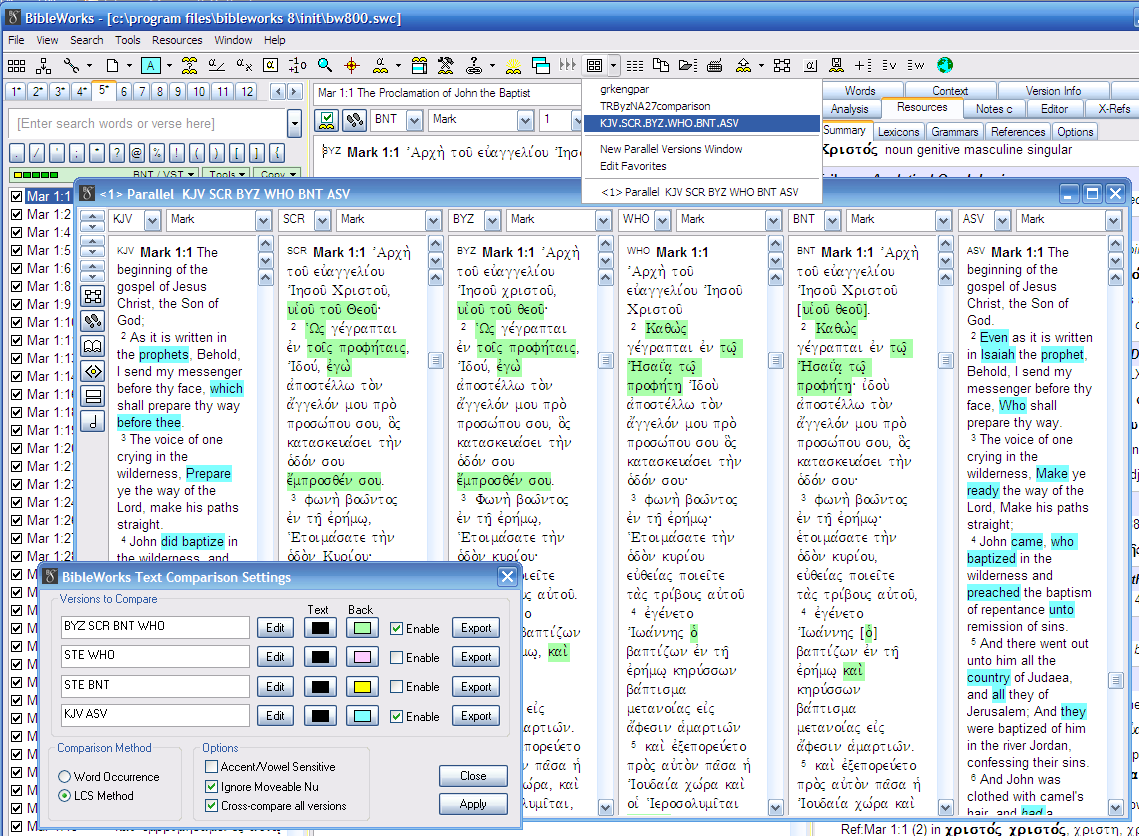
Comparing Greek New Testament Texts using Accordance8, BibleWorks8, Logos3, and Manuscript Comparator

A blog post by Matthew Burgess, responding to a debate between Bart Ehrman and James White, notes that the reliability of the Greek New Testament is at least 95% even between the two most extreme text traditions (Textus Receptus vs. Westcott & Hort). That led me to this posting where I compare the tools available for comparing Greek NT textual traditions using Accordance8, BibleWorks8, Logos3, and the online Manuscript Comparator. Actually, it ended up being a rather long post with lots of graphics, so to read the full review, you can READ THIS PAGE on my Scroll and Screen site. Here, though, is my conclusion UPDATED (2009.04.07) in light of the comments:

Each program has its strengths and special capabilities. Manuscript Comparator does the best job of displaying differences, but it lacks the NA27 and is intended as an online resource. Accordance does a good job of display, allows for a variety of comparison options, and creates useful lists of differences. BibleWorks has the most versatility and is the fastest Windows application. Logos has the most texts available for comparison, provides numerical and graphical comparisons, and results export easily.

BOTTOM LINE:

  • If you don't have any of the Bible software packages, Manuscript Comparator will achieve most of the the results you need.
  • If you do own one of the programs, my best advice is to familiarize yourself with the text comparison implementation in that package.
  • If you are looking to buy a Bible software program, the text comparison tools will probably not be a deciding factor, but the descriptions I provide here should make you aware of what is possible with each.
I am most familiar with BibleWorks, so if I have missed something significant in one of the other programs or in BW8, please let me know.

BTW, Logos provides a percentage difference between two versions. I ran a comparison of Scrivener's Textus Receptus (1894) against Westcott & Hort for the whole NT, and I came up with a 6.6% variance. (It took well over an hour to get that result.) So, a 93.4% reliable Greek NT? (And remember that this includes some spelling variations, insignificant transpositions, etc.)

Saturday, February 28, 2009

Open Scriptures' Manuscript Comparator

I've just discovered a fascinating online tool by Weston Ruter provided through his OpenScriptures web site. It is a remarkable demonstration of semantic linking showing how one can bring together biblical texts from the web and collate their similarities and differences. The payoff is the Manuscript Comparator that recently went live with the full New Testament available. Read more about it here and see the introduction and menu to the Comparator HERE. Here is how Ruter describes the project:

The database is constructed as follows: various manuscripts available on the Web today are each imported into the database individually, storing each manuscript’s word (token) separately with a unique identifier for each. After all of the individual manuscripts have been imported, they are then all merged together into a unified manuscript. The merging algorithm normalizes the text for comparison by removing all casing, diacritics, and punctuation; the unified manuscript stored in the database is composed of these normalized words. So the result of the manuscript merge is a unified manuscript which consists of every possible variant attested to by the contributing manuscripts; furthermore, all of the tokens in an individual manuscript are linked back to their corresponding words in the unified manuscript. Thus every manuscript is linked to every other manuscript by means of their links to a common point, the unified manuscript.
You'll enjoy simply playing around with the Comparator. First you set configuration options. Note the seven NT texts you can use, and to them you can choose to add Strong's definitions.
Here is what the results look like for a parallel display of Mark 1.1-3 (that will link you to the live version; below is a static graphic):

You'll want to read Ruter's description, but you can see quite easily the differences highlighted between the texts of NA, UBS, WH, and Tischendorf as compared to the Byzantine (Majority) Text and Textus Receptus. In my screen capture above, you can also see how hovering your mouse over a word in one of the parallels will highlight it in the other. If only certain versions have a particular reading, it will be highlighted in yellow in the heading. (In my example you can see where only Tischendorf includes the 1st singular pronoun.) In the hover-over popup, you can also see where morphological information is included along with--if you had chosen it in the configuration--a definition provided from Strong's.

BTW, if you will be attending BibleTech09 (sadly, I am not able to do so this year), Ruter is one of the speakers and will be talking about his Open Scriptures project which he describes as:
a comprehensive open-source Web repository for integrated scriptural data and a general application framework for building internationalized social applications of scripture.
Thanks to Weston Ruter for sharing this excellent resource!

Tuesday, June 10, 2008

Best Resources for Original Language Bible Study

I've been trying to compile a list of resources that I think my seminary students--but it would apply to anyone serious about Bible study--need most if they want to study the Bible using the original languages but whose native language is English.

My assumptions here are that people need a variety of resources to conduct Bible study for preaching, teaching, self-edification, reflection, and devotion. At the seminary where I teach (LTSG), about a year's worth of Greek is required. Hebrew is not required but is encouraged as an elective. I am assuming some facility with Greek, therefore, but I am not assuming that people will be 'fluent' in Hebrew or even Greek. I do assume that with the proper resources they will be able to make use of both. I am also assuming here that English is the primary, native language, and so the secondary resources and translations I highlight are English ones.

Interested in seeing my list? Well, I'm interested in hearing what you think of it. Please note that I am not angling for a theological fight here. You can probably guess from my list that I am some flavor of moderate Protestant (ELCA Lutheran to be precise with a Missouri Synod Lutheran background). That is, I don't think that any of the primary resources I list have any theological bias, but my inclinations are probably indicated by my preference for the NRSV as the 'neutral' English translation with which I make comparisons. Okay, so I am open to suggestions, and I am also hoping for a show of charitableness. (BTW, anyone is welcome to take my list and adapt it to their particular interests. Just give some acknowledgement.)

Here it is: Best Resources for Original Language Bible Study

Saturday, January 19, 2008

Evangelical Textual Criticism: Review of the Digital Textual Commentary of Metzger

There is an interesting post on the Evangelical Textual Criticism blog reviewing how one might use the digital version of Metzger's A Textual Commentary on the Greek New Testament. The reviewer, Tommy Wasserman, used the version available within Accordance. (A responder compared the results with the implementation in Logos, and it took a little figuring out how they match up, but it turns out to be rather similar.)
Wasserman looked at how many references were made to each NT book. He also looked at the "English Content" and in particular he provided some fascinating insights into instances where piety or theology were thought to have influenced a reading and how the committee decisions worked. He also drew out data about the mss. referenced and also the instances reflecting varying degrees of certainty.
You will want to read the whole post, but here is a part of his conclusion:

The digital version of Metzger's Textual Commentary will not only save time for many students and scholars, but it is also likely to lead to new ways of using this standard reference work. The search capacity of the digital version does not allow any detailed studies of the textual affiliation of the witnesses since the commentary due to its nature is highly selective. Nevertheless, it does allow a more detailed exploration of various aspects relating to the work of the committee. Moreover, the digital version will be particularly useful when scholars want to find representative examples of various textual phenomena.

Monday, December 10, 2007

NT Textual Criticism Chart Timesaver

Daniel Wallace of Greek grammar renown has been working on a software program that works with the Nestle apparatus. He describes it thus, "Essentially, it deciphers gothic M almost instantaneously, breaking down the various witnesses of gothic M into text-types and dates, and putting them all in a word document chart." If you are doing NT Textual Criticism and want a visual way of laying out the variants and their witnesses, this is a helpful program. Wallace just sent out an email noting that the PC version had been updated and that a Mac version was now available. Go to NT Textual Criticism for more info. In particular go HERE, and download the Instruction Manual to see what the program can do. The program costs $10 to download and will be going to $12.50 in the new year.

Friday, August 31, 2007

New Review of Libronix SESB v.2

David Instone-Brewer has just released his latest Tyndale Tech newsletter which features a lengthy and, for the most part, highly positive review of version 2 of the Stuttgart Electronic Study Bible. (SESB) I agree with him that most English-language users will be content to save some money and get the reduced Logos edition. I also agree with his conclusion that the SESB is why he now is using both BibleWorks and Logos. It's a beautiful thing to have the critical apparatus so handy...
The only extra comment I would add is that there are ways to do New Testament (not OT, however, like the SESB offers) textual criticism in BibleWorks.

  • Metzger's Textual Commentary is included in BW7 and linked to the text.
  • Pasquale Amicarelli compiled a text criticism module (check the first entry in the thread; it says the link is dead, but it is actually valid) integrated with BW7 that draws upon all his work at laparola.net. It's great.
  • Check out the other Textual Criticism modules posted at the BibleWorks blog. There are some great manuscript resources, but you will especially want to download Wieland Willker's Textual Commentary on the Gospels also compiled by Pasquale.

Friday, July 20, 2007

Textual Criticism Resource

It's posted on the BibleWorks Forum, but there is an incredibly thorough and useful Excel spreadsheet anyone can use and download for free that deals with the ancient manuscripts of the NT. There are sheets for Papyri, Uncials, Minuscules, Lectionaries, and Fathers with info on there identification number, contents, date, text type, name, provenance, comments, etc.
Thanks to pasquale and friends for sharing this great resource! (2007.07.21 update: This post in the thread is an updated version with the macro labels in English.)