Showing posts with label lexicon. Show all posts

Wednesday, February 1, 2017

The Brill Dictionary of Ancient Greek - An upgrade to Liddell-Scott-Jones

I'm catching up a bit here, but The Brill Dictionary of Ancient Greek (published late 2015) looks to be an important and critical addition to Greek lexical resources. (To keep this separate from BDAG=the Baer-Danker-Arndt-Gingrich lexicon, I guess we'll have to abbreviate this one to BrillDAG.) I've not looked at it personally yet, but according to Larry Hurtado, this lexicon effectively supercedes the venerable Liddell-Scott-Jones (LSJ) both by going beyond the 2nd century CE to the the 6th century CE and by including more entries from Christian patristic literature. According to the Brill catalog page:
The Brill Dictionary of Ancient Greek is the English translation of Franco Montanari’s Vocabolario della Lingua Greca. With an established reputation as the most important modern dictionary for Ancient Greek, it brings together 140,000 headwords taken from the literature, papyri, inscriptions and other sources of the archaic period up to the 6th Century CE, and occasionally beyond.The Brill Dictionary of Ancient Greek is an invaluable companion for the study of Classics and Ancient Greek, for beginning students and advanced scholars alike. Translated and edited under the auspices of The Center for Hellenic Studies in Washington, DC, The Brill Dictionary of Ancient Greek is based on the completely revised 3rd Italian edition published in 2013 by Loescher Editore, Torino. Features • The principal parts of some 15,000 verbs are listed directly following the entry and its etymology. For each of these forms, the occurrence in the ancient texts has been certified. When found only once, the location is cited. • Nearly all entries include citations from the texts with careful mention of the source. • The dictionary is especially rich in personal names re-checked against the sources for the 3rd Italian edition, and in scientific terms, which have been categorized according to discipline. • Each entry has a clear structure and typography making it easy to navigate.
There is a 28-page preview available, and it certainly is attractively laid out and presented.
A quick survey of some of the entries indicates that there are many more lemmata included as compared to either LSJ or BDAG, but one may still wish to consult those for some citations not included in BrillDAG. Considering that it is from Brill and is 2431 pages long (there is also a 2-volume edition), €99,00 / USD$125.00 seems to be quite a fair price. It's also available as an online resource, but that's going to cost you €1.975,00 / USD $2,590.00 per year!
It will be interesting to see if any of the major Bible software publishers will be able to obtain digital rights to include it within their packages.

Sunday, May 17, 2015

LEXICITY update

lexicity


Identifying itself as "The first and only comprehensive index for ancient language resources on the internet," lexicity is now online in an updated version. (I seem to have missed the first one.) From the site:
Two years ago we launched Lexicity - a site dedicated to providing online study resources for ancient languages. We're happy to announce the second version of our site, which looks cleaner, runs more efficiently, and gets you to the resources faster.
With the second version, we're also committed to continual updates and expansion for language resources. We hope to include other languages soon as well, and we remain focused on creating an online community for learners of ancient languages.
As you can see from the graphic above, there are links to resources for: Akkadian, Arabic, Aramaic, Church Slavonic, Coptic, Egyptian, Elamite, Ethiopic, Etruscan, Gaulish, Georgian, Gothic, Greek, Hebrew, Hittite, Latin, Mayan, Old Chinese, Old English, Old French, Old Frisian, Old High German, Old Irish, Old Norse, Old Persian, Old Turkic, Sanskrit, Sumerian, Syriac, Ugartitic.

Clicking on any of the languages will bring you to a page for subsequent links to Dictionaries, Grammars, Charts & Aids, Texts, and Other Resources.
I did a quick survey of resources connected to Aramaic, Greek, Hebrew, Latin, and Syriac, and I think the site authors have done a great job of locating and linking available material. This is a great place to start if you are looking for resources in this ancient languages.

Thursday, May 9, 2013

Liddell-Scott-Jones (LSJ) in Wiki

We have been fortunate for some time now to have the Liddell, Scott, Jones Ancient Greek Lexicon (LSJ) available on the Perseus site. It has now been rendered as a wiki on the LSJ Ancient Greek - English Dictionary site. Here's what they say:
The Liddell, Scott, Jones Ancient Greek Lexicon (LSJ) is perhaps the best known Ancient Greek-English dictionary. Here you can find a wiki implementation.The wikification of LSJ was no mean task but we hope that the extra features provided by the wiki set-up will enhance the user experience. Some of these features (like the indexes) were made possible through the use of Semantic Mediawiki extensions.
Different types of transliterations and word forms were used, so that everyone is happy: Ancient Greek scholars, speakers of Modern Greek, people who prefer transliterated Greek or Beta Code. For example, you will get results on the search box no matter whether you type in polytonic Greek, monotonic Greek, Greek without any accents at all, or transliterated Greek.
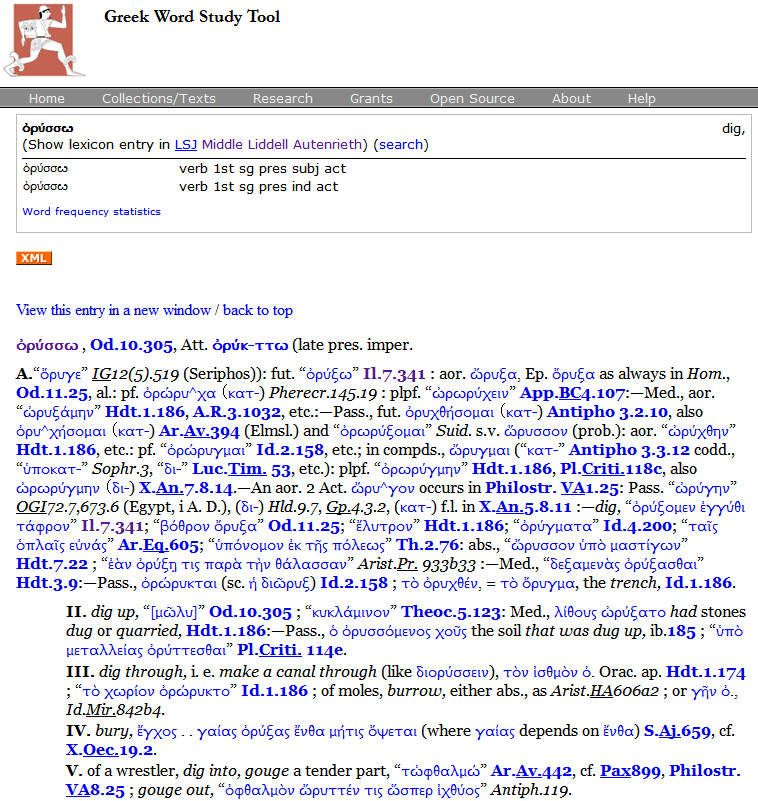
There are advantages to both sites. Below are screen captures (and links to actual pages) for the entry for ὀρύσσω.

The Perseus site can be a bit slow at times, but it does supply links to all the classical texts referenced in a definition.
Click HERE for actual page

The new wiki implementation has more flexibility in typing search terms, returns results more quickly, and displays the English glosses more noticeably. It also allows you to add a search form on your web site or a quick search link on your browser.
Click HERE for actual page

Give it a try, and if you're willing and able, you can apply to help improve the wiki.
[HT: Greek Language and Linguistics]

Monday, December 12, 2011

Searching for Greek Semantic Domains Using Louw-Nida in Accordance, BibleWorks, and Logos

In the previous post, I indicated how to go about searching for Greek roots in order to get a broader view of how a particular concept is presented by an author. While Accordance makes such a search quite simple (it's harder in Logos and would take even more work in BibleWorks), I also noted that what a person may really want is not a search based on word roots but one based on a particular concept or idea. What this means is that we really want to search on semantic domains. In my work, I want to do a domain search as often or more as I want to do a root search. For the Greek New Testament, this means that I want to use Louw-Nida's Greek-English Lexicon of the New Testament: Based on Semantic Domains. (This resource is standard in BibleWorks and is standard with any of the Greek NT packages in Accordance or Logos. Not too much has changed since an earlier review I did.) 

In the preface of this excellent lexicon it states its purpose:
This Greek New Testament lexicon based on semantic domains has been designed primarily for translators of the New Testament in various languages, but biblical scholars, pastors, and theological students will no doubt also find this lexicon of particular value, since it focuses on the related meanings of different words.
What Louw and Nida did was take every word in the NT and assign it to groupings of concepts (= semantic domains), so that one could compare words that are related conceptually but not lexically (i.e., by word roots). To continue the goal of the previous post where we were searching for roots related to κρινω in James, here is what a search for κρινω looks like in Accordance, BibleWorks, and Logos. 

Accordance: The search brings up the results (use the Show Paragraph), and the Browser can be expanded to show the organization.

BibleWorks: The search actually brings up the first instance of κρινω in the lexicon, but the middle pane on the left provides access to the other occurrences. 

Logos: The search actually just brings up the entry listings for κρινω in the lexicon, and from here you click on the entry that matches the concept you desire.

You will also see in the screenshots that I have located domain 56, "Courts and Legal Procedures," and its subdomain E, "Judge, Condemn, Acquit," which includes fifteen entries: 56.20-56.34. If it is the concept of "judging" (and not just the words whose roots are κρινω) we want to find in James, then what we want to do is search for all the words in this subdomain. 

So, those screenshots show me what group of words I'm looking for.
How do I go about conducting a search for words in a domain in the Bible software programs?

Accordance: Apparently it is not possible in Accordance to search the Greek NT by Louw-Nida domains. (Someone may have found a way...)

BibleWorks makes it quite easy to conduct Louw-Nida domain searches. First select a morphology Greek version (e.g., BGM, BNM, GNM...) and then right click in the command line. The popup offers an option of "Insert Louw-Nida Domain Code." Clicking on it opens a box with the LN domains, and it is easy to search for domains with a particular word or to browse through the domains to find the one you want.
Additionally, if you want to search multiple (sub)domains, you can use an OR search and simply type in, using angle brackets, the additional ones you want. As usual, BW is quite fast. A search for all the words in the NT in subdomains 56.20-56.34 took less than a second and returned 332 hits.

Logos isn't quite as straightforward as BW, and there are actually a couple ways of obtaining the desired results.
  • You can use a Syntax search and use the Lexham Syntactic Greek NT. When the search dialog opens and you start a new query, first add a Word. Among the options that are available, you can search for LN Domains (e.g., domain 56 on "Courts and Legal Procedures"), Subdomains (e.g., subdomain 56E on "Judge, Condemn, Acquit"), or Articles (e.g., 56.20 on "make legal decision). Unfortunately, Logos does not display any of those headings, so you need to first have consulted LN to find out which domain or subdomain or article you want. You can mix search categories using an OR command. As you can see above, a search for an article OR a subdomain in James took less than 5 seconds (a search on just subdomain 56E in James took less than a second), and Logos does return a nicely highlighted display of results in both the Greek and another version of your choice.
  • You can also use a Bible search using one of the Lexham Greek NTs and simply type in the command line in angle brackets the domain range you want (along with boolean operators for multiple ranges). As you can see below, a search for domains 56.20-34 in James took about a second. The advantage of conducting your search this was is that you have the option of displaying the results in a Grid, by Verses (with a Greek / English parallel if you wish), Aligned, or Analysis view as shown in the graphic.

A couple other related matters... 
BOTTOM LINE: BibleWorks has the most straightforward way of searching on Louw-Nida domains. Logos has more options in searching and especially in its display of results. Accordance is unable to conduct this kind of search.

Next: What about domain searches in Hebrew?

Tuesday, February 1, 2011

Moulton & Milligan: The Vocabulary of the Greek Testament

Larry Hurtado recently posted about the importance of Moulton & Milligan's The Vocabulary of the Greek Testament: Illustrated from the Papyri and Other Non-Literary Sources (M&M).  

Where can you obtain this excellent resource?
  • It is available at Amazon for under $30. This is the 1995 Hendrickson edition which includes a Scripture Index.
  • Mike Heiser on The Naked Bible noted its availability in Logos (for $40). It is linked to the Greek NT texts and is searchable in both Greek and English. An extra benefit is that the entries in BDAG which refer to M&M are linked.  
  • M&M is also included for free in BibleWorks, and words are all linked between the lexicon and the Greek NT texts. It also is searchable in both Greek and English.
  • (M&M does not appear to be available in Accordance?)
  • The 1929 edition is available on Archive.org for free. If you get it from here, be sure to use either one of the PDF versions or the DjVu version since they are page scans and will display the Greek. (Sadly, the Kindle version does not display the Greek.) These versions are searchable in English only.
Now you know...

Monday, October 19, 2009

Greek-English Lexical Resources Ratings Survey RESULTS

The survey on Greek-English Lexical Resources has been online for a week, and there are enough responses to make some observations about the results. (47 total responses as of 2009.10.19)

  • For exegetical work in biblical studies, Bauer, Danker, Arndt & Gingrich's Greek-English Lexicon (BDAG) is the clear favorite. There really is nothing as comprehensive, and it should, therefore, be at the top of the list of resources to be obtained for work in biblical and early Christian Greek texts. As noted in my post on lexicons available in Accordance, BibleWorks, and Logos, BDAG is an extra purchase of $150 for each.
  • There is basically a tie for 2nd place between Louw-Nida's Greek-English Lexicon of the NT based on Semantic Domains (LN) and Liddell-Scott's unabridged Greek Lexicon (LSJ). These have very different backgrounds and intents, but I would concur about the importance of both.
    • I commend LN to my students because it oftentimes provides an insightful perspective on how a word or concept might be heard in a different culture and thereby challenges assumptions we make about it. I also use it somewhat like a thesaurus to see what other Greek words might be used to express a concept and then to compare and better understand the nuance of a particular word. Fortunately, LN is standard with nearly all the Bible software packages, but note that it is strictly a NT lexicon.
    • The unabridged LSJ is a classical Greek lexicon, but it is indispensable for understanding the background of non-Christian and Koine usage of a term. The abridged version is of limited help and mainly indicates whether one should consult the full version. (The abridged version is standard in BW8 and most Logos libraries and an extra cost addon in Accordance.) The unabridged version runs about $135, but one can always go to (or link to from BW8 or Logos) the free, online Perseus resource. It is also available as part of the free, standalone Diogenes program.
  • The next three spots received similar scores and include Balz and Schneider's Exegetical Dictionary of the NT (EDNT); Kittel, Friedrich, and Bromiley's Theological Dictionary of NT (TDNT); and Lust, Eynikel, and Hauspie's Greek-English Lexicon of the Septuagint (LEH). As noted in some of the comments, I should have included Muraoka’s Greek-English Lexicon of the Septuagint (GELS), and I suspect it would have rated with this group as well.
    • I have used the EDNT, and it basically is a timesaver in collecting references to a given word, providing some context for their usage, and making some observations. This is the kind of work I would typically do when conducting a quick word study of my own. (The EDNT is available as an extra cost addon for BW8 and Logos.)
    • The TDNT has its drawbacks, but any exhaustive word study probably needs to consult it. I find that I don't check it that often, because I don't have time to read through the oftentimes very lengthy entries! OTOH, for getting a grasp of the background of significant words from a classical, LXX, Judaic, and variety of NT perspectives, this is a great resource. (Only Logos offers the full version and amazingly includes it as part of most of their libraries. The abridged version comes with BW8 and is available for purchase for Accordance.)
    • LEH and GELS are addressing a specific niche providing lexical support for the LXX (as compared to a focus on the NT). Given the importance of the LXX for NT and early Christian authors, these are indeed significant resources. I have used the LEH, and it is useful for a quick comparison to the range of meanings for a word usually given in its NT context. I have not used GELS, but it appears to more of a lexicon than simply a dictionary as LEH is. (For comments on and comparisons of LEH and GELS, see here, here, here, and here. LEH is included with some of the Logos libraries and is available for purchase for Accordance and BW8. I am unaware of any digital edition of GELS.)
  • Spicq's Theological Lexicon of the NT garnered some votes and has received some positive reviews, so its low rating may simply be due to the fact that it is not well known. A similar resource that I included in the second half of the survey should probably also be included here: The New International Dictionary of NT Theology (NIDNTT). I do not have personal experience with either of these, but NIDNTT appears to be a more concise TDNT, and that can be a good thing. (Both Spicq's and the NIDNTT are available for Accordance and Logos.)
  • Thayer's Greek-English Lexicon of the NT had previously received low, if not negative, reviews, so it's low rating here is no surprise. I suspect the low ratings for Lampe's Patristic Greek Lexicon are partly due its lack of easy availability and its focus on patristic literature.
I will try to comment on the other resources rated in my survey another time, but there are a few things I think are achieved by this survey:
  1. For students doing exegetical work in biblical studies, getting BDAG should be a high priority.
  2. Though I didn't include shorter or condensed lexicons in the survey, I would suggest that one should be available for quick reference prior to checking BDAG. Of the ones most commonly available (Barclay/Newman's UBS, NAS Greek, Gingrich/Danker's Shorter Lexicon of the GNT...), I recommend Friberg's Analytical Lexicon which is included in BW and available for Logos.
  3. The next resources to consult are Louw-Nida or Liddell-Scott. These are either included in the Bible software programs or available free online, so there is no excuse not to consult them.
  4. I would hope that the folks at Accordance, BibleWorks, Logos, and other Bible software creators take note of such a survey and focus their efforts on making the top resources accessible (in terms of how entries are linked to the text), attractive (how clear and readable the entries are, and affordable. (I will also be interested to see the forthcoming Concise Greek-English Lexicon of the NT by Danker and hope to see it in the software programs.)

Monday, October 12, 2009

Greek-English Lexical Resources Ratings Survey

What are the most important Greek-English lexical resources a biblical scholar should consult?
I realize that this question could be answered in different ways depending on the context, but I am particularly thinking of the typical seminary student or pastor or Bible teacher doing exegetical work in the NT. (As part of their NT work, they are also likely to need to consult the LXX, Philo, Josephus, and other early Christian literature in Greek.) I am recognizing, therefore, that cost also comes in to play somewhat, but by soliciting the general wisdom of all you biblical scholars to rate the most important resources, people should start forming conclusions about which ones they should be aiming to purchase first. In the meantime, they also have a better idea of which resources they should be checking in the library if they don't have them on their computer.

So, PLEASE TAKE THIS BRIEF SURVEY. (This will send you to a SurveyMonkey web page.)
You can see the live results of the survey HERE.

The first question asks you to rate in order the main, comprehensive Greek-English lexicons. (I've listed eight that I could think of, and you are forced to rank them in order.)
The second question asks you to rate some of the specialized lexicons, dictionaries, or other lexical resources.
I have listed 11 such resources, and they represent something of a mixed bag. They can be ranked from "Very important" to "Don't bother." You also can add additional resources I don't have listed.

Saturday, October 10, 2009

Greek-English Lexicons in Accordance, BibleWorks, and Logos

In the previous post, I ran a survey on the importance of Thayer's Lexicon for biblical studies. As I checked today (2009.10.10; 40 votes), 55% indicated it wasn't worth the bother and 28% said it may be helpful but wasn't worth the money. Only 5% put a high value on it, but 13% said it may be more harmful than helpful. SO...
What are the most important Greek-English lexical resources for biblical studies?
To start answering this question, I have constructed a database of the Greek-English lexicons, dictionaries, or related Greek lexical studies available in various packages of Accordance (A8), BibleWorks (BW8), and Logos (L3). You can view my collation in this PDF file or download the XLSX spreadsheet.

Some general observations:

  • The prices I provide are listed retail, but there are discounts available for all of them. (Probably the closest comparison is between BibleWorks and Accordance Standard or Premier and Logos Original Languages.) In general, prices are best for BibleWorks (especially for getting the BDAG + HALOT bundle). Accordance and Logos alternate with respect to the best prices on resources they have in common.
  • Remember that quantity of resources should not be the main factor in determining the quality of the program. One must also calculate the value/usefulness of the various lexical resources as well as the implementation of those resources in the program.
  • Though somewhat subjective, I have assigned the lexical resources to one of three groups.
  1. There are 'full' lexicons which intend to be comprehensive for a specified body of literature. Of these, Louw-Nida is the only one that is usually included. This an excellent lexicon and one well worth having. It will cost you to add BDAG for each program. The unabridged Liddell-Scott is not available for Accordance and is an extra cost for BW and Logos. Do note that the 'Great Scott' is available online at Perseus. BW and Logos can create a right-click accessible external link to this important resource. (One can also download the LS lexicon for free using Diogenes.)
  2. There are shorter lexicons which provide a gloss for a Greek word. Some are abridged or condensed from one of the full lexicons. (e.g., the Gingrich/Danker, the 'Middle Liddell,' or the 'Little Kittel') Some are simply rudimentary dictionaries. It is important to have one of these included in a base package. Of them, I think that the UBS Barclay/Newman or the ones based on Strong's (which simply reflect words used in the KJV or NAS translation) are the least helpful. I personally find the Friberg Analytical Lexicon or the Gingrich/Danker Shorter Lexicon to provide just enough additional information in an entry to alert my students when they should do further investigation.
  3. There are quite a few additional resources that are specialized lexicons, dictionaries, or word studies. I do not have much experience with most of them. I'd be interested in hearing recommendations...
Some observations about each program:

Accordance
:
  • I have not used Spicq's Theological Lexicon of the NT which is included in the Premier library. It would appear to be a decent resource, but I'm always a bit cautious about "theological" lexicons.
  • I wish that Accordance included a shorter lexicon (such as Friberg or Gingrich/Danker or even the 'Middle Liddell') in their packages. As noted above, the UBS Barclay/Newman isn't quite sufficient. Unlike BW and Logos, Accordance doesn't include the abridged Liddell-Scott. Louw-Nida at least is included.
  • It seems that a Web Links tool was anticipated so that one could link in to online resources (most importantly Perseus), but I don't see that it has been implemented yet for work on Greek texts.
  • One helpful feature is that you can set up a Tool Set including all the lexicons you want. Highlight the Greek word, click the Tool Set, and entries for that word show up in tabs for each lexicon.
BibleWorks
  • BW's greatest asset is its inclusion of Friberg, Gingrich/Danker (a condensed BDAG), and the 'Middle Liddell.' These provide a good start before getting a more comprehensive lexicon.
  • One can choose in BW to have the entries from all available Greek lexicons show up in the Analysis tab when hovering over any Greek word. In the Resource tab, it will indicate whether a specific reference is made to the word in that verse. One can also right click on a Greek word and "Lookup lemma in Lexicon Browser." From this browser one can choose between available lexicons, and the verse reference will be highlighted.
  • BW also makes it very easy to link to resources in many other programs and to online resources. E.g., I have right click links from Greek text to look up the lemma of the word in the EDNT which I have in Logos or to either the form or lemma in Perseus online.
Logos
  • The Original Languages Library does get you a nice collection of lexicons: Louw-Nida, the LEH Lexicon of the LXX, 'Middle Liddell,' and UBS. Most significantly, it also includes the unabridged Theological Dictionary of the NT by Kittel et al. (One of the reasons for jumping up to the Gold Library is that it adds Friberg and, more significantly, the Exegetical Dictionary of the NT [EDNT] of Balz/Schneider.)
  • Logos, as one might guess, offers the largest list of additional lexical resources one can buy.
  • Within the program, one can have multiple linked windows open to compare a lemma in any available lexical resource. One can also easily right/left arrow through lexicons (keylinking) in any single window. Right clicking on a Greek word and choosing the lemma also provides one option that links in to Perseus online.
The listing I provide and this blog post are a start at least in noting which lexical resources are available. As far as I know, there is no 'gotta have' lexicon out there that is not available in one of these software packages. (Am I missing something?)

==================
UPDATES 2009.10.12 in light of comments...
  • Spicq's Theological Lexicon of the NT is available for both Accordance and Logos. It receives positive reviews (including Danker). It covers about 625 words, which is significant, but it is not an exhaustive NT lexicon. (HT: Kevin Woodruff)
  • Liddell-Scott-Jones unabridged lexicon ('Great Scott') will be available for Accordance in November 2009. It is the 9th edition of 1940 which is the version available online at Perseus and in the downloadable Diogenes. (HT: Mike Aubrey) The Accordance, Logos, and BibleWorks renditions all include the 1996 Revised Supplement. (And to answer a question in the comments, 'Middle Liddell' is an extra purchase for Accordance.)
  • BibleWorks8 includes the 1965 Shorter Lexicon of the Greek New Testament, 2nd Edition, edited by F. Wilbur Gingrich and Frederick William Danker. The Concise Greek-English Lexicon of the New Testament by Danker will be released in November 2009. (HT: Rod Decker) It would be great if this could be included in the software programs.
==================
In my next post, I plan to start soliciting ratings on which lexical resources you think are the most important.

Tuesday, March 17, 2009

Perseus Digital Library Update

Michael Hanel on the BibleWorks blog has brought to my attention (yeah, I noticed the reminder...) that the Perseus Digital Library has just announced some significant updates (as well as a job opening for an ambitious grad student classicist). They announce that:

  • Many improvements to the Art & Archaeology data and interface. You can now search the A&A data and image captions.
  • Euclid's Elements have been added, as well as a large number of Plutarch texts, edited by Bernadotte Perrin. Links to these texts can be found on the Greek and Roman collection page.
The Art & Arachaelogy database is quite useful. It's a great place to find images of denarii (Matt 22.19), idols in Athens (Acts 16.17), earthen vessels in Corinth (2Cor 4.7), Artemis in Ephesus (Acts 19.28), the Via Egnatia in Philippi (Acts 16.11-12), and more, including many photographs of sites.
Of the new texts added, having Plutarch available in English is a wonderful resource. (There are actually more English texts than Greek for Plutarch for now. When both are available, you can get the parallel view as shown above.) Add to this the benefit of having every Greek word linked to the Liddell-Scott lexicon and numerous other resources, and it's a resource you surely should bookmark.

Saturday, September 13, 2008

Book download: Souter's A Pocket Lexicon of the Greek New Testament

I've posted previously about books that were worth downloading off the various public domain book repositories. Here's another one to add to the list: Alexander Souter's A Pocket Lexicon of the Greek New Testament of 1917. It is a true text scan, so you can search for English words with reliable success. (The scan doesn't know Greek, so you can't really search for Greek.) Here's the link at Internet Archive. (BTW, it is not available on Google Books.)
I thought to look for it because it is included with the new Westcott and Hort The Greek New Testament with Dictionary reviewed at RBL.

Thursday, September 4, 2008

Digital Vocabulary Flashcards for Greek/Hebrew

Danny Zacharias over at deinde has been very busy not only locating and organizing digital flashcard programs but also creating his own data sets. He's been posting separate blogs for various grammars so people can leave comments more easily, but you can see his accumulated work HERE. He reports datasets for Greek grammars by Stevens, Mounce, Croy, Black, and Duff as well as ones based on passage/frequency. For each of these, he lists resources (both free or for purchase) for Mac, PC, Palm, PocketPC, iPhone/iPod.
I can add a few other options to his list. First, some of the Bible software programs have flashcard resources.

  • BibleWorks has free, user-created vocab files (scroll down to the vocabulary section) for Greek grammars by Mounce, Baugh, Black, and Croy and for Aramaic by Johns along with a few others. If you buy Futato's Hebrew, it comes with vocab lists too. Davis' Greek is part of the base package and includes vocab lists as well. There is a flashcard feature you can use within the program (which includes sound files using Erasmian or modern Greek), and you can also print out vocab review sheets as well as standard front/back vocab cards.
  • Logos has a ton of free vocab lists available for Greek grammars by Mounce, Swetnam, Machen an others; for Hebrew grammars by Weingreen, Futato, Seow, Kelley, Lambdin, and others along with some Aramaic (Greenspahn, Johns) and Akkadian (Caplice). You can use the lists generated to print out standard front/back vocab cards.
  • Accordance can be used to create vocab lists, but it does not have a built in flashcard program or flashcard creator.
Some other programs to check:
  • Mark Goodacre at NTGateway lists Wordbase (Greek-English Hangman!) and QuickMem Greek (with vocab based on Metzger's Lexical Aids) among others.
  • VocabWorks - A free program (requires Internet Explorer) that is quite nice. It has a test editor and a number of styles of tests (standard, matching, multiple choice, pictorial). There are free vocab sets in Greek for Dobson, Mounce, Wenham, and a number of other based on vocab features. There are a few for Hebrew/Aramaic based on passages. You can also get a start on Meroitic, Ugaritic, and Middle Egyptian!
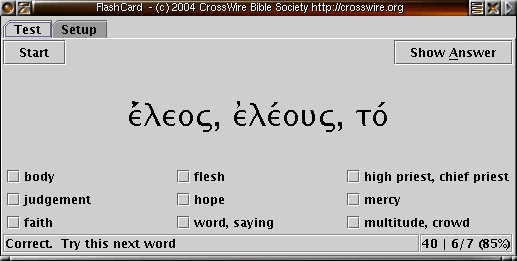
  • The CrossWire Bible Society offers a free FlashCards program that runs as a Java app. It has an editor but comes with datasets for Greek (Black, Mounce, parsings, frequencies) and Hebrew (Wegner, parsing, frequencies).
  • Valodas - A free program for Windows/Linux/Mac that can be used to create your own dictionary or download one of the many dual-language ones already available for free. Quality varies, and most are aimed toward modern usage (not biblical)... The Latin/English is pretty good. The Greek, not so much. No Hebrew.

Wednesday, June 11, 2008

Great Scott! Perseus (full LSJ and Lewis-Short) on your computer!

In the previous post, Jeremy linked to a notice regarding the Diogenes program which reported (in October 2007; am I among the last to find this?):

Announcing the release of version 3.1 of Diogenes, a free program for reading the databases of Latin and Greek texts published on CD-Rom by the Packard Humanities Institute and the Thesaurus Linguae Graecae.

The major new feature in this version is that, thanks to the generosity of the Perseus project, morphological data and dictionaries for Latin (Lewis-Short) and Greek (LSJ) and are built-in.
After checking with Jeremy and installing the program, I can confirm that you don't need the PHI / TLG CD-Rom to make this work. What it does do is put the full Liddell-Scott-Jones Greek-English Lexicon on your computer along with the Lewis & Short Latin lexicon. Not having purchased either of these, I have in the past resorted to using the wonderful Perseus website (I have created external links from within BibleWorks7 and Logos; not sure if Accordance can do that), but users of the site know that it does not always work and can be painfully slow sometimes. As the graphic below shows, Diogenes certainly doesn't provide all the linked information available on the Perseus site. If all you need are dictionary entries and parsing information, though, Diogenes is an incredible tool... and free!
Some notes and things to keep in mind:
  • The installation program is a 64Mb download, and after installation, it will take up slightly more than 500Mb on your harddrive.
  • There are versions for Mac OS X, Windows, and Linux.
  • Diogenes is very fast and opens in its own browser type of window.
  • If you are not using the PHI/TLG CD, you can choose one of two "Actions" (see the top graphic):
    "Look up a word in a dictionary" or
    "Parse the inflection of a Greek or Latin word."
  • Just leave the "Corpus" at "TLG Texts."
  • In the "Query," you will need to use Unicode input for the Greek. Diogenes is smart enough to know whether to search the Greek or Latin depending on your input language.
  • When your results appear, you can click on other Greek/Latin words that are linked in the lexicons, but you won't be able to click on the links to items on the TLG/PHI disk.
  • One little bug: it looks like Diogenes omits section number headings on the lexical entries.
Now, if someone can figure out how to pass parameters from the Bible software into this program...
Thanks for pointing out this resource, Jeremy. To learn about this resource is one of the reasons why I blog.

UPDATE: Check this blog post by SFJohnson for more info on Diogenes and its LSJ implementation in relation to the text and implementation in Logos.

Tuesday, June 10, 2008

Best Resources for Original Language Bible Study

I've been trying to compile a list of resources that I think my seminary students--but it would apply to anyone serious about Bible study--need most if they want to study the Bible using the original languages but whose native language is English.

My assumptions here are that people need a variety of resources to conduct Bible study for preaching, teaching, self-edification, reflection, and devotion. At the seminary where I teach (LTSG), about a year's worth of Greek is required. Hebrew is not required but is encouraged as an elective. I am assuming some facility with Greek, therefore, but I am not assuming that people will be 'fluent' in Hebrew or even Greek. I do assume that with the proper resources they will be able to make use of both. I am also assuming here that English is the primary, native language, and so the secondary resources and translations I highlight are English ones.

Interested in seeing my list? Well, I'm interested in hearing what you think of it. Please note that I am not angling for a theological fight here. You can probably guess from my list that I am some flavor of moderate Protestant (ELCA Lutheran to be precise with a Missouri Synod Lutheran background). That is, I don't think that any of the primary resources I list have any theological bias, but my inclinations are probably indicated by my preference for the NRSV as the 'neutral' English translation with which I make comparisons. Okay, so I am open to suggestions, and I am also hoping for a show of charitableness. (BTW, anyone is welcome to take my list and adapt it to their particular interests. Just give some acknowledgement.)

Here it is: Best Resources for Original Language Bible Study

Monday, September 3, 2007

Syriac Tools and Resources

UPDATE 2008.07.03 - Instead of trying to keep this blog entry current, I have an updated version of these resources listed HERE. Please consult this page which supercedes the info below.

A compilation of stuff you need to work with the Syriac biblical texts.

FONTS
Some old TrueType fonts are still available at the SBL site (SPEdessa) and at Peshitta.org (Estrangelo). What you really want, however, are the Unicode Syriac fonts such as TITUS Cyberbit or the wonderful collection of Meltho OpenType, Syriac scripts at Beth Mardutho. If you want to see what the fonts look like, go to this gallery page. (This page indicates that Syriac is not supported by TITUS Cyberbit, but the latest version I have linked above does indeed include it.)

TYPING IN SYRIAC
Here's your best guide to getting your system set up for Syriac and registering the keyboards. For biblical text work, I recommend that you install the Syriac Phonetic keyboard. Do you forget where all the accent and such are located on the keyboard? Then try the free UniqTitus Keyboard layout addin for MS Word. It's Unicode compliant and works well for Greek, Hebrew, and transliteration.


TEXTS
The Peshitta is the primary text of interest for biblical scholars. (The linked Wikipedia article looks quite accurate and is worth checking.)
Old Testament

  • A digital version of the Old Testament is available at the Comprehensive Aramaic Lexicon project (CAL). If you start at this page, you can invoke the Masoretic text, Targumim, and the Peshitta (be sure to check the "display Peshitta" box) all in parallel. Very nice! (Note, however, that for the Syriac to appear in a Syriac font, you need to be using IE7 or at least Firefox using an IE rendering.) Alternatively, you can start at this page and get the full Peshitta OT text (after a quick and free acceptance of terms). An outstanding feature of this display is that you can click on the verse number to get a full analysis of every word in the text. Be sure to select the viewing font (in the upper left corner; the Meltho-Unicode is recommended if you've installed the Meltho fonts listed above) before you select the text.
  • Images of the Ceriani edition of Codex Ambrosiano of the Syriac Peshitta OT are available here.
New Testament
  • For texts of the Peshitta NT, you can get them here or here (under Tools > Word Docs) as MS Word DOCS using the Estrangelo font from Peshitta.org listed above. (The files appear to be the same at both sites.) There are beautiful PDFs of the Peshitta NT available for download at the Beth Sapra project. Also a part of the Beth Sapra Library, you can download PDFs of Tetraeuangelium Sanctum (The Four Holy Gospels) by Philip Edward Pusey and George Henry Gwilliam, 1901. Read the notes on the page about this critical edition.
  • The Four Gospels in Syriac Transcribed from the Sinaitic Palimpsest by Bensly, Harris, and Burkitt is available here.
  • This page of Syriac NT resources has four versions of the Peshitta NT: ones using Serto, Estrangella, Unicode (Serto Batnan, but any of the Unicode Meltho fonts can be used), and a Romanized text version.
  • Want some images of actual manuscripts? Try here or here (PDFs with image, transcription, translation) or here.
Other Syriac Texts
ENGLISH TRANSLATIONS and INTERLINEARS
For English translations of the Peshitta, you have a number of options in the public domain.
LEXICONS and GRAMMARS
  • Of course the standard lexicon for the Syriac is the Payne Smith Compendious Syriac Dictionary. It is available online for free here, and it is broken down by initial letter, but it is basically a collection of image files which makes it rather cumbersome to find a desired entry. You can, however, buy a "Syriac Lexicons" CD of the book as a PDF scan for only $18. I'm not sure if it is the same PDF collection, but an explicitly "searchable and bookmarked" edition of it is available for download for $45 here. If you want the original Latin volumes, the Internet Archive has it here for free. (BTW, if you do want a hardcopy, I want to commend Wipf & Stock for producing a paperback version priced at a mere $36. )
  • An excellent online lexicon is available at the Dukhrana site. Lots of options for searching (English, Syriac, Lexeme, Root, Word ID), choice of fonts, and results allow for further research such as showing all inflected forms with analysis.
  • Similarly, the Peshitta.org site (under Tools > Lexicon) offers a nice Lexicon / Concordance searchable by English, Word Number, Aramaic, Lexeme, or Root.
  • There is a free, downloadable "Syriac Lexicon and Parser for the NT" based on the Kiraz' Sedra 3 data available on this page.
  • The CAL site provides a lexicon, but it is somewhat more awkward to use.
  • For a downloadable Syriac dictionary you can run independent of the web, use the Beth Mardutho one based on the SEDRA database.
  • For a free, online grammar of "Assyrian Aramaic," this appears to be a very nice site.
  • At the Beth Sapra Online Library, you can download PDFs of a bibliography, the 1906 The Elements of Syriac, and Eberhard Nestle's 1900 Syriac Grammar.
SYRIAC TEXTS in BIBLE SOFTWARE
  • BibleWorks7 comes with the Aramaic New Testament (Peshitta), with the Etheridge (1849), Lewis (1896), Murdock (1851), Norton (1881), and Magiera (2005) English translations. The OT is not included, and the Syriac text is not analyzed or linked to any lexicon.
  • Logos3 includes the Syriac Peshitta NT with Morphology along with editions of Codices Curetonianus and Sinaiticus in their Original Language, Silver, and Gold libraries. (The Peshitta NT can also be purchased separately for a list price of $19.95.) The Silver and Gold libraries (why not the Original Languages one??) also include the Analytical Lexicon of the Syriac NT. (Also available separately.) In Logos3, therefore, one can double click on any word in the Syriac text, and it will invoke the correct lexicon entry. There are not, however, any English translations available unless you buy the rather expensive ($179.95 list on pre-pub) Gorgias Press Syriac Collection which includes the Murdock translation along with 8 other books.
  • Accordance for the MAC, like Logos3, offers the Syriac Peshitta NT with Morphology along with editions of Codices Curetonianus and Sinaiticus. (But unlike Logos3, it will cost you $100.) Murdock's translation is also included, but I can't find that any Syriac lexicon is.
  • The NT Peshitta in Hebrew letters is available in the Online Bible.
  • The Murdoch translation of Peshitta NT is available for e-Sword.
For Further Study
  • The Aramaic Peshitta Bible Repository offers quite a bit of information and access to tools for studying the Aramaic NT.
  • There are numerous resources at Peshitta.org Under the Introduction heading is background information and links to fonts. There are a number of articles, tools (links to a grammar [cached page], lexicon, font encoding, Word DOCS), an interlinear NT (Matthew-Acts), a forum, music, and more links.
  • Also check out the Beith Morounoye site which provides a history of the Syriac language and lessons in Syriac along with other devotional resources.
  • The Syriac Orthodox Church has helpful background information on the Syriac Bible and various editions and commentaries.
  • Additionally, use this Google Books search link to find all the books with full views with Syriac in their titles. (The 29 hits that were returned on 2007.10.04 are mostly old grammars and catalogue listings, but there are some interesting texts and other reference works in the mix.)

Tuesday, July 10, 2007

Catching up...

Been away and simply catching up on some good sites:

  • Tyndale Tech Emails: David Instone-Brewer at Tyndale House has been providing an extremely helpful collection of online resources. I've previously referred to the font kit he provides on the site, but it is worthwhile to peruse his well-organized and annotated list of resources related to Bibles, fonts, translation, writing, etc. Be sure to check out the latest one on "Lexicons for Biblical Studies." In connection with this, he has provided an incredibly useful and handy lookup system for Hebrew/Aramaic, Greek, Latin, Syriac, Coptic, and Akkadian at his 2LetterLookup site. Using data from the online lexicons, the user first chooses the language, then the first two letters of the word (this approach actually works quite well), and the entries appear in a linked pane. For Hebrew/Aramaic, you get links to Gesenius and Jastrow, for Greek to the Liddell&Scoot (from Persesus via Resurgence Greek Project = Re:Greek = the zhubert.com site now redesignated), for Latin to an abbreviated lexicon at Notre Dame, for Syriac to a PDF page from Payne Smith, for Coptic to PDFs of the Crum dictionary, and more.
  • Rubén Gómez on his Bible Software Review site has posted a very thorough and positive review of Logos3 Gold.
  • This is not new information, but if you have not yet checked it out, Roy E. Ciampa has been accumulating resources and has a great collection of links on his Resources for New Testament Exegesis page. There are some fine bibliography lists, and I especially like his Resources for Textual Criticism. On that page, you will want to consider downloading his Reference Charts for Textual Criticism PDF.
  • Another great resource I just discovered is Vernon K. Robbins' Dictionary of Socio-Rhetorical Terms.