

Every word of the Hebrew text is included in this Jonah comic in multiple scripts (square, cursive, paleo-Hebrew) and multiple forms (consonantal, pointed, cantillated). You can also listen to my slow, deliberate read of the Hebrew text, and pause or repeat at any time. At the bottom of the screen you'll find ancient and modern translations that you can compare with the Hebrew text (Aramaic, Syriac, Greek, Latin, German, French, and 3 English translations). This comic is a great way to learn or practice your biblical Hebrew. It will help you develop an “ear” for the language and wean your dependence on pointed texts. For an extra challenge, use the 'no text' option to try memorizing the whole book. :)
Have fun playing Breakout while the program loads, and then remember that NEXT is following the Hebrew to the left! I'd love to see more of this type of multilingual learning resources.
While you are at the site, check out the great collection of other Hebrew learning resources (including Abbot & Costello learn Hebrew).
[HT: Theological German]
Monday, March 30, 2009
Jonah - Hebrew Comic and more...


Friday, March 27, 2009
YouTube EDU
 Quite some time ago I had blogged about Greek instructional videos posted on iTunes U. Now Google has responded with a subcategory of YouTube designated as YouTube EDU featuring "videos and channels from our college and university partners." It certainly isn't pretending to provide a comprehensive curriculum of instruction, but it does already have an extensive collection of videos that would be of interest to biblical studies persons. E.g., a search for "Bible" returns 42 videos by such noted scholars and authors as Robert Alter, Bart Ehrman, Jon Levenson, Harold Attridge, Eugene Peterson, Elaine Pagels, David Noel Freedman, Richard Elliott Friedman, Elizabeth Schussler Fiorenza, E. P. Sanders, Craig Blomberg, and others. Search for "new testament" adds additional ones by John P. Meier and Amy-Jill Levine and others. You can also check the Directory to see which instititutions are participating in this project. Hit and miss on topics (try "dead sea scrolls"), but worth checking.
[HT: Stephen's Web and note his critique]
Sunday, March 22, 2009
Biblical Bibliographies
Mark Goodacre has just updated his page of New Testament Bibliographies on his NT Gateway site. In addition to the links he provides there, I frequently consult the following as I am doing research. These are not all strictly NT bibliographies.
- The Review of Biblical Literature site now has over 5000 books reviewed.
- I also find that I often check the Logos Product Guides on such topics as: Cultural and Historical Background of the Bible, Comments on Commentaries, and Multi-Volume Commentaries. This last is particularly helpful in providing a brief summary of each commentary series and noting which commentaries are oriented to scholarly, pastoral, or lay interests.
- Here is a helpful post by Phil Gons on commentaries which includes a pointer to the excellent BestCommentaries site. The BestCommentaries site provides rankings and reviews, and indicates whether the book is more technical, pastoral, devotional, or a specialized study. With a free registration/login, you can also note which books you already have in your collection and keep an online record.
- I've also pulled together some bibliography resources HERE, including these compiled by the biblical studies people at my seminary: Recommended OT Commentaries.pdf and Recommended NT Commentaries.pdf
- Though it's a bit dated (2001) and only available via web archive, Ralph Martin compiled an extensive bibliography posted HERE.
- The Yale University Divinity School Library has an excellent collection of Reference Tools and Bibliographies related to the Bible HERE. Also note the Brief Bibliographic Introduction to New Testament Study.
Friday, March 20, 2009
Zhubert = ReGreek Goes Offline
 Zhubert.com, aka ReGreek has gone offline for good. This is sad, because it really was an outstanding online site for working with the Greek NT and could do some analytical tasks that couldn't be done elsewhere. Why has it gone down? Zack Hubert, the site creator, writes:
It has come to my attention that the MorphGNT team has had to pull their text offline at the request of the German Bible Society, so this site is offline as well. As their database was the heart of the window-dressing we provided here, there's not much to show without it.There are many great Bible study resources out there, and some new ones that are being built. I encourage you in your efforts to make use of those.
This site will be powered off for good soon.
For more information on the copyright and licensing issue, check HERE. Weston Ruter has done an amazing job in the last month or so reviving the Open Scriptures project, but he and the project have been attentive to being legal and observing copyrights. James Tauber notes that he and Ulrik Petersen have intentions on providing other ways to access the text which would not conflict with the German Bible Society copyright, but in the meantime, it appears that one will have to use the texts by Tischendorf or Westcott-Hort as base texts for any implementation.
(One such possibility is the GreekBibleStudy site which uses Tischendorf for the Greek NT.)
In any case, this is unfortunate news, and there are a number of other sites using the MorphGNT text which will be affected as well. The German Bible Society certainly has a right to their text, but one would hope that they would find ways of being more gracious in allowing it to be licensed.
Tuesday, March 17, 2009
Targum Isaiah in English Translation for BibleWorks
The Aramaic Targum of Isaiah is an incredibly important resource for the study of ancient biblical interpretation. It is particularly relevant to the study of the Old Testament in the New, because many of its readings/interpretations of the Hebrew text appear to inform, parallel, or be reflected in the New Testament. Accordance, BibleWorks, and Logos all have tagged Targum texts available. English translations are a bit harder to obtain. As far as I can find, Logos does not have any such translations available. BibleWorks contains the old Etheridge translations of the Pentateuch targums and Cook's translation of the Psalms Targum. Accordance is particularly notable for commissioning their own translation by Eldon Clem. In addition to the Pentateuch targums, they also have ones for Targum Jonathan to Joshua, Judges, 1 & 2 Samuel, Hosea. (I am under the impression that this translation project is ongoing, so more texts may be coming.)
- For online Aramaic texts, check the Comprehensive Aramaic Lexicon.
- The Etheridge translations of the Pentateuch targums are at NTCS. (Note the links to English translations to the targums on Lamentations, Ruth, and Psalms as well.)
- You can get the targumim--both Hebrew and English--for the Palm operating system HERE.
The good news here is that Jay Palmer has converted it into a module that can be integrated into BibleWorks. It's posted on the BibleWorks blog. Thanks!
Perseus Digital Library Update
Michael Hanel on the BibleWorks blog has brought to my attention (yeah, I noticed the reminder...) that the Perseus Digital Library has just announced some significant updates (as well as a job opening for an ambitious grad student classicist). They announce that:
- Many improvements to the Art & Archaeology data and interface. You can now search the A&A data and image captions.
- Euclid's Elements have been added, as well as a large number of Plutarch texts, edited by Bernadotte Perrin. Links to these texts can be found on the Greek and Roman collection page.
 Of the new texts added, having Plutarch available in English is a wonderful resource. (There are actually more English texts than Greek for Plutarch for now. When both are available, you can get the parallel view as shown above.) Add to this the benefit of having every Greek word linked to the Liddell-Scott lexicon and numerous other resources, and it's a resource you surely should bookmark.
Solomon's Temple - Virtual 3D Modeling

I had previously posted about the work of ARSights (the AR stands for Augmented Reality) who have developed an app that allows you virtually to hold selected Google Earth 3D models in your hand. I had noted some models of potential interest to biblical studies (Parthenon, Coliseum). I had also contacted ARSights and suggested that they add the Jerusalem Temple to their collection. They wrote back and shortly afterward posted up a model of Solomon's Temple in addition to the Dome of the Rock. As the little video shows, it is indeed the Temple from Solomon's time and includes the walled city. Enjoy!
Tuesday, March 10, 2009
Measuring Blog Authority and Popularity
My sabbatical review is finally going to occur in a couple weeks, and I am trying to find some metrics to validate the time I've spent on this blog. I had known that the primary metric was a blog's Technorati rating. This blog had been as high as 60 for awhile and now floats along around 50 or so, but Technorati has come under increasing criticism for its anomalies and for its inability to measure new forms of popularity as expressed by micro-reporting tools like Twitter, Facebook, and FriendFeed. Of more interest to me than some kind of rank, however, is the number and scope of people checking out this blog. With a bit of code embedded on this page, I have been using Google Analytics. It provides all sorts of helpful ways of looking at a site: visits, unique visitors, pageviews, referrers, geography, etc. I have never been able to determine, however, if the number it reports includes views by people who have subscribed to the blog.
 I think I have some idea of the number of subscribers using the "Details" view in my GoogleReader. If you are one of my 398 current subscribers, thanks!
 The reason I wonder if GoogleAnalytics was including all readers is because I also use ShareThis, both as a tool for quick posting on some other sites I have but also as that little link at the end of each post on this blog that lets one share the post in a variety of ways. Unfortunately, I don't see much correlation between page views reported by ShareThis as compared to GoogleAnalytics.
 I also have a couple tools to see where visitors are from. I have both ClustrMap data shown here
 and whos.amung.us data. As you would imagine, most visitors are from the United States and other English speaking countries, but there is a surprisingly large number of visitors from Italy. Viva Italia!
 Maybe another tool that can measure the value of a blog is Stimator.
Stimator is a real-time website value estimator. The engine deliveries the most accurate economical value that a website could worth by collecting important data from different sources. The results are indexed to database references and to the financial market in order to re-produce, as real as possible, how much investors are prepared to invest. Stimator is in beta stage as we keep improving this project.
 If anyone is interested in paying me USD $11,809 for this blog subdomain, let me know!
In any case, I figure these provide some perspectives to validate this blog as worthwhile work that contributes in some way to the scholarship in my areas of interest in a global context. If you have better ideas about how to gauge a blog's value as an academic form of expression, let us know! Thanks.
Saturday, March 7, 2009
The skill and art of map making
 Through my interest in digital mapping resources related to biblical studies, I have had the pleasure of making the virtual acquaintance of A.D. Riddle. He studied ancient Near Eastern languages and history at Trinity Evangelical Divinity School (completed an MDiv and almost an MA as well). He is now at Univ of Wisconsin-Madison, working on a 1-yr graduate certificate in GIS & Cartography. This coming fall, he will return to TEDS for PhD work, again focusing on ANE languages and history. His goal is to teach historical geography and make maps of biblical and ANE history. In the meantime he has provided some resources for Todd Bolen of BiblePlaces.com. (Check out the Jerusalem PPT they made.)
A.D. shared with me his first professional map of which you can see a partial, quality-reduced sample above. If you want a map of “Hieroglyphic Luwian Inscriptions from the Iron Age (ca. 1200-700 B.C.): Find Locations in Northern Mesopotamia and Anatolia,” this is the map you want! More interesting to me, however, is the process of map making he used. Even in the small clip I show below, you can see an incredible amount of detail and subtle shading that gives it its professional look.  Here’s how A.D. describes the map making process:
>>>>>>>>>>>
This map was a final project for one of my cartography classes. I used four software applications to create the map: Google Earth, ArcGIS, Adobe Photoshop and Adobe Illustrator. The main feature of this map is the relief, which is shown using two techniques: changes in color (hypsometric tinting) and shading.
(1) First, using two books on Hieroglyphic Luwian, I located all the sites visually in Google Earth. Then I created a database of sites with the latitudes and longitudes obtained from Google Earth.
(2) I downloaded the other data from various websites. For example, the elevation information (a DEM, or Digital Elevation Model) comes from NASA's SRTM mission (http://www2.jpl.nasa.gov/srtm/). Each pixel in the raster, instead of containing color values, contains an elevation value.
(3) In ArcGIS, I overlaid the different data layers: streams, lakes, site locations, and the DEM. I added the DEM layer twice. One was used to create a hypsometric tint map. This is a map where changes in elevation are indicated by changes in color. I manually entered 13 classes that I wanted the elevation divided into, such as 0-100 meters, 100-200 meters, and so forth. I used smaller increments for lower elevations so that I could show more terrain detail below 1000 meters. The second DEM layer was used later to create the shaded relief in Photoshop. Finally in ArcGIS, all of the layers were projected, and I added the scalebar, north arrow, and inset map. Once it was all laid out on the page the way I wanted it, I exported the raster images (the hypsometric tint and the DEM) separately to Photoshop. The sites, streams, and other layers were exported to Illustrator.
(4) In Photoshop, I adjusted the colors of the hypsometric tinting and created the relief shading using a directional lighting source. Here is where the Mediterranean was colored blue and given a coastal “glow.”
(5) In Illustrator, all of the components were reunited. Labeling was added, streamlines were redrawn where necessary, and lakes were given a blue fill.
The final result was a 19" x 20" poster, printed at 300 dpi on glossy paper. After staring at pixels for so long on a screen, I was not quite sure how the printed version would actually look. But in the end, I was quite pleased with how it all turned out. Of course, I already see several things I would like to change about the map. For example, here are some things I noticed. (1) The projection of the inset map should be different, and maybe country labels should be added. (2) Some of the solitary mountain peaks should probably have a triangle symbol. (3) A legend should be included for the “mountain pass” symbols, the yellow dot symbols, and the mountain peak triangles. (4) Also, some of the yellow dots, even if precisely positioned, appear to sit right on top of rivers—these should be shifted off the river lines. (5) On flatter terrain, the shading produced a “ribbing” effect which needs to be smoothed out. (6) I need to draw a cleaner coastline for the Mediterranean Sea.
The most time-consuming parts of the project were (1) locating the places in Google Earth (most of these are very obscure sites), (2) getting my color scheme for the hypsometric elevation classes straightened out, and having to go back and forth between RGB and CMYK, and (3) creating the labels, adjusting their fill and stroke, and positioning each one just right. There was also a learning curve since I had never used PhotoShop before. I spent several hours with a professional cartographer who showed me a lot of nice techniques. I asked another experienced cartographer to check my map and give me feedback before submitting the final version.
>>>>>>>>>>>
That final version clocked in as a 57Mb file! If you would like to see a reduced PNG version that is only 17Mb, A.D. has graciously posted it HERE for your viewing pleasure. If you would like more info about A.D.'s work, you can contact him at riddle2 wisc edu. (You know how to fill in the blanks.)
My thanks--as well as my considerable awe--to A.D. for sharing this map and his map-making process!
SBL Greek Unicode Font Released

In my opinion, it is a very attractive font. I think it is beautiful for continuous Greek text, but, with others, I do not think that the slant and size makes it a perfect complement to Times New Roman as the designer intended. (For size, I'm mainly looking at the x-height. Gentium does a good job of matching the Greek and English faces. TITUS Cyperbit does too, but I'm not a fan of its Greek font.) I do like that there are alternative forms for theta and phi. I know that some people like the inverted breve instead of the tilde for a circumflex, but the tilde (technically, it's a perispomeni) is fine by me. (If you want to know more about the circumflex and its forms in history and various fonts, HERE you go.)
The SBLHebrew font is also very attractive, but I confess that for now I am sticking with Cardo for my Hebrew/Greek use. Why? It includes both Greek and Hebrew in addition to numerous special characters used for biblical, textual work. In addition, it's free (as most of the Greek Unicode fonts are for personal use), and it displays well on screen and in print (and I like to have the continuity between the two). I did speak with John Huston, the SBL fonts designer, and he confirmed that a combined Hebrew/Greek set will be provided someday, so perhaps I'll switch then. (UPDATE in light of Comments) This combo font is to be called SBLBibLit, and it will include SBLHebrew, SBLGreek, and a full set of transliteration characters. (Do read Hudson's response on this discussion thread.)
The Coliseum and Parthenon in your hand
 This is too cool... ARSights (the AR stands for Augmented Reality) has developed an app that allows you virtually to hold selected Google Earth 3D models in your hand. Here's the company's description:
ARSights is a new web-based tool which improves Google Earth visualization capabilities by enabling users to visualize digital content mixed with real world information. Built upon the technology known as Augmented Reality, it allows users to enjoy Google Earth digital content in an astonishing as well as completely new way. All you need to make ARSights work is a PC, a USB camera, a printed marker and AR Application which can be downloaded directly on www.arsights.com. The aims of the project can be summarized as follows:Here's what it looks like in practice:
- To increase people’s awareness about the power of Augmented Reality
- To let people access information in an immersive and more engaging manner
- To impulse a new development of this technology
- To foster new business opportunities in many fields of application
 If you click on that graphic, you will see a short (and choppy) 40 sec video with me holding virtual models of the Parthenon and the Coliseum. You can see how the object can be rotated and tilted. (If I tilt it too askew, you will see that I lose the model momentarily.) For a better looking demonstration with the Eifel Tower, note this YouTube video from ARSights.
You need a web cam, and other than that, it involves downloading the app, printing the 'foundation' card, and downloading the KML file for GoogleEarth so you can see the models available. There are over 70 models from all over the world available at this time. Nothing from Jerusalem yet, and the Parthenon and Coliseum I model are the most relevant biblical studies related ones for now.
[HT: Google Earth Blog]
Tuesday, March 3, 2009
ESV Online Study Bible: FREE for March

[HT: Michael Hanel on the BW Forum]
Monday, March 2, 2009
Lutheran Study Bible Released
 Augsburg Fortress Publishing has just released their new Lutheran Study Bible. I usually don't report such things on this blog, but this is a significant publication arising from my Evangelical Lutheran Church in America background, and, I am happy to report, I wrote the study notes for the Gospel of Mark. I have not yet seen a physical copy, but it is available in both hardcover and paperback. If you follow the link above, you can read more details, and you can also download some sample excerpts including the full book of Jonah with notes provided by my colleague, Kristin Johnston Largen. An official publicity blurb states:
This exciting new Bible features the NRSV translation as well as introductions, notes, and articles written by over 60 Lutheran pastors and teaching theologians. Reader-friendly, inviting, and engaging, this is the perfect study Bible for both youth and adults who want to encounter Scripture in a fresh and new way!
FEATURES
BibleWorks8 Bibliographies Including Zotero, NotaBene, etc
BibleWorks includes a number of common bibliography program import files that you can use in Zotero or other common bibliography programs. Included are bibliography import files in the following file formats: RIS (Bibliography_RIS.ris) Refer-BiblX (Bibliography_Refer_BiblX.txt) Zotero RDF (Bibliography_Zotero_RDF.rdf) BibTeX (Bibliography_BibTeX.bib) I had previously reported that Logos had made it easy to export its resources into the Zotero bibliographic tool. I am now pleased to report that BibleWorks provides the same capability. As announced on the BW Forum, details can be found in chapter 62 of the Help file. There it states:
I've been recommending Zotero for some time, so this is an incredibly easy way to integrate the two. It took less than a minute to import the nearly 300 references. Using Zotero's syncing feature, I will be able quickly to get all these references on my other computer as well. Also note the other bibliographical formats provided. Use the RIS file for importing in to Ibidem in Nota Bene.
Saturday, February 28, 2009
Open Scriptures' Manuscript Comparator
I've just discovered a fascinating online tool by Weston Ruter provided through his OpenScriptures web site. It is a remarkable demonstration of semantic linking showing how one can bring together biblical texts from the web and collate their similarities and differences. The payoff is the Manuscript Comparator that recently went live with the full New Testament available. Read more about it here and see the introduction and menu to the Comparator HERE. Here is how Ruter describes the project:The database is constructed as follows: various manuscripts available on the Web today are each imported into the database individually, storing each manuscript’s word (token) separately with a unique identifier for each. After all of the individual manuscripts have been imported, they are then all merged together into a unified manuscript. The merging algorithm normalizes the text for comparison by removing all casing, diacritics, and punctuation; the unified manuscript stored in the database is composed of these normalized words. So the result of the manuscript merge is a unified manuscript which consists of every possible variant attested to by the contributing manuscripts; furthermore, all of the tokens in an individual manuscript are linked back to their corresponding words in the unified manuscript. Thus every manuscript is linked to every other manuscript by means of their links to a common point, the unified manuscript.
You'll enjoy simply playing around with the Comparator. First you set configuration options. Note the seven NT texts you can use, and to them you can choose to add Strong's definitions. Here is what the results look like for a parallel display of Mark 1.1-3 (that will link you to the live version; below is a static graphic):
 You'll want to read Ruter's description, but you can see quite easily the differences highlighted between the texts of NA, UBS, WH, and Tischendorf as compared to the Byzantine (Majority) Text and Textus Receptus. In my screen capture above, you can also see how hovering your mouse over a word in one of the parallels will highlight it in the other. If only certain versions have a particular reading, it will be highlighted in yellow in the heading. (In my example you can see where only Tischendorf includes the 1st singular pronoun.) In the hover-over popup, you can also see where morphological information is included along with--if you had chosen it in the configuration--a definition provided from Strong's.
BTW, if you will be attending BibleTech09 (sadly, I am not able to do so this year), Ruter is one of the speakers and will be talking about his Open Scriptures project which he describes as:
a comprehensive open-source Web repository for integrated scriptural data and a general application framework for building internationalized social applications of scripture.Thanks to Weston Ruter for sharing this excellent resource!
Unicode Greek font with full set of symbols
Danny Zacharias noted this Unicode Greek font on his deinde blog, but it's worth repeating here. If you can read French, check this page at the Institut Français d’Archéologie Orientale (IFAO) site. (If not, here is the page in comprehensible English.) The font is described as:IFAOGrec Unicode: Unicode Greek font with special characters and editing epigraphic Papyrology
As this text sample shows, it is an attractive font that does match well with Times New Roman. It is indeed free, even for publishers (with attribution). Do note that it has been especially designed for people doing text critical work, so there is a very full set of text critical symbols.
Successor Font to IFAOGrec2002 (A standard signs B, C Signs)
IFAOGrec Unicode is a font of all Greek and Coptic characters which includes the main diacritical marks, acronyms and symbols useful in editions of epigraphic texts or Papyrology as well as Greek texts in related fields (mathematics, astronomy, magic, music, poetry, etc.)..
It is fully compatible with other standard Unicode Greek fonts with respect to its character mapping (Main Area Plane 0) and tries to be as much as possible - with, for example, New Athena Unicode - in the private (Private Use Area) and Plane Zone 1. It also offers many characters absent from other fonts. It was also designed to harmonize perfectly with Times (New Roman), including its module and line spacing.
It was designed by Jean-Luc Fournet. The unicode implementation is due to Ralph Hancock. Its development was also assisted by Adam Bülow-Jacobsen. It is free and free of copyright. Near the bottom of the IFAO page you will find the ZIP file to download the file along with two PDF files providing documentation and character maps. If you need a Coptic font, IFAO offers a Unicode one as well.
Friday, February 13, 2009
First Online Virtual Library of Medieval Works
 Catalogue of Digitized Medieval Manuscripts
As reported in SpaceMart:
Two years ago [UCLA Asst. Prof. Matthew] Fisher, former UCLA Professor Christopher Baswell, two graduate students and a computer developer decided to collect links to every manuscript from the eighth to the 15th century that had been fully digitized by any library, archive, institute or private owner anywhere in the world.Note that in addition to a ms. search function, you can also browse by location of ms., shelfmark, author, title, or language. Anything medieval is usual way too modern for a NT guy like me, but it does include quite a number of biblical mss. Below is a screen capture of Codex Delta, a 9th century Greek/Latin ms. of the Gospels. Shown is the (longer) ending of the Gospel of Mark and below it are Eusebian references to sections in Luke which follows.
Last December the researchers officially opened the Catalogue of Digitized Medieval Manuscripts that links to nearly 1,000 manuscripts by 193 authors in 20 languages from 59 libraries around the world.

Wednesday, February 11, 2009
Logos and Zotero
 Here's some good news! Phil Gons has just posted a notice on the Logos blog about exporting all the bibliographic info from your Logos/Libronix library into Zotero. I've been recommending Zotero for some time, so this is an incredibly easy way to integrate the two. Follow the directions on Phil's post. It took me less than 3 minutes to export my 736 unlocked resources in Logos and then import them into my Zotero collection. See the graphic above.
Thanks for pointing out this most excellent way to do this!
The Doré Gallery of Bible Illustrations: Online and in Bible Software
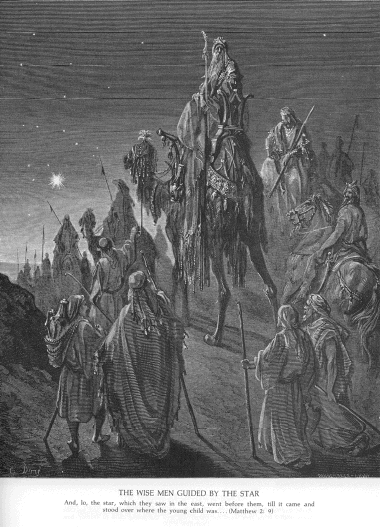
Gustave Doré was the popular 19th century French illustrator known for his 'dramatic' depictions. In 1866, he published an illustrated 2 volume work with over 200 Bible illustrations, but his also illustrated numerous other works (Dante's Divine Comedy, Milton's Paradise Lost) and had hosts of other indiviual pieces. His fame continues today, since his works are in the public domain, have been widely scanned, and are easily available for free on the Internet. You will probably recognize his images for their distinctive woodcut style.
I have collated some of the best ways to access his Bible-related works, noting both ways to obtain images online, to download, or to integrate with Bible software.
(Links provided to download modules for Accordance, BibleWorks, E-Sword, LaParola, and Logos. You may already have the artwork in Accordance, but these are free downloads for the other programs. The PBB file for Logos is brand new thanks to Don Ring. [UPDATE: LaParola added to list via comment by Richard Wilson.])
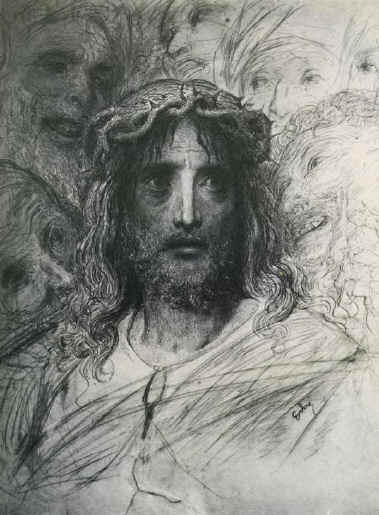
While Doré was not regarded as an 'elite' artist in his own day and most of his images certainly have a 19th century look to them, he does have some interesting depictions worth considering. Here's an illustration of Jesus (not included in the Bible volumes) that is rather well done, imo.
Tuesday, February 10, 2009
Free "Notes for the Study of the New Testament" Update
Terry Cook has given me permission to post his updated Notes for the Study of the Greek New Testament. (I posted about an earlier edition here which was 305 pages long. This new one is 364 pages.) I quote from his preface:As will become immediately clear, what follows is built on foundational work done by many others and as we go along, the importance of these foundational contributions will become clear. The purpose of this presentation is to help explain Greek grammar and syntax with an approach that is different from the usual Greek textbooks or supplements. The goal of this supplement is to clarify and reinforce the material presented in the textbooks given in the bibliography, after the students’ initial reading.
He has over 50 Greek grammar and reference works listed in the bibliography including the usual suspects: Funk, Goodwin, Machen, Moule, Moulton, Mounce, Nunn, Porter, Robinson, Wallace. The Table of Contents displayed below will give you an idea of the organization. The Glossary at the end is also worth consulting.
Very important to the use of this guide is understanding the layout so that the user will be able to make the most of the material. The design includes hundreds of “notes” from these textbooks on all the features of New Testament Koine that I felt might be important to a 2nd-3rd year Greek student whose primary interest is the Koine Greek New Testament. I have provided information on syntax and grammar, definitions5 (which appear at the end), explanations, and examples from both English and Greek- citing examples from the Greek New Testament when appropriate. It is my hope that when used as intended this guide will help students to gain a solid foundation upon which to understand the New Testament in its original language and that this guide might lead the student to pursue subsequent study and gain a thorough mastery of the language. Again, this guide is not intended for use as a stand-alone study guide but aims to provide the interested person a supplement to one or more of the many fine textbooks available.
It is thought that this essay might be profitable for use in self-study,6 for use in the classroom, and as an independent reference tool.
I checked some things that are often confusing to students like the article, participles, infinitives, tense, and case, and I found him to offer solid, reasonable remarks throughout. Thanks to Terry Cook for sharing this fine resource. You can download the 1.8Mb PDF file HERE.


