- I have seen how Twitter can be helpful, but I just have not found it compelling to use very often.
- Google Drive/Docs has become a very important tool in my teaching. We use Moodlerooms for our class management system, but for collaborative work, Google Docs still works best for me.
- YouTube and PowerPoint: Until we're ready to step up considerably with our video production and hosting, I have found that for most of my online 'presentations,' what I've ended up doing is narrating/recording my PowerPoints. This internal PowerPoint feature became available in Office 2010 and generated huge WMV files. It is somewhat improved in Office 365 which generates MP4 files. The files are still quite large, so the best way to share them is to upload them to YouTube and then share a private YouTube link. (Note that you need to request a free educational YouTube account to upload large files.)
- Dropbox: I use this as one of my cloud backup systems, but I've had much better experience with SugarSync. You get 5GB free instead of Dropbox's 2GB, and I find it easier to manage the folders that I sync. (Signing up with this link gets you and me an extra 500MB storage. Thanks!)
- Facebook and Google+/Hangouts: I've been using it to set up private groups. Since most students are already on FB, it works pretty well. I'd like to move to Google+, and it has been helpful for more school business interaction rather than social. I also would like to use Hangouts more, but there is a lot of inertia with others about moving away from Skype.
- LinkedIn: It still seems to me that people are afraid not to be on LinkedIn rather than finding it so great to be in it.
- Prezi: It's not just a trendy alternative to PowerPoint. I have had some students do some really excellent presentations with it.
- Feedly: With the demise of GoogleReader, I went to Feedly, and it's been fine.
- Diigo: I use it, and I like it, but it's hard getting my students to use it. It really is a great way to share links and information.
- Jing, Camtasia, Snagit...: I have a very old version of Camtasia that is still helpful, but for easy and free screen video capture, I have my students use Jing. For screen captures, a really outstanding free and open source program I highly recommend is Greenshot. It has a variety of capture options, a handy editor for quick annotating of the capture, and a variety of save and share options. If you've read this far, learning about Greenshot is the payoff!
- Voicethread: I keep suggesting that my students try it to illustrate a biblical narrative...
- Adobe Photoshop and other photography stuff: For the photographs I've taken in Israel/Jordan/Palestine/Turkey/Greece, I primarily use Lightroom. It's great. If I need to do more elaborate touchup, I use Photoshop Elements which is more than enough for me. For a free but still quite robust alternative that I regularly use for quick viewing and touchup, I use Faststone Image Viewer. For sharing photos online, I can use Lightroom to create an attractive viewer on my own server, or I send photos to SugarSync if I want to share and make them easily downloadable, or I send them to Flickr (which has really improved) or to my Google+ since it's so well connected with my smartphone.
- SurveyMonkey: A great way to make quick surveys for my classes. The seminary got a commercial license, and it is now what we use for all our course evaluations.
- Google Maps and Google Earth: I recently blogged about these and clicking on the links will bring you to the posts with exercises showing ways to use these resources for biblical geography.
- I mentioned it last year, and I'll mention it again. The really significant omission on the list is Zotero. I have come to use this nearly daily as a way to organize books, articles, PDFs, and web pages I come across. It's such an outstanding bibliographic tool. I did buy the Scanner for Zotero app for my smartphone, so I'm prepared for Society of Biblical Literature meeting this year. Zotero also allows for collaboration with the sharing of libraries, so it's one way I share my bibliographies with my students and allow them to add to it. (There are Zotero mobile apps for other platforms too.)
Thursday, October 10, 2013
Jane Hart's Top 100 Tools for Learning 2013
Posted by
MGVHoffman
at
12:05 PM
0
comments
Labels: biblical resources, library management, online resources
Tuesday, October 1, 2013
Accordance for Windows Released
Today is a great day to be a PC user, because Accordance is now available natively on Windows! It’s true, after 20 years of history on Mac we are pleased to announce Accordance for Windows. The release version is Accordance 10.3 and it includes all of the new features that were simultaneously released today in Accordance 10.3 for Mac. You can learn about those new features on our New Features in 10.3 page.
All Accordance 10 collections include a universal license that covers up to five personal Mac, Windows, and iOS devices. So, if you are a pastor who uses a Mac at home and a Windows PC at the church, you only need one Accordance 10 license to cover both devices. This also means that if you already own an Accordance 10 collection for Mac, you can download Accordance 10 for Windows right now at no additional cost!
To learn more, be sure to check out our new Accordance for Windows page, where you'll find a new Windows video and an FAQ.
Posted by
MGVHoffman
at
12:12 AM
0
comments
Labels: accordance, bible software
Monday, September 30, 2013
Google Earth Exercise for Biblical Geography
If you are not familiar with Google Earth, this exercise provides a step-by-step introduction to it. If you are acquainted with it, the exercise highlights features related to biblical geography. In particular, I have pasted in section 7 of the exercise below which provides links to some of the most helpful addins (KMZ files) for biblical geography.
This exercise was composed simply based on my experiences with the program. I certainly may have overlooked something significant, so please share what you know in the comments.
HERE is the PDF exercise you can download.
Section 7 of the exercise:
RESOURCES FOR BIBLICAL GEOGRAPHY
Now that you have a general idea of how Google Earth works, how can we maximize its use for doing biblical geography? Here are files and links you will want to use that can be saved in the My Places panel on the left.(Note: Google Earth uses KMZ and KML to store location data. Clicking on the KMZ or KML links below. You cana open them in Google Earth, and they will appear in your Temporary Places at the bottom of the My Places panel. If you decide you want to save that collection, right click on it and “Save to My Places.” When you exit Google Earth, it will ask if you want to save the files that are in the Temporary Places.)

- Bible Places (ISBE) KMZ with info from ISBE and Easton Bible Dictionaries

- Note that the ISBE is from 1939 and Easton is from 1897. Use this dated information with discernment! (This file originated with the Bible Places group in the Google Earth Community, but I have corrected some errors and grouped sites alphabetically for easier navigation in Google Earth.)
- Complete list of Bible Place KMZ (from OpenBible.info; cf. below) with listing of every biblical mention and live links to the online ESV Bible
- Note that when you click on a Bible text, it will open a browser pane in Google Earth. You can open the window in your usual internet browser by clicking in the upper right corner [Open in ...]. To get back to the Earth view, click on “Back to Google Earth” at the upper left.
- Also available: KMZs arranged by biblical book and by chapter. Turn book or chapter layers on and off to see patterns across the Bible.
- Biblical Rivers and Bodies of Water KML (OpenBible.info)
- Jerusalem Overlays (OpenBible.info) Historical map overlays for Jerusalem
- Bible Mountains addins
- Sacred Destinations addins: Over 1000 sacred spots around the world
- Jerusalem Temple Overlays: Quite a few overlays and markers for spots at and around the Jerusalem Temple
- Sites of Jesus addin
- Google Earth and journeys of Paul
- Viewing Biblical Sites in Google Earth - Some helpful tips and a collection of links to KMZ files including Journeys of Paul (from Tim Schumacher)
- Paul's Missionary Journeys kmz file (get file HERE)
- Paul's first journey (annotated) kmz file
- Paul's second journey with locations in Athens kmz file
- Gerasa (by Stephen Langfur) is great example of using GoogleEarth to demonstrate city geometry
Posted by
MGVHoffman
at
2:04 PM
0
comments
Labels: biblical resources, geomapping, googleearth
Friday, September 27, 2013
Google Maps Exercise for Biblical Geography
- learn basic navigation skills in Google Maps
- use Map, Satellite, Earth, Terrain, and Street Views
- see Panaramio photos
I have now posted another exercise for Google Earth.
Posted by
MGVHoffman
at
10:33 PM
0
comments
Labels: geomapping, google maps
Monday, September 23, 2013
SBL releases new SBL BibLit font!
The Society of Biblical Literature is pleased to announce the newest font in the SBL fonts series, SBL BibLit. This font contains Latin, Greek, and Hebrew characters, including the characters suitable for the transliteration of Ancient Near Eastern and Mediterranean languages. When combined with appropriate software keyboards, SBL BibLit allows for the use of one font for all biblical languages. This release is of a regular weight only; italic and bold weights will not be released at this time.
In addition to the release of the SBL BibLit font, SBL is also making available software keyboards for both Windows and Macintosh OS X operating systems that give easier access to the diacritics necessary for the transliteration of Ancient Near Eastern and Mediterranean languages. These keyboards, along with the font file and the previously-released SBL fonts, can be downloaded from the SBL website.Instructions for their installation and use are also available in the updated Biblical Fonts FAQ,including platform-specific instructions for Windows 7, Windows 8, and Macintosh OS X.
Joining SBL Hebrew and SBL Greek, SBL BibLit is the third font of the SBL font series. All of these fonts were commissioned by the Society of Biblical Literature to assist in the society's mission to foster biblical scholarship. John Hudson of Tiro Typeworks designed each font, ensuring that each one represented the cutting edge of font technology, maintained full Unicode compatibility, and that each would be as beneficial as possible to scholars in biblical studies and related disciplines. SBL is pleased to present this font as the final installment and the culmination of the initial font series.
Posted by
MGVHoffman
at
5:13 PM
0
comments
Thursday, August 22, 2013
The NET Bible iOS
As the description notes:
The NET Bible is a completely new translation of the Bible with 60,932 translators’ notes! It was completed by more than 25 scholars – experts in the original biblical languages – who worked directly from the best currently available Hebrew, Aramaic, and Greek texts.I believe there are plans to get it on Android devices at some point. In the meantime, anyone whose device has an internet browser can get the full text and all those notes by going to net.bible.org. That site works well on my Android smartphone, but you cannot necessarily get the full NET Bible Environment experience, and it can be pretty flaky depending on the browser you use (Dolphin, Chrome, IE, etc.)
This App allows you to experience the translation and all of the notes for free in a visually friendly and intuitive way.
- Read the Bible like the book that it is, by swiping through its pages without worrying about chapter boundaries.
- Tap the current passage title to change passages.
- Learn and grow by reading the 60,932 translators’ notes and the associated Bible cross references in popups.
- Bookmark your favorite passages by tapping a verse number.
- Take notes that are tied to verses, or just a date.
- Sync your notes and bookmarks with net.bible.org and other iOS devices running this App.
- See an indication of your notes when reading the text.
- Search the bible using our fuzzy search that doesn't require you to know all of the words or even the translation it came from.
- Share verses via Twitter, Facebook, Email, and Messaging by tapping a verse number.
- Choose books by using a grid, canonical list, or alphabetical list of books.
- Two-finger swipe left/right to navigate your history during sermons and Bible studies.
- Change the font and size of the text.
Posted by
MGVHoffman
at
9:01 PM
0
comments
Labels: biblical resources, biblical studies, iOS, iPhone, itunes
Monday, August 19, 2013
Bible.Is and Bible App for American Sign Language
Nothing particularly remarkable about the site beyond basic search functionality, but the inclusion of the English Version for the Deaf points to a more notable offering, the Deaf Bible.Is ASL App available for free from iTunes, GooglePlay, and Amazon Appstore.
Experience the Bible like never before! The first translation of God’s Word in American Sign Language (ASL) is now available in an interactive, easy to use, Bible app, featuring skilled deaf signers in sharp, close-up, color video. Immerse yourself in a complete Bible experience – interacting in rich Bible content accessible in video and TEXT! [It also includes] 61 "Jesus" film segments in ASL.Glad to see something like this is available. Check it out.
HT: ChurchCrunch
Posted by
MGVHoffman
at
11:33 PM
0
comments
Labels: android, biblical studies, iOS, itunes
Thursday, July 25, 2013
BibleMap App
Only available for iOS for now but promised for Android in the fall. Looks interesting and only 99cents at iTunes.
If you are working on the web, be sure to check out Bible Geocoding at OpenBible.info.
Posted by
MGVHoffman
at
3:25 PM
0
comments
Labels: biblical mapping, geomapping, iOS
Tyndale Launches Online STEP Bible Study Resource
Tyndale House Cambridge Launches Beta-version of Scripture Tools for Every Person (STEP), a new free Bible study resource
Tyndale just released their STEP online Bible resource. From their announcement:
Today the STEP development team of Tyndale House Cambridge launched the Beta-test version of a new free Bible study resource at www.StepBible.org.Be sure to read the announcement page for more info about this project and how it developed. You will see that this is a product of many volunteers and contributors, and the primary focus is to make it downloadable for persons in the Majority World. "Ten language interfaces are available and another 83 are ready for volunteers to work on."
STEP software is designed especially for teachers and preachers who don’t have access to resources such as Tyndale House Library, which specialises in the biblical text, interpretation, languages and biblical historical background and is a leading research institution for Biblical Studies.
The web-based program, which will soon also be downloadable for PCs and Macs, will aid users who lack resources, or who have to rely only on smartphones or outmoded computers.
Here are some of my initial impressions of this online beta version.
TEXTS:
Ancient texts available include:
- Hebrew: Leningrad, Aleppo - All have vocabulary encoded and some have extra grammatical coding and interlinear capability.
- Samaritan Pentateuch: with Hebrew MT, with MT & DSS, with DSS, (and in KJV English)
- LXX Greek: Orthodox LXX, Rahlf's LXX (and Brenton's English)
- NT Greek: Orthodox NT, Byzantine, Elzevir TR, TR, Tregelles, SBLGNT, Westcott-Hort w/ NA & UBS variants
- Syriac NT Peshitta: in Syriac and with Etheridge and Murdoch English translations
- Latin: Jerome's Vulgate, Sixti, Clementine, (and Douay-Rheims English)
DISPLAY: It took me a while to figure out how to manage the display features. I ended up choosing a two-panel display and keeping the right in sync with the left. (The sync did not work well for me.) With most panes, you also have the option of choosing a Basic, Intermediate, or Advanced view. You can set up a display like I have pictured above. Note the capability of sympathetic highlighting. Clicking on a word in any language will popup original language information on that word. With the Advanced view option, you can set up text to be viewed as interlinear or interleaved. Cf. the graphic below. Note that hovering your mouse over a highlighted chapter:verse reference will pop up vocabulary data for every word in that verse. Using the Advanced option for that popup will not only give the basic Strong's information but also include LSJ data as well. With the KJV, you can also enable grammatical coding. I could not figure out its coloring scheme, but there is full English grammatical analysis of every word provided.
Pointed Hebrew and marked Greek did display nicely, but the text critical marks of the SBLGNT did not show up correctly.
Navigation to texts and selection of options is intuitive, but a bit clunky. (E.g., you can type a passage reference to get there directly, but using the dropdown boxes takes some clicking and scrolling.)
I did try viewing the web page on a smartphone browser, but it was a frustrating experience. The menu bars and center column take up quite a bit of screen room leaving little space for the text.
SUMMARY: There are still some beta-version issues to be worked out, but this is a useful web resource. I found the display to be a bit cumbersome, but it has some nice features to display multiple versions and languages. One of the best features is the ability to do an original language word search from the English and discover all sorts of related words. It's great that this is available online, but remember that it is intended to be a downloadable resource, especially for those in the Majority World who might not be able to afford or have access to a major software program. For now, STEP is mostly restricted to biblical texts with no associated resources other than lexical and grammatical info. For an online Bible resource, I still think that the NET Bible Study Environment offers a better selection of texts, especially the NET Bible with all its notes. The interface is a bit cleaner and does not use popup windows. There are many more 'social' options on the NET Bible site, but it doesn't have the search capabilities of the STEP Bible site.
Posted by
MGVHoffman
at
1:27 AM
0
comments
Labels: bible software, biblical resources, biblical studies, online bible
Friday, July 19, 2013
Textal, A Free SmartPhone App for Text Analysis & Other Concordance Programs
First Look: Textal, A Free SmartPhone App for Text Analysis - ProfHacker - The Chronicle of Higher Education
More info on their website.
There have been other textual analysis or concordance type tools around for a while. (Online, try Text Analyzer or Textalyser or see this list.)
Accordance, BibleWorks, and Logos can all create concordances of texts in their databases. I also know that Logos can create a Wordle type of word analysis diagram using the Passage Analysis tool. (Expand the "Interesting Words" entry and choose either English or Greek.)
Posted by
MGVHoffman
at
10:38 AM
0
comments
Labels: accordance, bibleworks, logos
Friday, July 12, 2013
Working with Hebrew, Greek, and English in the MT and LXX - Logos5
- Show how to set up the Hebrew MT and the Greek LXX with English versions so that hovering over a Hebrew or Greek word will highlight the English word. The example used is in Genesis 1.1 of שָּׁמַיִם and οὐρανὸν.
- See the connection between the Hebrew and Greek, using Tov's "MT-LXX Parallel" tool. This tool matches up each word in the Hebrew with the word(s) used to translate it (or not!) in the LXX.
- "Find every place where the LXX translates the Hebrew word tselem by some form of the word eikon." (This is the word usually translated in Genesis 1.26 with "image.")
Logos 5
The graphic below shows just how easily and excellently Logos shows the relationship between the Hebrew MT, the Greek LXX, and the English translations. All of this works because of Logos' implementation of reverse interlinears. (Note: I'm using the Windows version. I don't know how similarly it works on a Mac. For more info on Logos interlinears, check the Logos Wiki.)- For the Hebrew, use either the Lexham Hebrew Bible, the Lexham Hebrew-English Interlinear Bible, the BHS SESB, BHS Westminster 4.2 Morphology, Hebrew Bible: Andersen-Forbes, or the BHS WIVU.
- For the Greek, use either Swete's Greek-Hebrew Reverse Interlinear Septuagint or the Logos LXX. (To see the reverse interlinear at work, click on the Interlinear icon at the top of the tab. It looks like a small box with lines at the bottom. It will open the interlinear data at the bottom of the tab. Now when you click on a Greek word, it will show you the underlying Hebrew.)
- For English, you can use KJV, ESV, NASB, NIV, NKJV, Lexham English Bible, or NRSV. (The interlinear display works similarly to the Greek.)
- Open one of each of those Bible, set them up in columns or rows as desired
- Synchronize them (click on the book and choose the same link set for each; I'm using "A" which you can see in my graphic)
- If not by default, click on the Visual Filter icon (the intersecting color circles at the top of the tab) and make sure Sympathetic Highlighting is checked
- Personally, I also dock the Information window which you can see in the lower left
- Left click on any word in any language, and the Info window will show the word's analysis, what it is translating, or how it is translated
- Right click on any word in any version, and the word will be shaded 'sympathetically' in the other versions.
Logos does have Tov's Parallel Hebrew-Greek, as you can see below, but frankly, it's not of much use. It's not morphologically tagged, and everything you would want it to do can be better accomplished with the reverse interlinear resources and the Bible Word Studies which I will describe in a moment.
Finally, the last task... Again, here is the question posed: "Find every place where the LXX translates the Hebrew word tselem by some form of the word eikon." There are a few ways to get at this.
- Go to Genesis 1.26 again, right-click on צלמ, but this time choose to do a Bible Word Study.
- If it's not expanded, click on Translation. With the mouse on the Translation line, click on Settings on the right, and choose Logos LXX. (For some reason, LXX Swete does not work.)
- Now click on צלמ in the middle of the circle, and it will generate all
the LXX texts. Here's what you get:
- A couple issues... First, we only have the Hebrew and not the Aramaic results. Second, you will see that Greek forms, not lemmas, are given. (It appears as if this information is being drawn from the non-morph tagged Tov.)
- But do note the extra information embedded here. Let the mouse hover any
of the colored wheel parts, and, as the graphic below shows, a popup will
show all the other Hebrew forms that this Greek form is translating.
-
I could start with a search for צלמ but we'll jump right to Genesis 1.26 in the Hebrew where initiated the question.
-
I could right-click on the Hebrew word, but note that I can also right-click on "image" in the English version as well.
-
As you can see in the graphic below, I want to choose the correct lemma, and then click on "Search this resource"
-
If you run that search yourself, you will see a problem that I identified in the previous post. Logos, like BibleWorks, makes a distinction between the Hebrew and Aramaic texts of the OT. Our search only found the Hebrew instances of צלמ . You can see in the graphic below that I actually created an OR search and added the Aramaic form.
-
You can also see that I floated the results window (CTRL-F11).
-
Click on Verses
-
If a second column is not already visible, click on Add a Version and enter "Logos LXX"
-
-
Now you can see all the instances of צלמ highlighted and see all the Greek words translating it highlighted as well.
-
The search works fine, but it will take a little bit of scanning to see where εικων is translating צלמ or not. There is a better way!
- Using the results of the word search you just did, instead of looking for All Bible Text in All Passages in Lexham Hebrew Bible, click on that last term, and change it to Logos LXX = Septuagint with Logos Morphology. Yes, it seems odd to be looking for Hebrew and Aramaic roots in the Greek LXX, but the reverse interlinear coding can handle it.
- When the results come up, click on Analysis.
- Now, as it says, "Drag a column here to group by that column" - So,
choose Lemma (Greek) and drag it there. Here's what you get:
- Note that this is the info we want! (If you right-click on the little down arrow next to the Greek lemma, you can choose to expand/collapse the levels as I've done to make the graphic smaller.)
- You still may need to do a little sorting. (E.g., the 3 instances of "--" are actually coding issues and are included properly in the other hits.
4) More Sophisticated Word Search
- Don't want to sort through results? Do you exactly and only want to answer the posed question: "Find every place where the LXX translates the Hebrew word tselem by some form of the word eikon." Here's what you do.
- Using our results of the previous search, and still using All Bible Text
in All Passages in Septuagint with Logos Morphology, use this in the search
command line:
(<Lemma = lbs/he/צֶ֫לֶם:1>,<Lemma = lbs/arc/צְלֵם>) ANDEQUALS <Lemma = lbs/el/εἰκών> (If you see < and > here, those are supposed to open and close angle brackets.) - Note that I've grouped the Hebrew and Aramaic terms in parentheses, but also note that you cannot use an OR to link them. Use the comma instead.
-
The ANDEQUALS now is functioning to look at all instances of צלם in either the Hebrew and Aramaic when they are translated in the LXX with εικων.
-
Perfect!
-
Most of your searches like this won't be so tricky if you're not worried about getting both Hebrew and Aramaic.
-
Note that you can also work this somewhat in reverse. I.e., you can search for a Greek lemma in the LXX and then use the Analysis to organize your results by the Hebrew (or Aramaic) lemma.
-
The tricky part in all of this when using Logos is that you need to get the right Hebrew lemmas and the Greek requires proper diacriticals. My solution is to do a search on a word I want by right-clicking on the word and then copy/paste the search coding to reuse it. Also, always be sure to select the options that Logos offers rather than trying to type the whole thing yourself. (This applies to Greek/Hebrew as well as to resources.) You'll still find that sometimes you can type using g:... or h:... to start getting Greek or Hebrew results. Sometimes you will need to switch your keyboard to Greek or Hebrew.
-
My biggest complaint? What if I want to save the list of verses generated by my search? Logos offers no way to generate a condensed listing. (See the list I was able to generate with BibleWorks in the previous post.) Logos does have Print/Export options. It also can generate a "Passage List," but even in its "compact" form, it still gives each verse as its own separate entry/line and doesn't condense them. I.e., I want this: Gen 1:26, 27; 5:3; 9:6; 2Ki 11:18; Psa 39:7; 73:20; Eze 7:20; 16:17; 23:14; Dan 2:31, 31, 34, 35; 3:1, 2, 3, 5, 7, 10, 12, 14, 15, 18. But the best Logos can do is give me this:
Logos 5 Overall
-
CONS:
-
You have to keep track of which resources are capable of which search possibilities
-
Entering the proper Greek or Hebrew or Aramaic can be tricky
-
Logos cannot generate condensed verse lists
-
-
PROS:
-
Logos is extremely powerful and flexible in the tools it offers, all in an attractive and (mostly) intuitive package
-
Logos has done a great job of implementing their reverse interlinears
-
The Sympathetic Highlighting which can connect Hebrew, Greek, and English is wonderful!
-
The Bible Word Study offers helpful perspectives on the connections between the Hebrew and Greek
-
It's possible to construct sophisticated searches that provide good visual results as well as offering further analytical and organizational possibilities
-
Posted by
MGVHoffman
at
7:27 PM
0
comments
Labels: accordance, bible software, bibleworks, logos
Working with Hebrew, Greek, and English in the MT and LXX - BibleWorks9 (and Logos5)
- First, Lang shows how Accordance has linked the Hebrew MT and the Greek LXX with English versions so that hovering over a Hebrew or Greek word will highlight the English word. He uses the example in Genesis 1.1 of שָּׁמַיִם and οὐρανὸν. The problem, however, is that though you can see the relationship of Hebrew>English and Greek>English, you cannot see the relationship between the Hebrew and Greek
- To see the connection between the Hebrew and Greek, Lang shows how to use the "MT-LXX Parallel" tool. (I'm assuming this is Tov's work or one similar to it.) This tool matches up each word in the Hebrew with the word(s) used to translate it (or not!) in the LXX.
- Since the Hebrew is not tagged in that resource, Lang then shows how to use a MERGE command to handle searches like: "Find every place where the LXX translates the Hebrew word tselem by some form of the word eikon." (This is the word usually translated in Genesis 1.26 with "image.")
BibleWorks9
As an example, how is שָּׁמַיִם translated in the LXX and English versions? There is no easy way to see this visually in BibleWorks. The closest option I can think of is to find that the Hebrew word is assigned 08064 in Strong's. You could then use the Graphical Search Engine and search for this:Run the search, and you will see this in the results:
This does let you see both words highlighted, but it only works with the MT and either the KJV or NASB (the only versions with Strong's coding). When hovering the mouse over the Strong's number, you can also see in the Analysis tab the usage statistics. Like Accordance, this kind of matched visual highlighting will not work for Hebrew MT and Greek LXX. So, similarly, BW9 offers Tov's Parallel Hebrew and LXX. (Click on the little icon with the Greek alpha and Hebrew aleph or find it under the Resources in the menu line.) Doing so will give you this:
One thing that should be noted here is that both the Hebrew and Greek are morphologically tagged. This will make it easier to answer Lang's question, "Find every place where the LXX translates the Hebrew word tselem by some form of the word eikon."
There are a number of ways to do this in BibleWorks.
- You could use the Graphical Search engine and conduct a search like
this:
In .08 seconds it will generate the 11 hits that match. Hmmm.... Lang came up with 26 or so hits. What's going on? It turns out that Tov's Parallel Hebrew-Greek does not distinguish between the Hebrew and Aramaic parts of the OT, but BibleWorks does separate them. And there a whole bunch of "images" in the Aramaic parts of Daniel! So, yourhttp://www.scrollandscreen.com/biblestudyresources/http://www.scrollandscreen.com/biblestudyresources/ Graphical Search engine query needs to look like this:
(Note that the percentage sign % following the root indicates Aramaic and the at@ sign indicates Hebrew. If you want the QF file of this search, HERE it is.) Now I get the 30 hits in 23 verses in 0.14 seconds. This is good, but... it's not necessarily what you want. It's actually searching for verses where the Hebrew/Aramaic word appears and the Greek word also appears. It does not necessarily mean that the Greek is translating that particular Hebrew word. -
Another way you might answer our question is by using Tov's Parallel again and take advantage of BW's morphological tagging of it. Click on the little binoculars with the א=α above it. When it opens, you can type in the Hebrew root, start the search and you will get this:
This is a good way to look at all the ways that a Hebrew root is rendered in Greek (or, conversely, how a Greek lemma is rendering the Hebrew), but you also see that the results will need some closer inspection. (You see that the article or conjunctions or prepositions are sometimes listed. This is an issue w/ how Tov categorized things.) -
SO, HERE IS THE BEST SOLUTION! Click on the line with the words you are interested in, and then click on the bigger binoculars in Tov, and the Alignment Search Window will appear. Now you can search according to particular Forms or Analysis or Lemmas. For the specific question we were asking, I did a little editing of the fields so that my search looked like this. (Note which boxes I checked.)
The search takes a bit longer, but it gives exactly the results I want. I can also easily select all my results, send them to the main BW search window, and then generate a list of verses I want: Gen 1:26, 27; 5:3; 9:6; 2Ki 11:18; Psa 39:7; 73:20; Eze 7:20; 16:17; 23:14; Dan 2:31, 31, 34, 35; 3:1, 2, 3, 5, 7, 10, 12, 14, 15, 18.
Note that this is also the better way to generate all the instances of Hebrew>Greek or Greek<Hebrew. Unfortunately, I don't see any easy way of extracting and synthesizing the results to get the numbers of times a Hebrew word is being translated by particular Greek words.
- CONS:
- There is no visual link of Hebrew, Greek, and English in the normal display mode.
- There is not easy way to extract a count of how a Hebrew word is rendered by Greek words or a count of what Hebrew words are being translated by a Greek word.
- PROS:
- BW offers a number of ways of working with the texts.
- BW's implementation of Tov's parallel Hebrew and Greek is notable for its morphological tagging which allows for powerful searching capabilities.
- It's easy to generate lists of verses that match search criteria.
Posted by
MGVHoffman
at
2:16 AM
0
comments
Labels: accordance, bibleworks, greek, hebrew, logos
Monday, July 8, 2013
Laridian PocketBible for Mac OS Kickstarter
Posted by
MGVHoffman
at
10:16 AM
0
comments
Sunday, July 7, 2013
Choosing a Bible Atlas - Part 2 - Advice?
- Crossway ESV Bible Atlas by Currid and Barrett (Crossway) 2010
- New Moody Atlas of the Bible by Barry J. Beitzel (Moody) 2009
- Zondervan Atlas of the Bible (revised edition) by Carl G. Rasmussen (Zondervan) 2010
I would really appreciate hearing from people who have classroom experience (either as teacher or student) with either of those atlases. Please leave a comment! I have read Phillip Long's helpful conclusions, but he is a bit torn between the Crossway and Moody as well.
Thanks for any insight or experience you can provide.
Posted by
MGVHoffman
at
1:21 AM
0
comments
Labels: biblical mapping
Saturday, July 6, 2013
High-Resolution Maps of Science... with Religion at the Center!
PLOS ONE: Clickstream Data Yields High-Resolution Maps of Science
According to the above mentioned methodology we constructed a map of science that visualizes the relationships between journals according to user clickstreams. We first discuss the visual structure of the map, and then attempt to validate the structural features of its underlying clickstream model by comparing the latter to journal centrality rankings and an alternative model of journal relations derived from classification data.Interesting to see how the sciences are related... with Religion in the middle!
Posted by
MGVHoffman
at
10:43 AM
0
comments
Thursday, July 4, 2013
Choosing a Bible Atlas
A better understanding of the Bible is enhanced by a better understanding of the larger scope of the history, geography, and other practical realities of the lands in which it was written and its events occurred. This course will provide a survey of the lands of the Bible and consider topics such as biblical geography, topology, culture, climate, flora and fauna, travel routes, archaeology and the like. It will benefit both readers of the text and visitors to the biblical lands. It will increase understanding both of the biblical world and of the realities in those lands today.I plan to make use of a variety of resources available in Bible software programs, web sites like BiblePlaces and BibleWalks, and a tool like Google Earth. Still, I'd like to have a common core textbook, and the scope I want to cover would generally be shared by any good Bible Atlas. I don't have particular expertise in biblical geography, but how hard could it be to select a good Bible Atlas for my class? As it turns out, it's been a very hard task.
First, I discovered that there are MANY Bible Atlases available. I thinned the list somewhat by simply looking for ones that have been published or revised within the last 10 years or so and are still in print. That still left me with over 15 ones to check over.
So, I composed some parameters for evaluating atlases. It's long enough that I will point you to a separate web page HERE. To summarize all that, I looked at the following:
- Approach: Is it intended as a reference book (like a Bible dictionary) or as a full-blown introduction and overview of biblical geography and related history?
- General Matters: Quality, contents, and cost! I'm looking for books that have value for the students beyond the class I'm teaching. (One significant consideration is whether it is a book they will take with them--as a book or as a digital version--as they travel.)
- Scope: Is it strictly focused on the Bible (and thus ends in the 1st century CE) or on the lands of the Bible (and may extend its interest to the modern day)?
- Perspective: This turns out to be a critical factor. The extremes are represented by a) those who start with the Bible texts and use it to interpret all other archaeological and historical data and b) those who start with the data and largely disregard the Bible as mythical or theologically motivated history. I, with many others, am somewhere in the middle. I do not need archaeology to prove anything in the Bible. I do not understand the Bible to be focused on relating history and science, but I think it is a historical resource that should be considered and included with all the other information available when it comes to creating an 'objective' history. I list a number of examples I used to determine perspective.
Part 2 now posted HERE.
Posted by
MGVHoffman
at
2:41 PM
0
comments
Labels: biblical mapping, biblical resources
Wednesday, June 26, 2013
The Megalithic Portal - Prehistoric and Ancient Sites for Google Earth
Perhaps a better way would be to download a KMZ file that can be used in Google Earth. On the Google Earth Community Group (get the KMZ file from there), Burnham says of the KMZ file:
It is a compilation of the 25000+ locations we have listed on the Megalithic Portal. Each entry includes summary descriptions and a thumbnail image, where available.The links do provide good information and multiple pictures where available. The sites are organized according to what they are in 50+ categories: temple, palace, tomb, mound, cave, pyramid, etc.
In terms of sites connected with the Bible, it's a mixed bag, but this is an ongoing work, and users can add their own sites and pictures. E.g., in the screen shot of west-central Turkey above, there are some links for Ephesus, Miletus, Sardis, Smyrna, Laodicea..., but not for Philadelphia or Colossae. In Greece, you can Philippi and Corinth but not Thessalonika.
In any case, it's worth getting the KMZ file and adding the web site to your list of resources.
Posted by
MGVHoffman
at
1:53 PM
1 comments
Labels: biblical mapping, googleearth, online resources
Thursday, May 9, 2013
Liddell-Scott-Jones (LSJ) in Wiki
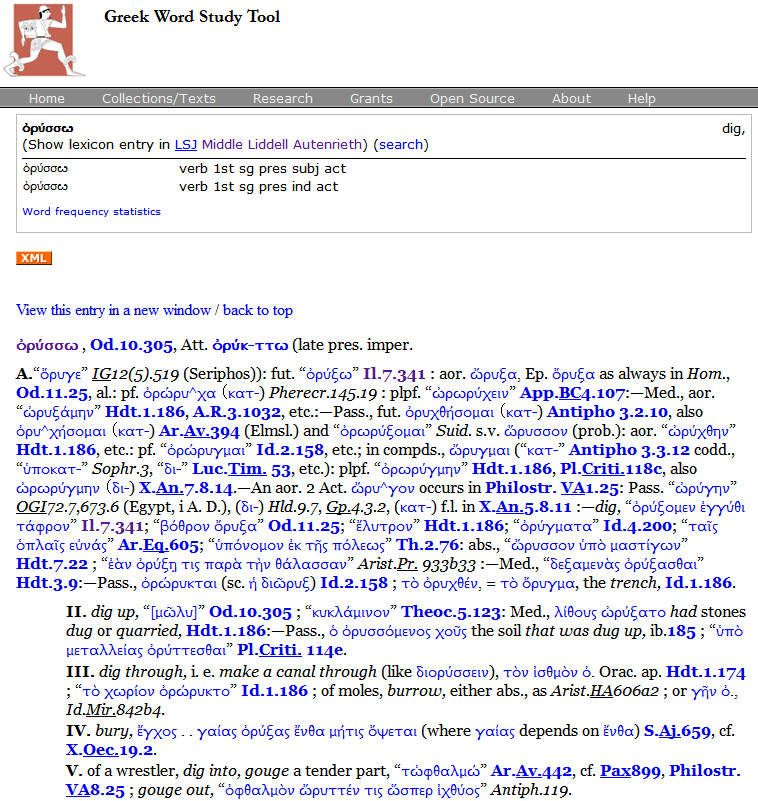
The Liddell, Scott, Jones Ancient Greek Lexicon (LSJ) is perhaps the best known Ancient Greek-English dictionary. Here you can find a wiki implementation.The wikification of LSJ was no mean task but we hope that the extra features provided by the wiki set-up will enhance the user experience. Some of these features (like the indexes) were made possible through the use of Semantic Mediawiki extensions.There are advantages to both sites. Below are screen captures (and links to actual pages) for the entry for ὀρύσσω.
Different types of transliterations and word forms were used, so that everyone is happy: Ancient Greek scholars, speakers of Modern Greek, people who prefer transliterated Greek or Beta Code. For example, you will get results on the search box no matter whether you type in polytonic Greek, monotonic Greek, Greek without any accents at all, or transliterated Greek.
The Perseus site can be a bit slow at times, but it does supply links to all the classical texts referenced in a definition.
![]() |
| Click HERE for actual page |
The new wiki implementation has more flexibility in typing search terms, returns results more quickly, and displays the English glosses more noticeably. It also allows you to add a search form on your web site or a quick search link on your browser.
![]() |
| Click HERE for actual page |
Give it a try, and if you're willing and able, you can apply to help improve the wiki.
[HT: Greek Language and Linguistics]
Posted by
MGVHoffman
at
8:35 PM
1 comments
Labels: greek, lexicon, online resources
Saturday, March 16, 2013
How to Train Your Franken-Bible by Stephen Smith
He discusses the disruption that ebooks have caused in the publishing world and looks ahead to see what implications this has for Bible translations. Quoting the BibleTech 2013 conference description:
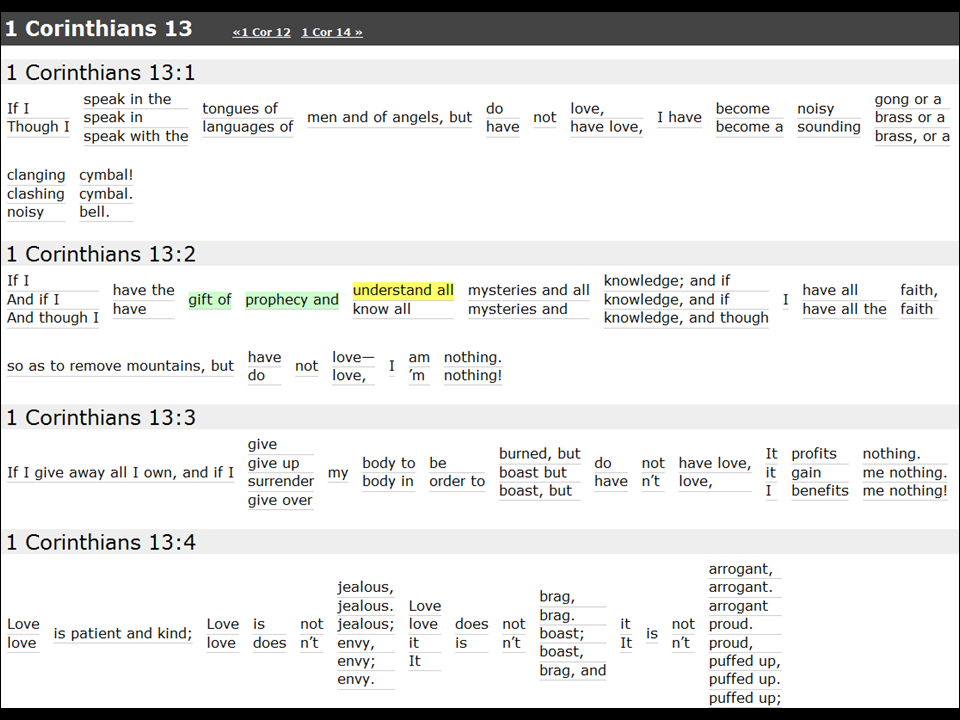
This talk explores the viability of using machine learning and other math-filled buzzwords to computationally derive an English translation of the Bible. While automated processes often produce nonsensical or uncanny-valley-style translations that are just wrong enough to be unnerving, do we have enough linguistic and semantic Bible data to produce a reasonable-quality automated translation of the Bible? And if so, what could such a translation and process look like?Using readily available technologies such as WordNet, Smith shows what something like this might look like at his Adaptive Bible website. As you can see in the slide below, for users, it's a matter of clicking through on various options of words/phrases in a verse that have been collected from a variety of English versions. (Choices made are in green. Probable next options in yellow.)
Smith is well aware of the dangers of such an approach to Bible translation. As he concludes:
I'll add two comments of my own:
- What I’ve just described is one pretty basic approach to what I think is inevitable: the explosion of translations into Franken-Bibles as technology gets better. In the future, we won’t be talking about particular translations anymore but rather about trust networks.
- To be clear, I’m not saying that I think this development is a particularly great one for the church, and it’s definitely not good for existing Bible translations. But I do think it’s only a matter of time until Franken-Bibles arrive. At first they’ll be unwieldy and ridiculously bad, but over time they’ll adapt, improve, and will need to be taken seriously.
- This approach is a bit different because it starts with English versions, not the Greek original. I suppose this would get one closer to natural English more quickly, and Smith did note one by-product of what he was doing for creating semantic ranges of a particular Strong's number entry using WordNet.
- I'm also thinking that machine language translation tools will improve and become specialized so that eventually we will have the capability of translating from Koine (not modern) Greek into English. I also imagine that you would be able to create that translation and specify parameters regarding how literal/dynamic it is and reading level of the generated text.
Posted by
MGVHoffman
at
1:13 PM
2
comments
Labels: bible software, openbible, translation
Friday, March 8, 2013
Cyber-Archaeology in Petra
The 2012 Petra Cyber-Archaeology Cultural Conservation Expedition: Temple of the Winged Lions and environs, Jordan
Posted by
MGVHoffman
at
12:25 AM
0
comments
Labels: archaeology